
Whatever I write is
Vietnamese. I can never not –
You won’t let me not –
Lick the leash or bite it.
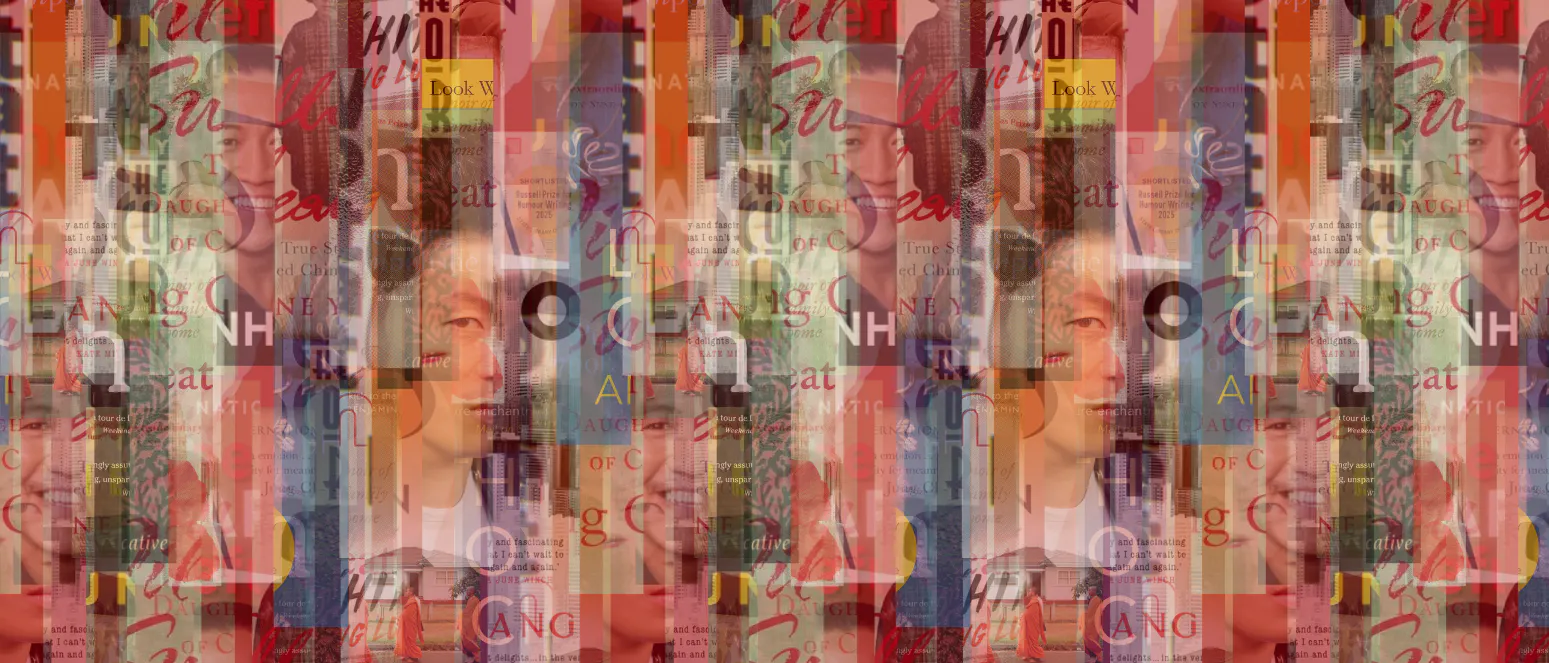
Jody Lee on the homogenisation of Asian Australian writing
Asian diasporic writing has had its share of commercial successes. How do such texts shape the acquisition and marketing decisions made by publishers today? Jody Lee scrutinises the narrow expectations being imposed on Asian Australian writing.
A manuscript lands in my inbox. It’s a memoir by a food writer who brought Asian cooking classes into the mainstream. One of the publishers I work with has sent it. They’re asking me to put together an editorial report with suggestions for how it could be improved, how to make it more accessible for a general readership. They want more emphasis on the food, on the struggles of fitting in, on acceptance. A comment from the publisher accompanies the manuscript – ‘It could be brilliant and heartbreaking if it hits the right note and makes stronger connections back to the author’s homeland’. The words are heartfelt and genuine. I feel a familiar drop in my stomach. I have played a part in this story many times before. It feels like my personal Groundhog Day.
Working as a freelance editor in Australian publishing, and identifying as Asian Australian, I have witnessed for years the expectations placed around what diasporic stories ‘must’ tell to be considered marketable or suitable for publishing: the yearning for homeland, cultural nostalgia, and the struggle to fit in. These aren’t organic patterns emerging from writers’ imaginations. They are templates carefully maintained by an industry that has learned exactly which kind of Asian Australian story sells, and which kind doesn’t. What cultural theorist Stuart Hall termed ‘the burden of representation’ operates with particular force in the Australian publishing context, where Asian Australian writers find themselves corralled into a narrow set of representational possibilities.
The manuscript I’ve described is just one example of such corralling. But it represents something larger – a publishing ecosystem that has systemised the framing of diverse Asian Australian voices into predictable, marketable narratives. If I write my editorial report suggesting the author foreground her grandmother’s recipes for dumplings and her struggles with belonging, then I too will participate in the machinery that determines how Asian Australian writers are represented. (For the record, I write back to the publisher and suggest there are other ways to develop this manuscript, doing so at the risk that I might not get another editorial job from them.)
What I want to examine is where those expectations come from, how they operate, and – most urgently – what writers can do about them. Because the question of agency is not simple. Some of what constrains Asian Australian writers lies entirely outside of their control – in acquisition meetings, in marketing decisions, in the apparatus of comparable titles and BookScan data. But some of it – more than is often acknowledged – can be shaped, resisted or refused at the level of writing itself. The most interesting Asian Australian writers are the ones who have understood this distinction and are acting on it.
The expectations surrounding Asian Australian writing did not emerge from the Australian reading public or even from Australian publishers alone. These expectations arrived, in large part, already formed, transported across the Pacific and across the Anglophone book trade with the commercial success of a specific set of Asian American texts.
The foundational case is Maxine Hong Kingston’s The Woman Warrior (1976). Kingston’s genre-bending work – part memoir, part mythology, part fiction – was categorised by the publisher as non-fiction, a designation that produced a telling critical response. Kingston later reflected that she had ‘written a new way of biography using the techniques of fiction and non-fiction’, and that after The Woman Warrior was published, ‘there was a whole new genre which they are calling creative non-fiction now’. But what crystallised around the book was not an appreciation of its formal innovation. The critical debate that followed focused on questions of cultural authenticity, ethnic representation, and whether Kingston had accurately depicted Chinese culture – questions pertaining more to ethnography than literature. Ironically, a work engaged in transcending, and transgressing, expectations around genre was received through the narrow confines of a single genre – memoir.
Amy Tan’s The Joy Luck Club (1989) – fiction, not memoir – cemented the template. The novel sold an astonishing 275,000 hardcover copies on publication, and publishers took their cues from not only its commercial viability but its specific subject matter: mother-daughter conflict, intergenerational cultural negotiation, the past haunting the present through food and ritual and family story. These became the trappings associated with the diasporic text, regardless of genre. In a 1995 interview with Salon, Tan chafed against what this success had produced: ‘I don’t feel the need to be a role model, it’s just something that has been thrust upon me […] placing on writers the responsibility to represent culture is an onerous burden. Someone who writes fiction is not necessarily writing a depiction of any generalised group; they are writing a specific story’. This is the burden of the breakthrough text. It becomes the template against which everything that follows is measured.
Jung Chang’s memoir Wild Swans (1991) also set expectations for Asian diasporic texts to come, establishing a market for narratives in which Asian women were portrayed as stereotypical victims, suffering under patriarchal societies in their homelands before escaping to relative freedom in the West. Falling Leaves (1997) by Adeline Yen Mah added family dysfunction and childhood trauma to the list of standard tropes.
Cumulatively, the commercial success of these texts taught publishers the world over what Asian diasporic writing was for: to explain, to testify, to make the unfamiliar familiar, to reassure readers in the dominant culture that the journey from elsewhere to here was ultimately resolved, difference domesticated. When Australian publishers looked for local equivalents, they were looking for this specific emotional and narrative architecture, regardless of whether it was fiction or non-fiction.
Scholars of Asian Australian writing have noted the delayed and partial institutionalisation of the field relative to its American counterpart. Wenche Ommundsen observes that ‘as a category of writing, Asian Australian writing did not emerge until the 1990s’, precisely when those American (and British) bestsellers were circulating globally and shaping publishing expectations here.1 The category emerged with a representational burden. It was, in the Australian context, compounded by the fact that the representational expectations had arrived pre-packaged from elsewhere.
The most direct impact can be seen in the memoir market. Anh Do’s The Happiest Refugee (2010) became the central ‘comparable title’ (to use an industry term) for a generation of Australian acquisitions – a warm, funny, ultimately reassuring memoir about a Vietnamese family’s boat journey to Australia and their eventual success. Do’s story is genuinely moving, and his family’s resilience deserves celebration. But what followed was an industry-wide attempt to replicate its alchemy: hardship overcome, gratitude expressed, Australian identity embraced. The memoir established a narrative pattern in which the migrant subject performs their successful integration for the consumption and validation of the dominant culture. Reviewers highlighted Do’s gratefulness for acceptance and his family’s capacity to work hard and succeed. ‘It’s like a Vietnamese Angela’s Ashes’, a radio host proclaimed; The Age declared it a ‘story of our times’; the Sydney Morning Herald stated that Australia ‘is immeasurably richer for it’. This made the migrant experience not merely central but defining – the primary lens through which Asian Australian writing was considered and marketed by commercial Australian publishers.
Less noted is what The Happiest Refugee is not: it is not a text that interrogates what Australia demands of its migrants, or that is angry about the terms of acceptance, or that refuses the frame of ‘successful integration’ as the measure of life. These are legitimate things a memoir could do. But they are not what the template asks for. And when every successful Asian Australian memoir becomes the comparable title for a publisher’s next acquisition, the template becomes self-reinforcing: editors look for the next The Happiest Refugee, which means writers who want to be published must reckon with what that implies.
Paige Clark has been open about her experience with her debut short story collection She is Haunted, and how she was encouraged to add certain elements at the manuscript stage in order to make it more sellable to publishers: ‘After reading the manuscript, the agent made the suggestion I’d come to dread: make it more Chinese […] I could write a story about Kung Fu, reference the I Ching, title a story “Chinese Whispers” and add more ghosts.'
Alice Pung’s Unpolished Gem (2006) understood the trap before Do’s memoir had even set it. This memoir offered something more complex – a sharp, funny, occasionally uncomfortable examination of growing up in a Chinese Cambodian family in the Melbourne suburb of Footscray. The first line, ‘This story does not begin on a boat’, is an act of authorial positioning so deliberate it amounts to a declaration. Pung also fought, successfully, to change the back-cover blurb ‘about three generations of suffering women’, insisting on copy that announced, ‘Nor does it contain any wild swans or falling leaves.’2 This was an author using what leverage she had – at the level of text and paratext – to control the framing of the work before the industry applied its own.
The strategy worked, partially. But it could not prevent reviewers and booksellers from reading Unpolished Gem according to the template anyway, flattening what made it distinctive – the biting social observation, her refusal of easy sentiment, the complicated relationship with both Cambodian and Australian identities.
Because the foundational commercially successful books described above were either memoirs or fiction read as autobiography, the expectation of testimonial transparency has migrated across genres. Asian Australian fiction is routinely expected to perform the same confessional, explanatory, culturally mediating work as memoir. This is the structural problem illuminated by the genealogy I’ve traced back to Kingston and Tan. Brian Castro, whose career stretches back to 1983, represents perhaps the most sustained refusal of this demand. Castro has written critically for decades about the pressure on writers of Chinese heritage to produce what he has called the literature of testimony. His formally adventurous, intellectually playful fiction refuses to be pinned to a single cultural location, exploring European modernism and settler history and the nature of writing itself.
Tom Cho’s Look Who’s Morphing (2009) performs a different kind of refusal. A collection of shape-shifting fictions – the narrator becomes, variously, a figure from a TV soap opera, the Incredible Hulk, a pop cultural assemblage of half-remembered references – Cho’s book refuses cultural authenticity as a category altogether. There is no homeland to yearn for, no integration narrative resolved through understanding. The book found its readership in queer communities, experimental literature circles, readers already equipped with tools for reading fiction that doesn’t behave like memoir. It did not find the mainstream literary reception that its formal achievement warrants – a gap that is itself evidence of what the template demands and what happens to work that doesn’t supply it.
Beth Yahp offers one of the starkest illustrations of the gap between a writer’s achievement and how the industry chooses to frame it. The layered, non-linear prose of her debut novel, the award-winning The Crocodile Fury (1992) refused the transparency that diasporic narrative conventionally requires, offering, instead something mythic and formally demanding. When Yahp published Eat First, Talk Later in 2015, the same publisher positioned it as a ‘beautifully written, absorbing memoir […] about love and betrayal; home and belonging; and about the joys of food.’ The framing was not wrong; the book does move through these themes. But it overlooked what made Yahp’s work genuinely unusual: her interrogation of memoir itself, her interest in what it means to excavate an Asian Australian life from the inside, her refusal to deliver the genre’s expected emotional resolution. The book was shortlisted for the Adelaide Festival Award for Literature in Non-Fiction, yet the critical conversation around it largely stayed inside the frame the publisher had constructed.
The template doesn’t only shape what gets acquired. It shapes what gets seen.
Understanding what a writer can and cannot control requires understanding the mechanisms that operate above the level of the individual manuscript. Australian publishing, like publishing internationally, is a windfall industry reliant on breakout bestsellers in a market of distracted attention and wafer-thin margins. Most books barely cover costs. On the one hand, a bestseller allows a publisher to take risks on titles that might not fit the commercial paradigm. On the other, the pressure to find, or replicate, bestsellers shapes the majority of acquisition decisions.
Central to those decisions is BookScan – a subscription service available only to publishers and booksellers charting book sales, updated weekly, which has significantly changed the way publishers consider acquisitions since its launch in 2001. BookScan data offers ‘two crucial data points: the sales history of the potential author, if it exists, and the sales history of comparable (or “comp”), titles’. The logic is straightforward. Book A (new title) is similar to Book B (already published). Because Book B sold many copies and made so much money, we can project that Book A will too. These comparable titles function as a kind of gatekeeper, determining who gets published and given access to the marketplace. Risk is minimised by staying close to what has already worked. Publishers’ reliance on BookScan as a crystal ball encourages the recycling of the same kinds of books that have sold well in the past. Until an unexpected author breaks through and cracks that crystal ball.
The problem is compounded by the identity of the decision makers. The 2022 Australian Publishing Industry Workforce Survey on Diversity and Inclusion by the Australian Publishers Association and the University of Melbourne found that ‘fewer than 1% of Australian Publishing Professionals are First Nations and only 8.5% have an Asian cultural identity’. When the gatekeepers don’t reflect the communities they are publishing, when the people making acquisition decisions have a limited understanding of Asian Australian experience beyond what they have read in previous books, the templates become even more entrenched.
(I have a confession to make, too. To get some of the trickier acquisitions over the line and convince sales and marketing directors that a particular book and author would be a good punt for a winner, my comparisons did, at times, lean towards the fanciful. ‘This manuscript brings together elements of Fitzgerald’s The Great Gatsby with the literary brilliance of Saunders’ Lincoln in the Bardo and the whip-smart self-parody of R.F. Kuang’s Yellowface.’ You sometimes must play a bit of literary Twister to get the manuscript you are championing over the line. These comparisons are often a performance, a translation of literary value into commercial language, and all the people in the room know it. But the performance still has to be made, and the framework it performs within remains the template.)
Data-driven systems don’t just shape acquisition decisions – they shape how we think about Asian Australian literature. In acquisition meetings, I have heard colleagues praise manuscripts for being ‘authentically representative’. I’ve watched promising manuscripts rejected because the ‘cultural tension is not developed clearly enough’. Many times, the simple question is ‘But how will we position this?’ Asian Australian novels might be promoted as ‘perfect for book clubs looking to diversify their reading’ or ‘exciting new stories from fresh voices’. These are not individual failures of imagination. They are structural.
When Australian publishing demands these narrow narratives, it compresses the enormous diversity of Asian Australian experience into easy, marketable formats. The term ‘Asian Australian’ itself encompasses people from many countries, hundreds of ethnic groups, with wildly different histories of migration, settlement and cultural practice. Yet Australian publishing often treats it as a monolith, as though there’s a single, coherent ‘Asian Australian’ story rather than individual lives that have nothing to do with tiger mothers or ghosts or yearning for homelands many have never seen.
Despite all of this, writers make choices that the publishing apparatus cannot entirely override – choices at the level of form, framing, genre, and what they refuse to provide.
Literary theorist and filmmaker Trinh T. Minh-ha has coined a distinction that is useful here: the difference between ‘speaking about’ and ‘speaking nearby’.3 To speak about a culture or community is to claim authority over it, to position oneself as the interpreter and explainer – the role that the publishing template assigns to Asian Australian writers by default. To speak nearby is something more oblique and more honest: to approach a subject without assuming mastery of it, to leave the space of representation open. The distinction matters because it reframes what literary resistance looks like. It is not simply a refusal of content – no homeland, not dumplings, no ‘cultural integration’ arc – but a refusal of a particular relationship between writer, subject and reader. The writer who speaks nearby does not translate culture for a presumed outsider. They write, and they trust the reader to meet them.
This is precisely what writers such as Castro and Cho, but also Ouyang Yu, Grace Chan, Elizabeth Tan, Julie Koh, to name a few, have been doing. Writers working largely with independent publishers have been given the freedom to write their own particular stories. Each, in different ways, have refused the ethnographic gaze, and stepped away from the expectation of memoir. Their work engages with questions of identity, place, and belonging but on their own terms.
Nam Le’s The Boat (2008) was perhaps one of the first Asian Australian writers who confronted these unspoken expectations in the Australian context. The opening story, ‘Love and Honour and Pity and Pride and Compassion and Sacrifice’, features a Vietnamese Australian writer at the Iowa Writers Workshop whose mentor and classmates expect him to write about boat people. ‘“It’s hot,” a writing instructor told me at the bar. “Ethnic literature’s hot. And important too”.’ The narrator's friend suggests that he could ‘just write about Vietnamese boat people all the time […] You could totally exploit the Vietnamese thing.’ Le’s narrator resists, wanting to write about anything else – Colombian assassins, Hiroshima orphans, New York painters with haemorrhoids, before eventually, desperately, cynically writing the boat people story everyone expects.
‘Love and Honour and Pity and Pride and Compassion and Sacrifice’ is a devastating piece of metafiction exposing the machinery of cultural expectation while simultaneously delivering what the market demands. Taking its title from a quote by William Faulkner, with its cadence-like litany, the story announces the very thing it interrogates, that these noble themes have been commodified into a list that minority writing is expected to check off. But the remaining stories in The Boat refuse to be contained by that critique – Le’s collection ranges wildly across geographies and subject matter, including stories set in Tehran, New York, a coastal town in Australia, Cartegena, while featuring characters of multiple ethnicities. One of the stories, ‘Halflead Bay’, shifts the focus to place and landscape. ‘It was shaping up to be a good summer for Jamie. Exams were over. School was out in a couple of weeks – the holidays stretched before him, wide and flat and blue.’
Le uses short, laconic sentences, building a fictional Australian coastal town – an expanse of ocean, a bay, a jetty, harsh summer light bleaching a hard-scrabble fishing town. The story is told with economy. A promising footballer, adolescence, sex, family tragedy, the menace of toxic masculinity and maintenance of the status quo. The characters use broad Australian vernacular – ‘Don’t be such a little dickhead, then’, ‘Carn Halfie’, ‘Leyland, couldn’t be stuffed with footy’. Le’s writing intentionally tilts towards Tim Winton’s portrayal of an Australian identity built on birthplace and background.
Le refuses to be constrained by writing about his identity, to answer the loaded question of ‘where he is really from’. The implicit argument is that a Vietnamese Australian writer should be free to write about anything, not conscripted into perpetual service as cultural ambassador. In Le’s 2024 poetry collection, 36 Ways of Writing a Vietnamese Poem, he wryly remarks on the seeming inescapability of playing his role.
Whatever I write is
Vietnamese. I can never not –
You won’t let me not –
Lick the leash or bite it.
Le notes that he makes art as ‘a complicated writer with full selfhood and scope […] not as an emissary’, finding the paradigm that has emerged around ‘authenticity’ problematic. According to Le, ‘You’re [then] already trading in the vocabulary and ethos of branding because something that is “authentic” can then exclude the other things that “are not authentic”.’ A bind, especially for writers of colour.
Authenticity can sound like liberation, promising writers the freedom to tell their own stories on their own terms. But Le identifies the mechanism by which it quietly becomes the opposite. Once authenticity becomes the governing value, it creates a perimeter. It hands the power of deciding what counts as authentic cultural experience not to the writer but to the market – publishers, reviewers, readers, prize committees – all of whom bring their own pre-formed ideas about what a diasporic experience is supposed to look like.
Jessica Au’s Cold Enough for Snow (2022) takes an entirely different approach to resistance: radical withholding. Her novel follows a woman and her mother through Japan, observing art, architecture, and the small adjustments of their relationship. What is revolutionary is what Au refuses to do. She doesn’t explain who these characters are in terms of ethnicity or cultural background. She doesn’t provide the migration backstory readers have been trained to expect. She doesn’t create scenes where cultural misunderstanding becomes a metaphor for something larger. Rather, she demands attention to texture, atmosphere, the phenomenology of experience. Take the following passage:
There were dense ferns, thin black trunks and in the distance a mist so deep it seemed to be mauve against the green at a few points, I stopped to rest and look at the view. Through the sheets of rain, the landscape almost looked like a screen painting that we had seen in one of the old houses. It had been made up of several panels, and yet the artist had used the brush only minimally, making a few careful lines on the paper. Some were strong and definite, while others bled and faded, giving the impression of vapour.
When Cold Enough for Snow won the inaugural Novel Prize in 2021 and was later shortlisted for the 2023 Miles Franklin Literary Award, it was praised for its ‘precise, elegant prose’, and for being a celebrated work that ‘signalled a new direction in Australian literature’. When it was shortlisted for the Stella Prize in 2023, the citation mentioned its ‘exquisite restraint’. Au’s publishers (Fitzcarraldo Editions, Giramondo, and New Directions) framed the work around craft and expansion of form, drawing comparisons to broader non-culturally specific themes like memory and perception. What went largely unremarked was its refusal of the entire apparatus of migrant literature. Au created space for Asian Australian literature that doesn’t perform cultural identity.
I’ve watched commercial publishers pass on manuscripts that follow Au’s model – sparse, lyrical, refusing explanation – reasoning that ‘we’re not sure how to position this’ or ‘it doesn’t feel substantial enough’. There is also the fallback of economic concern. ‘A novella is not financially viable.’ What Au’s example reveals is that writerly agency needs institutional support. She succeeded in part because she won an international prize and was also published by a small independent publisher who was nimble enough to take the risk to publish something that didn’t dance to the beat of the data drum.
Siang Lu has become one of the most interesting chroniclers of this dynamic across his two novels. The Whitewash (2022), a scathing satire of the big-budget film industry’s racial myopia was his debut, published by an independent publisher. Ghost Cities (2024), his second novel won the 2025 Miles Franklin Literary Award, with the judges’ comments declaring the novel ‘at once a grand farce and a haunting meditation on diaspora […] a genuine landmark in Australian literature’. What made Ghost Cities remarkable was its refusal of the easy tropes associated with Asian diasporic writing. The protagonist doesn’t find himself through reconnecting with his Chinese heritage, doesn’t achieve redemption through family reconciliation, never neatly harmonises his dual identities – Australian and Chinese. The two identities are better understood not simply as national and ethnic but as something more uncomfortable. Lu refuses to let these two identities sit separately or to merge them into representational predictability. This refusal brings both into sharp focus.
Allegorical and satirical, Ghost Cities thumbed its nose at the sort of risk-averse reasoning that dominates acquisition meetings. Winning the Miles Franklin has demonstrated that Asian Australian stories don’t need to be migrant stories that fit neatly into the template. Interestingly, Lu’s next book Useless Tse, to be published in 2026, has been picked up by a commercial Australian publisher and is set for international release. Whether this signals genuine change or simply the absorption of a successful outlier into the commercial system remains to be seen. Lu himself is clear-eyed about it: ‘It’s a Pandora’s box, because there is good, but there’s a ton of bad that comes with it […] It’s another box to put the ethnic writer in […] I’ve spoken with Asian writers who feel boxed in by this pressure to write Asian stories.’
What this all means is that stories go untold. The Asian Australian character who is anxious about climate, not cultural belonging. The fourth-generation Chinese Australian who feels no connection to a homeland is exhausted by people assuming she does. The Vietnamese Australian queer writer who wants to explore desire and embodiment without having to contextualise it through migration narratives or family trauma. These stories exist. I know because I have read them as manuscripts, but they struggle to find champions within commercial publishing houses because they don’t deliver what the industry has learned to expect and market. Some writers give up or try to write to the template, but I am heartened that many writers are defiant and keep telling their stories no matter what. It is the story that is important, not the publishing path.
What is lost when a template determines what gets told is not simply a matter of individual writers being misread or misdirected. It is a narrowing of what literature can know about itself. A literature in which Asian Australian writers are permitted to be anxious about climate, or indifferent to their heritage, or interested in zombie apocalpyses and spicy fantasy dystopias and the texture of late-stage capitalist alienation – this is literature capacious enough to reflect the range of Australian life.
The writers who have refused the template have not done so by abandoning questions of identity or place. They have done so by insisting that those questions are theirs to frame, not the industry’s to answer on their behalf. Nam Le’s metatextual balking at the expectations surrounding what he should write about. Jessica Au’s withholding cultural explanation. Siang Lu’s refusing the resolution that the template requires. They, and many more Asian Australian authors, are claiming the right to exercise the full range of what a writer can do.
The commercial apparatus – its acquisition meetings, comparable titles, BookScan data – will not transform itself. Change happens at the margins, through individual agents and editors willing to champion writing that breaks the mould, through independent publishers willing to take risks, through prize committees and reviewers developing the critical vocabulary to recognise work that doesn’t adhere to a template, through writers who write back and suggest other possibilities. That insistence is the most distinct literary act available. And it is the act that Australian publishing most urgently needs to learn to read.
Until this work is done – by more editors, agents, publishers, marketers and publicists, reviewers and readers – we’ll keep getting manuscripts about food writers learning to connect to their heritage through cooking. We’ll keep celebrating diverse voices which sound remarkably similar. We’ll keep congratulating ourselves on representation while maintaining the very structures that limit what gets represented.
The manuscripts will keep landing in my inbox. The notes will keep asking for the food, the struggle, the grateful arrival. But what the examples of Nam Le, Jessica Au, and Siang Lu, and the many writers who have gone before them as well as the writers who will come after, demonstrate is that the template has never been totalising — that writers have found, in form, in refusal, in radical withholding, ways to claim the terms of their own representation. The question is not whether Asian Australian writers have the imaginative range to exceed what the industry expects of them. They demonstrably do. The question is whether the publishing apparatus can develop the critical vocabulary to recognise and support work that doesn’t arrive pre-translated. Until it does, the most important Asian Australian writing will continue to find its readers despite the industry rather than because of it.