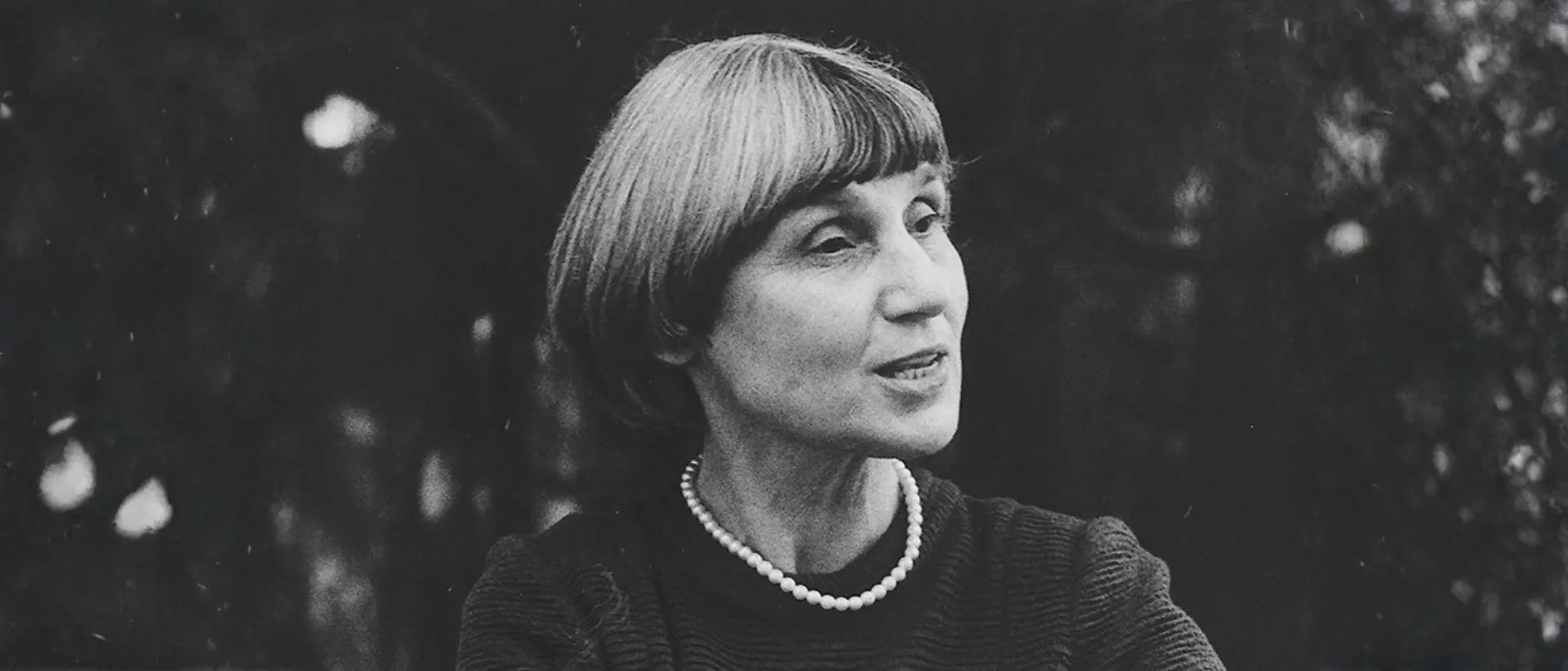
Yet just as history is a site of ruination and estrangement, so is language. The writer’s work on the edifice of language is one that leads them out of their philological comfort zone: if you are working properly, you start to perceive it truly for the first time, which means also perceiving the alterity within it. Thus, to encounter those ‘successive generations’ in the language is to experience both refamiliarisation and defamiliarisation at once.
‘As with any type of material,’ Kefala once said in interview, ‘you realise that the material itself has its own laws, its own definitions, its own forms […] that have been shaped by life, environment or culture. You are constantly forced into a combination that you might not like or agree with, or which does not actually express what you want to put across.’ This is especially, but not exclusively, the case for people who have moved between countries and languages. For Alexia, language – in all its non-familiarity – attracts not as the locus for happy continuous unity within the family but rather as something thrillingly individual, something ‘more potent, inventive and durable than people imagined’, something that is capable of producing ‘daily miracles that no one noticed any longer and everyone took for granted’. Facing the alienation in the language means tapping into literature’s power source. Alexia has been noticing that words, throughout that story, are gaining distance from the world. A sound only echoes when it has space to reverberate in; you can’t chisel marble without some space to swing your arm.
Kefala does seem to prize a certain distance from Australian English. When asked in an interview about the influence of Seferis, she made sure to insist on her differences from the older poet – he could do anything he wanted, she argued, because he was working in the language he was born and raised in, whereas she had to come to English anew and develop a whole poetics from scratch. One should never believe authors who say they make things up all on their own, but in utterances like these Kefala shows herself committed to an only-half-at-home-ness in English, perhaps a kind of linguistic Unheimlichkeit. She sometimes spoke in interview of her sense that coming to the language from outside meant bringing ‘baggage’ – and how one realises one is ‘dealing with a construct, something that was created by a group of people with a certain historical base and a certain physical location’. Working at the edifice of Australian English was thus a collective or even cooperative act, with a sense of the common weal: Sydney Journals frets about the intrusion of advertising talk into daily life and mocks Australian poetry that has been written the way men talk in pubs, ‘with no sense of [language’s] fragility, the beautiful energy, the dynamics that can be released when well used’. She fights for an English that has room to fit time – the singularity of death, to be sure, but also the plurality of pasts that people have brought to the material. And so her writing leaves space for repetition, transformation, variation, reverberation (sometimes literally so, as in the late poem ‘After the Reading’ where ‘the cage’ of the poet’s body is ‘the resonating chamber / of an instrument / still vibrating / with the last chords’). Her tendency to fragments, her broken lines, her unstable symbolic matrix: these leave space for onward resonances, even if the language and the landscape are disastered.
The Japanese-German author Yoko Tawada has written of seeking out not necessarily a multiplicity of languages, but rather the ‘ravine between languages’ as a space for creativity. Kefala is, perhaps, most interested in the ravine within the language – or perhaps the ravine between different baggages. She shows herself dedicated to building an Australian English with many linguistic imprints on it, and an Australia with many kinds of baggage inside. Her journals, in particular, show how committed she was to active intellectual friendship with a wide range of Australian authors and artists; they also show how much she loved Australian birds and landscapes. In the poem ‘Friends’, Kefala conjures these milieux with an understated affection: ‘All of us wounded people / stubbornly / analysing the condition.’ The poet Anna Couani has described the symbolic value of these journals, documents that pull in Kefala’s haut cosmopolitan touchstones alongside local milieux of cultural production: ‘Gertrude Stein, Goethe, Genet, Cavafy, Xenakis, Angelopoulos, Gogol, Berlioz, Brancusi, Byron, Klimov, Akhmatova and about 500 more. All mixed in together with “us”.’
Much has been written about that us, about the more or less explicit mechanisms by which Australia’s literary mainstream has excluded female authors with migration in their background – especially, perhaps, those who like Kefala refuse to simply do confession or witness or experience-chronicling in an easily consumable way. And much of Kefala’s critical reception has had to do with questions around the extent to which she is a Greek author, an Australian author, a woman author, a diasporic author. Kefala once wrote in an essay that, when asked whether she considered herself an Australian author or a migrant author, she would reply that of course she was both. These questions are not just a matter of semantics; they certainly were not during her career. Vrasidas Karalis and Efi Hatzimanolis, among others, have described how influentially Kefala’s work enabled and inspired the Greek- and otherwise hyphenated Australian authors who came after her.
But with the posthumous release of these two volumes – Fiction and Poetry – there seems an opportunity to insist on a broad canonisation of her as a literary author as well. This is not an unpolitical way to read her work. Every piece of literature is an intervention in the present; every bit of poesis an intervention in the language. For Kefala, this present was an Australian one – more specifically a Sydney one – and this language was in her case Australian English. Yet more often than not interior conditions are played out over local landscapes in terms of universal elements. In Sydney Journals, she notes something Patrick White says on the radio: that Australian literature ‘can only be developed from inner experiences, that is, when there are people making inner discoveries in this landscape, and having the courage to write about them’. Kefala’s visions are forceful, but never definitive, their essential lability meaning that every fragment’s meaning might be different any instant, fractally rearranged by the passage of time or the viewer’s baggage. Even her Sydney is one of many potential Sydneys: in the harbour’s ‘rip of darkness’ (to return to Slessor’s poem), there is space for countless pasts and countless ‘inner discoveries’, too – none elbowed out or delegitimised by another. Nothing only has one meaning. Kefala’s work penetrates the glossy anglophone Antipodean mainstream with inconvenient selfhood – and creates a present in which many deaths, many pasts, many linguistic histories can coexist. If that is not political, I don’t know what is.
Kefala has also now arrived on the global anglophone literary market, with the US publisher Transit releasing The Island last year and Sydney Journals this year – alas, no poetry yet. It helps nobody to be a persnickety provincial gatekeeper, but certain small factual errors in The Island’s American reception do stand out. One or two pieces seem to think that novella is set in Australia rather than New Zealand, while a listicle at Lithub seemed to think the book had been translated into English – presumably on account of its author not having a name like Helen or Gerald. The hard commercial facts notwithstanding, the absence of Kefala’s poetry in shaping her US reception is regrettable, and not just for the poems’ sake; without this context, readers might miss the extent that her young prose narrators are shown to be thinking as poets, or proto-poets at least. Reading her – in the US style – as an autobiographical fictioneer also risks missing the distance she holds from the figures in her work, many of whom are not simply Kefala stand-ins, her interest being more in states and conditions rather than individual trajectories. It might sound strange to say, especially of a diarist, but Kefala strikes me as an unusually un-confessional author. The act of saying, explaining, reviving might get done – but it has no special status in her work. And there is no real juicy beef in her journals, which are better read anyway as nonfiction prose experiments that make use of ‘lived experience’ than as author’s diaries in the generic sense.
Is something coming through in all this handwringing: a fear of Kefala’s being pigeonholed and limited in her global reception to a fearless chronicler of marginalised experience, to being the voice of her generation, or at least a voice for a generation? I’ve certainly done this when recommending her work around Berlin: here is the great poet of the multiculturalism era, the bard of those postwar migrants who remade Australia into the place I kind of love, that generation who gave the nation (say) Addison Road Community Centre, Tina Arena, and the Postecoglous. But every time I do that, it feels wrong. Her corpus is inflected by marginalisation, but that does not make it an essentially marginal one. It is instead a minor universalism, one that aims at the metamorphosis – the alienation – of the entire shared world. She makes all her readers into aliens too; in exchange, we get to see the stone as stony again. She is the national poet for an alien nation. In this, I think it suits my city well: beautiful and cruel and diverse, stolen by settlers and remade by migrants, and surreal-seeming from where I am currently writing, a snowy greyed-in city in the disastered heart of Europe, some 16,000 kilometres distant, a place from which the time-filled Sydney Harbour – all that land, and all that water – is visible only by moving the yellow Google Maps man around.