The Past in All of Our Nows
Heather Taylor-Johnson and Grace Yee on Joss: A History

Heather Taylor-Johnson talks to Grace Yee about her second book, Joss: A History – its weaving together of colonialist and Chinese settler voices, the archives we carry in our bodies, and the deep, deliberate processing involved in creating poems.
Alongside partaking in a poetry reading with a new book in hand at Adelaide Writers’ Week, I was meant to lead an in-conversation with fellow poet Grace Yee about her latest book, Joss: A History. Shortly after the disinvitation of Palestinian Australian author Dr Randa Abdel-Fattah by the Adelaide Festival board, Grace and I discussed, over the phone, our mutual decision to boycott the festival before we made our official statements. Both of us were devastated to miss out on such an opportunity, but, disgusted by the act of censorship amid a daily live-streamed genocide, we knew we had no other choice. In a time as seemingly hopeless as ours, perhaps serving as a beacon of protest is one thing art can still do.
What rose from the ashes of the cancelled Adelaide Writers’ Week were community and grass-roots actions. In less than six weeks, the Constellations: Not Writers’ Week had been organised – a free literary festival comprised of sixty-five sessions, featuring 123 speakers and more than 10,000 registered attendees, all united by a resistance to censorship and to the silencing of marginalised voices.
Because of budget constraints, not every writer who suffered the loss of income and promotion due to the original festival’s cancellation could be invited to Constellations. Nevertheless, it was with great pleasure that I was still able to have a conversation with Grace Yee.
What follows is a back-and-forth email exchange about Joss: A History, a work that engages with early Chinese settlement in Australia, and that attends to the voices of the Chinese diaspora through its use of archival text.
Heather Taylor-Johnson: It’s amazing we’re having this conversation online right now when we could have been at the Pioneer Women’s Memorial Garden in Adelaide, sitting under a couple of sails in front of a large audience, talking about your book Joss. And it would’ve been Adelaide Writers’ Week’s first ever Poetry Day, too.
Grace Yee: I was thrilled to be invited and was so looking forward to Poetry Day on the Green – it would have been my first-ever appearance at Adelaide Writers’ Week. It was very disappointing to see censorship raise its ugly head again. Last year I withdrew from the Bendigo Writers Festival due to censorship concerns, and in 2024, I pulled out of a State Library Victoria event due to the lack of transparency over the Teen Bootcamp cancellations. Last month I turned down another opportunity from SLV when I found out the Teen Bootcamp situation still hadn’t been resolved. These amount to significant missed opportunities – poor wee Joss missed two major festivals!
But if we cave to censorship demands, what we stand to lose – freedom of speech and expression, the very things that drive our artistic endeavours – would be far more considerable. Both Chinese Fish and Joss: A History are concerned with colonialism and racism across social, cultural, and historical contexts. It would be absurd and unconscionable for me to discuss such matters on public platforms where other writers have been explicitly excluded or prohibited from speaking of the same in contemporary contexts. But yes, it is amazing that we’re having this conversation right now.
HTJ: I’m thinking about your poem in Joss, ‘(heffernan lane)’, which is accompanied by a fantastic photo of a group of Chinese women in decorative, traditional costume, with a white man in a suit and hat standing to the side. It’s a rather remarkable photo, and you write: ‘how do we daughters of the middle kingdom – world famous for self-effacement – begin to deconstruct the status quo of colonialist, anthropological government?’ Is there a feeling for you that colonial discourse is best if it’s women-led?
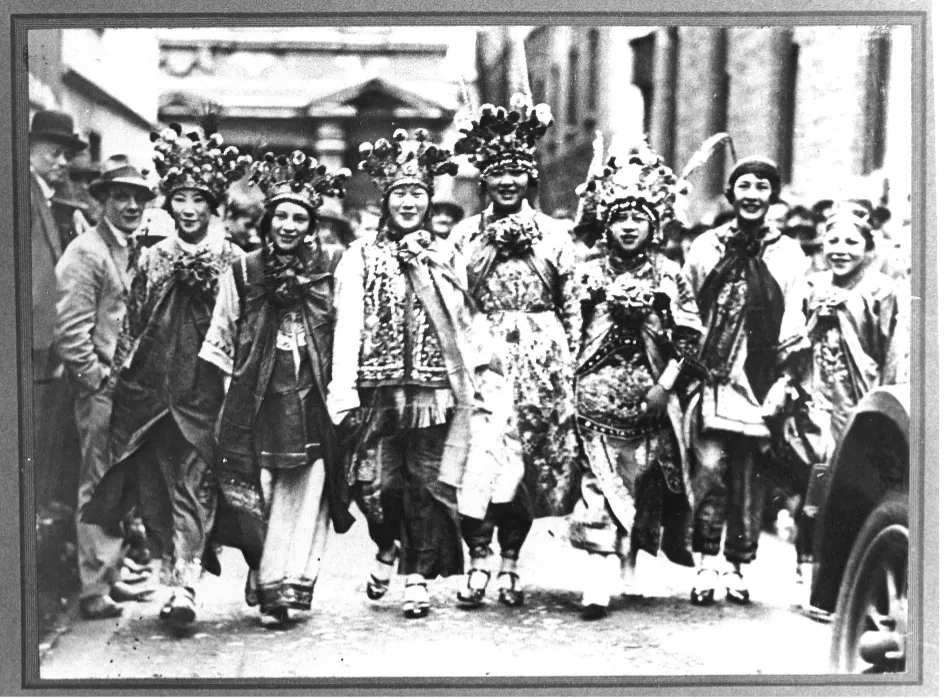
A photograph of part of a procession to raise funds for famine relief in China. Melbourne, 1929. Pictures Collection. State Library Victoria. Photographer unknown.
GY: I love the ‘(heffernan lane)’ photograph too – it’s a rare shot of Chinese women’s exuberance in a Western context, where they were, for generations, raised to keep themselves small, to know their place. The photo was taken in Melbourne in 1929, which makes this very public, confident show of Chinese women-ness all the more extraordinary. I don’t know if colonial discourse is ‘best’ if ‘women-led’. What I do know, if I can extrapolate from years of research into the lives of settler Chinese women in this part of the world, is that women have often been excluded or marginalised in colonial projects.
In Aotearoa New Zealand, there were very tight quotas for the entry of Chinese women well into the twentieth century. We’re talking extremely low numbers – ten or twenty per year – for a very limited period, a few years. (They let Chinese men in because they needed them for the hard labour of running laundries and growing vegetables to feed the nation.) When the government did raise the quotas, entry was restricted to women who were believed to be beyond childbearing age, in the hope that their population wouldn’t increase too much.
Because colonial projects are patriarchal projects, primarily led by men, and also women who have internalised patriarchal priorities, it makes sense that a feminist take needs to be part of the counternarrative. But of course, any marginalised woman who dares to speak is a potential target, or scapegoat. The entire system is, for lack of a better word right now, so damn inexpungible! I refer to this, facetiously and resignedly, in ‘(heffernan lane)’, after the lines you’ve just quoted: ‘should we pray for rain so the builders go home, or meditate on the structure’s neutrality and learning objectives?’
HTJ: When you’re working on a project such as Joss, where does anger sit in the process, if it does at all? How do you contain it so it doesn’t filter into your lived life?
GY: Anger isn’t part of the research or writing process once the project has been conceived. I’m working on my third book now, and what I’ve found is that it typically takes years of thinking and reflection before I feel ready to commit pen to paper and begin The Book Project itself. I spend this lead-up period doing a lot of brain-dump journalling, which I suppose is cathartic, but I’m not writing explicitly for the book or doing any left-brain analytical thinking at this stage. The journal is a messy soup of images, feelings, conversations, and reflections on places, objects, people’s behaviour – things I notice, observe, or recall. There may be anger or distress while journalling, which is precisely why I can’t possibly commit to drafting poems during this phase. In my experience, drafts that arise directly from raw or untamed emotion usually result in terrible poems that no amount of editing can fix. The drafting process requires calm and presence of mind. Drafts are not seeded from ideas though – I don’t set out to write a poem about something. I usually begin with words and images randomly mined from journals or notebooks, and I play with these until something takes shape.
Despite the subject matter of many of the poems that evolve, this is my happy place. At the same time, both my books involved a great deal of what I think of as circumstantial emotional labour. My parents and several other family members passed during the lead-up to the publication of Chinese Fish – the book is inspired by family stories, and I remember bawling my eyes out while I was working on the final revisions. Much of Joss was also written during the upheaval of the pandemic years, when sinophobic violence was happening in public places; there were days when the histories I engaged with felt intensely omnipresent, like I was writing-living the poems. I think the poems contained me.
HTJ: I love a strongly themed poetry book, like Joss, and also your first book, Chinese Fish, and clearly you do, too. I’ve done one and when I was in the middle of it, I constantly referred to it as a ‘project book’. What I find interesting about your project is this journalling for years before the poetry begins, almost as if you’re creating your own archive. But then there are the real archives – what was it like for you to transport yourself through them and communicate with your ancestors’ stories, or perhaps their non-stories?
GY: I suppose I was creating my own archive in a sense – there is, after all, so much more to ‘the archives’ than the dusty tomes and boxes of documents most of us imagine when we hear the word. As Xiaole Zhan points out in her recent review of Joss in Lantana: ‘Joss recognises that the archive is situated firmly in the body.’ The journalling that I did in the lead-up to working on the draft proper was, in many ways, a process of offloading truckloads of thought, feeling, nebulous images, memories, etc., much of which I had unknowingly absorbed from my forebears – the kind of baggage that we all inherit.
By ‘the real archives’, I assume you mean those stored in libraries and museums? I felt a deep sense of familiarity while going through them. Much of the research for Joss was facilitated by a creative fellowship at the State Library Victoria, for which I researched both stories told about early Chinese settlers and stories told by the settlers themselves. I found that the stories told about them mostly reflected the usual colonialist orientalist stories, but there were also very good ‘on the ground’ narratives – for example, from an audio accompanying a self-guided tour of Little Bourke Street from the Museum of Chinese Australian History in Melbourne, and some excellent books I read under the auspices of the Golden Dragon Museum in Bendigo, which focused on individuals, cultural practices, and interpersonal relationships.1 I found the stories told by the settlers themselves (in diaries, memoirs, oral history recordings, film clips, etc.) very interesting too, particularly those that revealed the ways they navigated everyday life. There were many resonances with my family’s history in Aotearoa, but at the same time, settler Chinese histories in Australia do differ in significant ways. I could have happily continued researching, but alas, all good things must come to an end!
HTJ: I’ve never thought of archives we keep in the body, and how intergenerational trauma is just that. I love the image, of shelves of boxes and papers filling up the spaces between my skin and bone, filled with the stories of my ancestors.
While I was reading Joss, I wondered how you navigated where your own voice fit into and among the voices of your ancestors, how you managed to keep yourself intact. But maybe it’s more like the voices are finally rising up and using your words to speak. In that way, it’s kind of like you were urged to write this book from something(s) or someone(s) deeply embedded. That seems like a huge responsibility. And a little ghosty, I suppose. Do you have any thoughts or feelings about the spirit world in this sense?
GY: I have long been interested in this idea of a ‘spirit world’, but I don’t see it as separate from the ‘real’ world. Like ‘the past’, which some people perceive as distinct from the present, it’s not. The past, our histories, are omnipresent, and that conviction is fundamental to Joss. To me it’s not ‘ghosty’, it’s simply our lived experience. The word ‘ghost’ brings to mind ‘haunt’, as in ‘she was haunted by her family’s past’, which also suggests separateness or otherness. But the past just is, it co-exists, is integrated into all of our ‘nows’. I wasn’t conscious during the writing process of where my voice was situated in relation to the voices of others – Joss is a porous and polyphonic work and I would say that ‘I’ spoke with and alongside them.
The image I have of archives in the body isn’t tidy. I believe that we incorporate our ancestors’ stories at a cellular level, within our flesh and bone. Incidentally, the research into epigenetics validates this: we literally carry their trauma, and probably their triumphs as well, and their resilience. (Last year I sent a sample of my saliva off to a DNA testing service and was interested to see that, among other things, the analysis revealed that I inherited ‘motivation and determination’.)
HTJ: My last novel was about my mother’s neglected upbringing and I felt my grandmother – who I didn’t really know – kind of hovering over and around me while I wrote. I was very aware of her DNA inside of me, but the idea that I carried her trauma, and my mother’s, was kind of hard for me to accept. But then again, I wrote the book, didn’t I? I think it’s hard to know how much of our impulses as creatives are cerebral and how much are felt.
GY: I feel that the impulse to write is definitely felt in the body, embodied. And that the initial creative urge – flow, spillage – isn’t compatible with editing. I can’t draft and think critically (about the writing) at the same time – stemming the flow to revise is counterproductive. That’s not to say that revision doesn’t involve creativity, it does, but there’s a big difference between pouring out the raw material and smoothing it over to please an imagined reader. We are each of us unique and there are stories that only we, as individuals, can tell. And these singularities have more space to unfurl when we allow our feelings and creative instincts to lead, particularly in the early stages. That’s interesting, what you say about your grandmother hovering while you wrote. Did she talk and did you listen? I find that researching and writing involves as much listening as reading.
HTJ: Mostly I felt as though my grandmother was worried or disappointed because I didn’t paint her very nicely in the novel. I went to a clairvoyant for a birthday as a lark and there she was, talking to me then! But that is an entirely different kind of listening and receiving, and entirely different story.
On this topic of listening and receiving stories, one of my favourite poems in Joss is ‘Quongs’ which is about a Chinese family in Patrick White’s novel Happy Valley, published in 1939. That final line of yours, ‘it is indeed a bloody good read’ – it’s a really layered statement and I love it as an ending. When you read work that old, where the racism feels naively open and natural – none of that educated political correctness that pisses off so many white readers today – do you need to practise forgiveness?
GY: Patrick White’s Happy Valley is one of my all-time favourite novels – I’m fascinated by small towns. Maybe it’s because I grew up in a small place myself: in the small city of Ōtautahi, in a Chinese community of fewer than a thousand people, where everyone knew everyone and everyone else’s business. The upside was that there was always plenty of company and the family and extended ‘family’ were (usually) in your corner. But there was no privacy and it was very insular, and it was ‘normal’ for people to be open about their prejudices. (Pākehā were not the only racists in town!) Many people didn’t hesitate to express their xenophobic/homophobic/misogynist/ableist opinions. In retrospect these bigotries seem shocking, but I think it’s important to consider the context, and reflect on whether we have progressed as much as we think we have.
In small towns, people do tend to be more inward-looking, and Patrick White captures this mindset brilliantly. I sum it up in the closing lines of ‘Quongs’, which is a hybrid review-poem: ‘Happy Valley is […] a novel in which unfiltered bigotries, betrayals and quiet desperations fester in the minds of its characters in constantly shifting circling points of view that coalesce to devise the town that is its namesake’. The line that you’ve quoted, ‘it is indeed a bloody good read’ was written in earnest. The emotion I felt most in my early readings of the book was not anger, but curiosity, and in subsequent readings, empathy (there is as much misogyny as racism in the novel). What does make me bristle is the ‘educated political correctness’ that prevails today, because it is so often performed in place of – instead of – actual progress.
Marginalised people – First Nations people, people of colour, women, children, people living in poverty, etc. – have been fighting the same battles for decades (actually, centuries). Politically correct speech has been around for decades: it is placating speech, designed to turn the heat down, to sustain an impression of progress. It is a disingenuous strategy for deferring real change and maintaining the status quo for those in power. The implication is that as long as the ways that we are addressed, spoken about, and treated appear respectful (or, at least, do not appear grossly disrespectful) then that is supposedly sufficient to offset whatever discriminatory apparatus persists systemically. The bigotry that the characters in Happy Valley manifest is barefaced, perhaps shocking to some, but it’s preferable to the dissembling by politically correct strategists, because their open hostilities, though unpleasant, are expressions of fear and vulnerabilities that are easier to contend, and potentially, empathise with.
HTJ: I love that answer so much, though I do fear that it lets the worst people off the hook. To my thinking, you’re practicing forgiveness by doing the hard work of understanding the other side, rather than blaming. It feels active and connective, and I guess that’s where the lack of anger comes from. What you just said and what you’re doing with Joss really shows a heightened level of awareness that maybe only being on the short end of othering can attest to. Thank you for the heavy lifting you’ve done with Joss and for the time you’ve taken with this conversation.
GY: Thank you Heather. It has been a pleasure to have this conversation with you over the last couple of weeks. By way of closing, I’ll add that my answer doesn’t let ‘the worst people off the hook’ at all. The worst people are not the ordinary propaganda-fed people on the ground; they are the ruling classes and politicians – those in power, who continue to perpetuate division by pitting communities against each other because such tensions benefit them.
As for being on ‘the short end of othering’, I know what you mean, but in a broader context, being othered is not a ‘short’ experience. If anything, being repeatedly othered has an expansive effect: it enables us to see them. At the same time, the fact that we’re watching them watch us is often forgotten (by them).
I illustrate this mindset in the poem ‘slides’, where I imagine a white-man National-Geographic kind of anthropology lecture about ‘orientals’ taking place sometime in the early twentieth century. The poem is narrated in two voices – Chinese, and orientalist – and at the end of the poem the Chinese narrator indicates that he sees them clearly, their ‘colonial imperial indolence beneath a single moon, / the same loose stones’.