
Reflections: 20 Years of the Writing and Society Research Centre

In 2026, the Writing and Society Research Centre (WSRC) at Western Sydney University celebrates its twentieth birthday. Over the past two decades, it has broadened the horizons of Australian literature by fostering a unique environment in which leading literary scholars shared a corridor (and cakes) with some of the nation’s most renowned writers. With each collaborative project and public event, the Centre has kept drawing the virtuous circle between the critical and creative, institutional and communal, national and cosmopolitan that has become its signature.
To celebrate this milestone, the Centre will be holding a half-day symposium on November 20 at Parramatta Library (PHIVE) that will consider its evolving role in the cultural, scholarly, educational, and literary landscapes of Western Sydney and beyond, as well as canvassing the broader challenges affecting the scholarly and creative communities of which the Centre is a part.
In the lead-up to this celebration, the Sydney Review of Books – a brainchild of Writing and Society – is publishing a series of personal reflections on the origins and continuing life of the Centre to honour the breadth of its contributions to writing pedagogy, translation and transnational exchange, and digital publishing (among other things). These are ‘reflections’ in a double sense — not only acts of retrospection, but in the play of mirroring and obliquity, an enduring image of an intellectual life held in common.
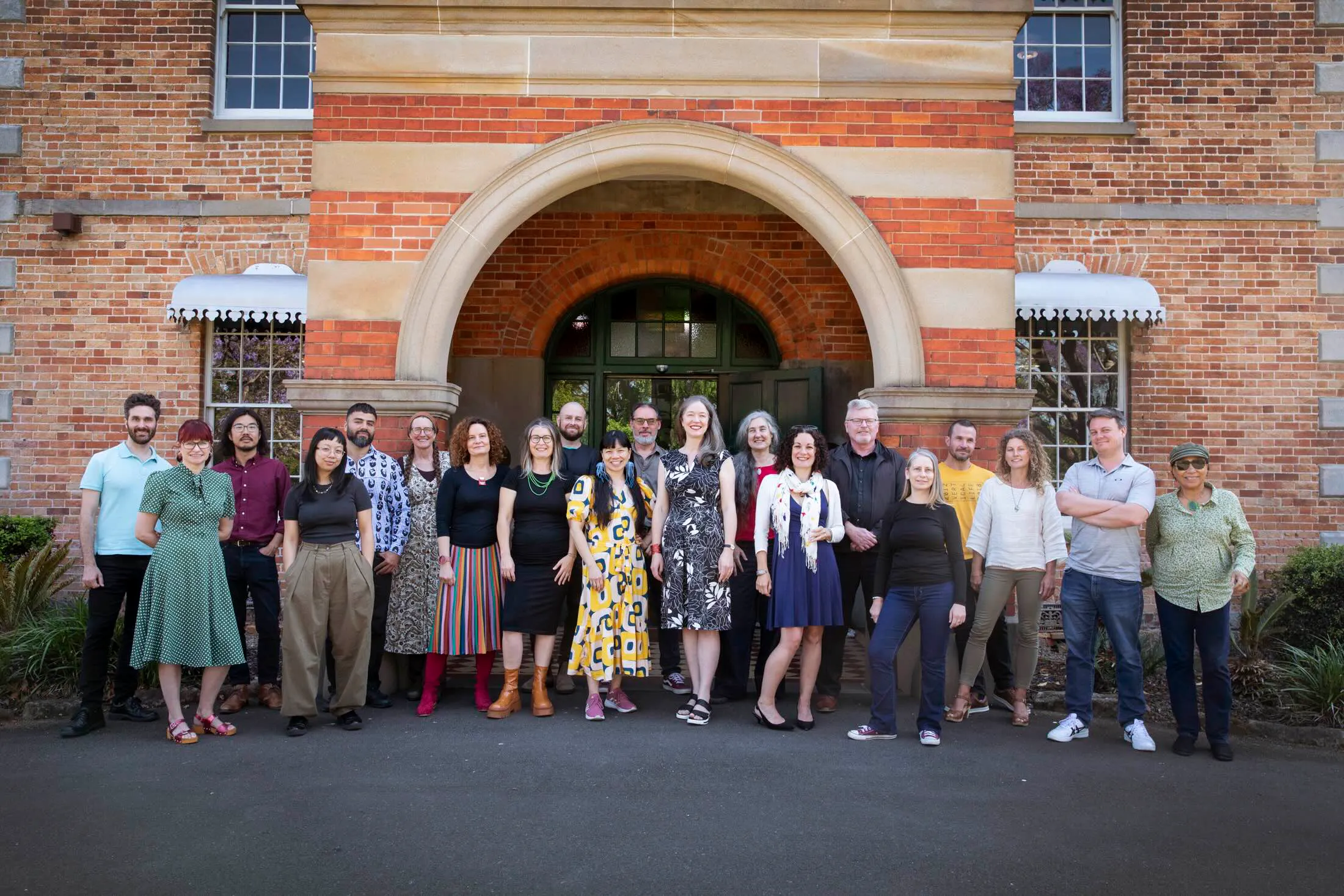
Contributors
Chris Andrews | Felicity Castagna | Mridula Chakraborty | Farz Edraki | Kate Fagan | Ivor Indyk | Melinda Jewell | Nick Jose | Yumna Kassab | Sara Knox | Catriona Menzies-Pike | Hazel Smith | Anthony Uhlmann | Alexis Wright
Chris Andrews
Writing, Society, Translation
Translation has been woven into the activities of Writing & Society from the early days. In 2010, the Group (not yet a Centre) hosted the Sydney Symposium on Literary Translation, which brought together translators from around Australia and from China, as well as keynote speakers from Argentina (Marcelo Cohen) and the USA (Esther Allen). This was an occasion for many practitioners who already knew each other’s work to meet face to face for the first time. Listening recently to recordings of the sessions, I was struck by how much relaxed laughter they provoked, particularly ‘The Classic in Translation’, in which John Minford recounted how he recovered from the ethical trial of translating Sun Tzu's The Art of War by plunging into the baffling wonders of the I Ching.
Financial resources for events such as the Symposium have dwindled over the years, but the Centre’s intellectual investment in translation has not. There is space to mention only a few examples here.
Centre members have made important works of French philosophy available in English, such as Bruno Clément’s Bergson as Writer: Literature in Philosophy, translated by Anthony Uhlmann, and Simone de Beauvoir’s ‘What Can Literature Do?’ translated by Chris Fleming. Chris Conti and James Gourley’s edited volume Literature as Translation/Translation as Literature (2014), deploys an ‘expanded idea of translation’ to illuminate processes of literary composition while staying in touch with finicky verbal details.
Over the years, translation has been the focal point of several of the Centre’s research seminars: Michael Hofmann unfolding four poems from his anthology of twentieth-century German poetry (2012); Valentina Gosetti and Jim Rheingans discussing their work as translators and editors, of French women poets and the Tibetan scholar-mediator Karma Thrinlepa, respectively (2018); Tiffany Tsao and myself conversing with Yumna Kassab about the frustrations and satisfactions of the translator’s craft and trade (2024).
When the Writing & Society Research Group was founded twenty years ago, translators often laughed amongst themselves at the silly mistakes made by Google Translate. That was before the rise of the neural network models and the public releases of Deep-L (2017) and Chat-GPT (2022). The laughter now is less relaxed. In the wider world, AI translating and interpreting are reinforcing the monolingual mindset, masking the changes that translation inevitably brings, and promoting the illusion of perfect interlingual transparency.
If that transparency were possible, there would be little point or pleasure in learning other languages. Perhaps that conclusion would satisfy certain tech lords and prophets, but it is false. There is no perfect interlingual transparency. A translation is always the result of interpretation and choice. It could always have been otherwise. And hopefully the slowly pondered, personally inflected choices of particular human translators will continue to be favoured by a substantial literary readership committed to more than unfettered access and sense extraction.
We do need translations for access to what has been written and thought in the vast majority of languages beyond our competence, but not only for that. Translations can have many other functions. They can, for instance, prompt us to learn a language and aid, like disposable scaffolding, in that endeavor. Or crucially for the health of our culture, they can expose us to other notions of what an effective literary style or genre can be.
As readers and writers, many of us want to live in a world – the whole world of human culture as it has evolved – and not to be confined to one nation, a single language domain, or a bloc of ‘like-minded’ military allies. Translations that accompany the originals rather than conjuring them away equip us to resist such confinements. I hope that soon, and in years to come, new members will multiply the translation strands in Writing & Society’s weft.
Felicity Castagna
Professor Ivor Indyk thinks we met at a writer’s group in Bankstown, after he became the Chair of the Writing and Society Research Centre and was trying to help foster a writing culture in this community. But it wasn’t the first time that we’d met. The first time I met him I was eighteen and we were both smoking on the vast green lawn at Sydney Uni and he recognised that I was that kid from his Australian Literature lecture who kept endlessly sending him submissions for a magazine he was running called HEAT. And because he’d rejected me at least twenty times by that point I think he felt the need to hand me some sage advice, which was something like, ‘You know you have to keep writing for a long time before you get any good at it.’
I’m still writing and I’m still learning my craft many years on, but meeting Ivor, who later became my PhD supervisor and then my publisher, was a big part of that, as was being supervised by the formidable Professor Gail Jones.
I started my working life in this community as a high school teacher. I started my writing life here through this university and through the many different literary organisations and writing groups I enthusiastically became a part of. I’m now part of the Writing and Society Research Centre as a permanent member of the Creative Writing staff: after many many years of working here casually I think someone realised I wasn’t going anywhere.
Recently, a colleague asked me if I ever planned on leaving my job here and I said, ‘Nah, I can’t. I just walk in circles around the neighbourhood all day.’ I meant it quite literally. I do walk in circles around this neighbourhood most days. I go from home, to my kid’s school, to the university where I teach, to the neighbourhood schools where I still run a lot of writing workshops, and at least a couple of nights a week, I make it to a local arts or writing event where I’m often in the company of former and present students I’ve taught at Western who are both in the audience and on stage. If there’s one thing I try to teach them, it’s the importance of showing up – on the page but also for each other: if you love the arts, show up for them.
A lot of us have been walking the same circle around this neighbourhood for a long time, between the Writing and Society Research Centre and the arts and cultural spaces of the neighbourhood that are so deeply connected with the Centre in so many ways.
What keeps me alive in the writing industry, which can be so cruel and so hard for so many reasons, is that everywhere I walk in this neighbourhood there’s always someone with a story. Sometimes it’s my neighbour who wants to tell me about his lemon tree and sometimes it’s a student who is writing about the time their grandmother helped at an exorcism and sometimes it’s one of the arts elders of the neighbourhood who tells me about a show they’ve developing.
And a lot of the time I run into people who are my students or were my students or who might become my students one day, and I tell them that there are so many stories here but it takes a lot of time to learn how you want to write them.
Mridula Chakraborty
It was a crisp cold July morning in 2008 when I walked into the special annexe where the Writing and Society Research Centre was located in the Milperra campus of what was then called the University of Western Sydney. Making my way from Potts Point, where UWS had put me up in a serviced apartment till my belongings arrived from Edmonton, I undertook a journey very different from the eighteen-hour non-stop flight that had brought me from Canada to Australia. I did not know at that time that taking the train on the Bankstown line and then a connecting bus to a eucalypt-scented campus would be another kind of intercontinental, transnational journey. For it was a tale of two cities: centre and periphery became defined along that line; journeying away from the bowels of sinful shining Sinni was this parallel universe in Western Sydney that I would soon come to think of as quintessential Austraya! Home to the Darug people for millennia, and to successive generations of increasingly upwardly mobile migrant communities, this place would define the literary agenda for the nation within the next decade! Writing and Society was salient to that project.
For the next six and a half years, the public transport commute from the Inner West brought me to a place that felt less like ‘work’ and more like a continuous inhabitation of reading, writing, thinking, and just living the fabled life of the mind! A life of the mind often hints at an existence in the hallowed corridors of whatever the ivory tower institution might be. The mind, as per René Descartes, seemingly splits off to some book-lined garret/refuge leaving the body outside, languishing away in separation anxiety. This was simply not the case at Writing & Society: a life of the mind was as much life, oh, but so much more (of course I did not know it on that first day). On that day, however, there she was! In a light-filled office, a cork board pinned with a hundred or so green teabag-envelopes behind her. Kathleen Olive! Research Officer of the Centre par excellence, who would initiate me into the ways of Writing & Society as well as a whole new life on this country-continent. Answerer of all my annoying questions regarding Australianisms, adroit navigator of administrivia, and when she left UWS for glamorous globe-encompassing travel, a friend for life.
On that day, however, as a cool image of professionalism, Kathleen introduced me to my supervisor, the legendary Ivor Indyk of Giramondo Publishing, and Dean of Arts, Wayne McKenna, whose support had been critical, I came to know in the days to come, of making something like Writing & Society possible. What a place it was! A storied enclave in a university whose primary commitment was to the Greater Western Sydney region, where our students were first in family, of low socio-economic, migrant and refugee backgrounds, where my colleagues were each, not a star but a constellation in the Australian literary firmament: Chris Andrews, Gail Jones, Nicholas Jose, Sara Knox, Catherine Rey, Hazel Smith, Anthony Uhlmann, Alexis Wright. To be able to say that these were the luminaries with whom I had the privilege of co-teaching literary studies, who gave their time and commitment to what the Centre represented: writing and its place in society! In the following months, I would come to understand just how precious our student cohorts were and how, within five years of my being at Writing & Society, they would be the vanguard of Australian literature: Michael Mohammed Ahmed, Luke Carman, Felicity Castagna, Jen Craig, Nasrin Mahoutchi, Irini Savvides, Fiona Wright.
I have such vivid memories of events even a decade later. One day stands out in particular, when Chris Andrews, award-winning translator of Roberto Bolaño and César Aira, and Juan Salazar from the university’s Institute of Culture and Society, invited Manuel Vicuña from Universidad Diego Portales, Chile, and all of us Centre members just sat around for an entire morning talking about what reading and writing mean for our lives and societies. Such idealism and luxury seem unimaginable just a decade later in the corporatised spaces that universities have become. Book launches at Gleebooks in Glebe, big literary initiatives like the China-Australia Literary Forum (2011) that brought ten Chinese writers to Sydney to be in conversation with their Australian counterparts. Brainchild of Nick Jose, that gathering became a model for a similar initiative I curated at the State Library of New South Wales, the Australia-India Literatures International Forum (2012) that saw twelve writers from twelve different bhashas in India in conversation with twenty-four multicultural Australian writers, fully funded by the Literature Board of the Australia Council and DFAT. That led to a tri-national workshop (2013) at Jadavpur University, Kolkata, where students translated the work of Indigenous poets Ali Cobby Eckermann and the late Lionel Fogarty into Bengali.
In another multi-year program, Literary Commons: Writing Australia-India in the Asian century with Dalit, indigenous and multilingual tongues (2013-2014), I took ten Indigenous Australian writers to five of India’s famed literary festivals and brought back ten Dalit and multilingual writers from India’s venerable vernacular literary traditions in a reciprocal visit to Australia. Nominated as a Finalist at the inaugural Australian Arts in Asia Award, that exchange between First Peoples in both countries has left a continuing legacy. An output of that program was a special issue in Cordite Poetry Review, a publishing initiative that had never been attempted before nor has been repeated since.
It is considered gauche to talk about food in the same breath as books, but Writing & Society was entirely different in this respect. I cannot recall a single monthly seminar, literary event, or graduate student soiree that was not simply heaving with food ordered from the fabulous ‘multicultural’ outlets of Western Sydney, all halal before that word began to have certain connotations in retrograde Australia. Ivor was of the firm belief that the brain and the belly needed equal parts nurturing: staff gatherings at one of Bankstown’s yum cha joints were de rigueur and trained me to organise lavish catering for one of my first big projects at Writing & Society, Being Bengali: At Home and in the World (2010) that saw almost fifty community members of the Bengali diaspora from Western Sydney, alongside prominent Sydney academics, turn up for a day-long symposium to listen to stalwarts of South Asian academia (Fakrul Alam, Firdous Azim, Sekhar Bandyopadhyay, Dipesh Chakraborty, Paulomi Chakraborty, Vijay Mishra, Ranabir Samaddar, and Mahua Sarkar), to discuss and debate this elite ethno-linguist community from the Bay of Bengal. There was another life lesson in there: it was Ramadan, most of the lay attendees were fasting and half the food was uneaten. This was a life of the mind alongside life in all its vicissitudes.
This reflection would be remiss if it did not mention the two leading lights under which Writing & Society made available the space to gather and ruminate upon the ways in which art, creativity, and debate, nourish the innermost workings of human beings. During my time, it was mercurial Ivor followed by imperturbable Anthony: such different personalities, but equally committed to complex and difficult conversations with far-reaching consequences for the sustenance of the human spirit. These words may sound hagiographic, quixotic, and sentimental, anachronistic almost, but my time at Writing & Society was magic. To write of the Centre in its twentieth year of flourishing is to celebrate the best of its collective intelligence, commitment to public good, and continuing capacity to transform this lucky country (pace Donald Horne). Tall poppies each one of its members – not to be cut down but encouraged to grow even taller, the tyranny of distance melting away to make it a meeting place of the cosmopolites. This is Austraya! Even today, when I have lived in Melbourne for double the time that I did in Sydney, I cannot wake up in the mornings without reminiscing about something that happened at the Centre. The banal aphorism, the soul travels at the speed of a camel, makes meaning afresh when I look upon those years that afforded so much deep thought amidst camaraderie and community. I could tally up a string of academic achievements no doubt, but much more important is the unmistakable sense of the arts counting, of writing making a difference in the world, each and every day. I can feel my soul still travelling with Writing & Society.
Farz Edraki
I click on a Zoom link to enter an online tutorial with a handful of other students. It’s 2020, the year we said farewell to a litany of certainties. I say hello to my new cohort of fellow creative writing students: Jazz, Henry, Jack, Suzanne. On my laptop screen, they are small squares talking about Lacan and the split self. Woolf. Perec. These tutorials buoy me. How exciting, these ideas! All hope is not lost! In Melinda’s writing group, the small squares share their own words, lend an ear for feedback. That feeling of being lifted by each other balloons across the next three years. Not pictured: late night deadlines.
‘I feel like they’re my wise literary fairy godmothers,’ I text my partner in my final year, after a meeting with Anne and Felicity. I was lucky – really, so lucky – to have their counsel and wisdom as my supervisors. The conversations in Felicity’s office on a Tuesday afternoon, the encouraging and eviscerating Word comments. What does this mean? Or Keep going!
In the month before my elder daughter is born, I take leave from my day job as an editor to prepare – in more ways than one. And, importantly, I use this time to finally finish my thesis. When my daughter is a week old, I take her to the same café where I wrote the final pages. She does not cry. Two projects come into being in 2023. Only one of them keeps me up at night.
Every now and then, a message will come through on my phone in a group chat titled ‘Varuna Crew 22’. Many are finishing their doctorates now; others waiting on a Western Now ticket to get confirmation of theirs. I smile, thinking back to reading Victoria’s novel set against ecological and personal crises in the Mountains. Or listening to John or Ramona explain their work over dinner in the big yellow house.
We walk from Parramatta Square, past high-rise buildings and office workers having coffee, crossing roads to meet the road that meets the river. We’re heading to campus. I’m with Ben and Vivian, talking about how to tackle the week’s readings. Ghassan Kanafani. It’s my first semester as a tutor. I watch students sitting in the lecture theatre listen intently to Ben’s lecture. I furiously take my own notes. Even though I am teaching now, I know I still have so much to learn – from Ben, from Felicity, from Henry, from Vivian, from everyone who is connected, past and present, to the Writing and Society Research Centre. I owe so much to the people who make up this literary hub. Behind the publications and awards, it is the staff and students who cement the institution, who write it into being.
I unpack my bag next to the lectern. I start the Kanafani tutorial with a bad joke about the light rail being late, then: ‘I’m so glad to be here.’
Kate Fagan
Crossroads and Keys
Right as the Covid pandemic realigned earth’s gravity in 2020 and we scrambled into the first of multiple lockdowns, Catriona, Melinda, and I began to design a mentoring program called The Writing Zone. Our aim was to support emerging writers and arts-workers from Western Sydney in knitting together a community of literary practice. This was familiar terrain for the Writing and Society Research Centre – from which had grown the Western Sydney Writing Project, Sweatshop, Sydney Review of Books, and Finishing School Collective. I had been Centre Director for only two months before Parramatta became a temporary ghost town. Between openings and closures in 2021, we published The Wayward Sky, our first Writing Zone anthology. We tentatively held a launch in the Square. Almost every young writer brought their families. Eileen Chong gave an uplifting talk to usher the volume into public life. Amidst the doubts and new awkwardness of distancing, people’s smiles could not have been more luminous. It was radical to see people hug.
I travelled to Guangzhou three years earlier with an ensemble of WSRC writers and artists including Nick Jose, Waanyi author Alexis Wright, Gail Jones, and Ben Denham, for the fourth international convention held under the CALF umbrella. A buzzing crowd of students spontaneously broke into applause during an auditorium reading in which Alexis reflected on her ancestral links to the Guangdong region. Many were close readers of her books in translation. The previous day, writers Zheng Xiaoqiong and Yang Ke had walked us through Shawan, where we listened to Cantonese music and observed water dragons built on rooftops to protect houses from fire.
Yumna Kassab attended her first meeting as Parramatta’s literary Laureate wearing a white rechargeable fan tucked around her neck like a pair of galactic headphones. Close by the SRB offices in Hassall Street, she outlined a vision for her dictionary of Parramatta. I’d like the council to instigate a literary walking tour of Parramatta, she declared. We can build an app that people download as a guide. Why not link it to the dictionary? Yumna often foretells the future. Like Alexis Wright, she feels acutely how many different times can exist simultaneously. She also understands haunting and its fierce currency.
Books, books. Praiseworthy. One another. Lime green chair. Her fidelity. First light. Second city. The idealist. Cicada chimes. Samuel Beckett and the philosophical image. The details. Losing face. The snow laundry. Holocene pointbreaks. No more boats. Running time. An ordinary ecstasy. What kept you?
Suzanne brought a baked cheesecake one Friday to the small, windowless seminar room of Building One on the Milperra campus. People barely looked up when Judy Davis tried to take an inconspicuous seat just as things got underway. Judy wore her sunglasses for the entire paper. After every seminar, I used to sit under the lemon-scented gums to breathe in lorikeet song.
Jerome Rothenberg and his partner Diane were guests of the Poetry and Poetics Project in 2017. After a dynamic seminar in the Centre’s new Bankstown digs, which canvased that year’s reissue of Technicians of the Sacred, my partner Peter Minter and I brought the Rothenbergs to a prehistoric swamp overhanging the Megalong Valley. I can still see them in borrowed beanies, leaning into gale force winds, and hear Jerome singing outrageous Polish workers’ songs by a blazing fire.
Founding WSRC Director Ivor Indyk emailed out of the blue in 2008 and asked me to dinner with visiting scholar Charles Altieri. He suggested I round up a few innovative poets for whom that night’s conversations might resonate. I jumped at the chance. By that evening’s end, a plan had been hatched in which I’d work with the Centre to apply for grants in contemporary poetics. I next saw Charles eight years later, having secured funds to co-convene the Active Aesthetics conference at UC Berkeley with Lyn Hejinian and Ann Vickery. Backed by both WSRC and WSU, our Berkeley keynotes included Yankunytjatjara poet Ali Cobby Eckermann and Narungga poet Natalie Harkin. That 2016 assembly of thirty-six Australian poets – matched by as many US and Canadian counterparts, and matchless in the generosity of Lyn, her students, and her colleague Eric Falci – remains historically the largest offshore gathering of its kind.
When Anthony Uhlmann became WSRC’s Director in 2011 and relocated to Bankstown, he handed me the key to his glass-walled office on Kingswood campus. Take it, he said. Let’s do a straight swap. I moved in almost immediately. It took years before that audacious gift became a ‘paperwork issue’.
Our stellar doctoral alumna Raaza Jamshed, now Editor-in-Chief of the magazine Guernica, invited New York-based journalist and author Michael Shaikh to the Centre in May 2026 for a conversation about his new book. To celebrate The Last Sweet Bite and Raaza’s return from Lebanon, Anne suggested we work with WSU’s lively student partnership team. Under Shivani Suresh’s generous care, the students curated a table of food to share after the discussion. Local women cooked recipes from their mothers and grandmothers, tied to students’ treasured memories. We listened to poetry by some of our best student writers in a communion of words and sustenance.
It has been one of the great honours of my scholarly and writing career to direct this formidable outfit for seven years. Seven feels like a number straight from folklore. In the musical traditions I know best, it retains a talismanic force.
The abridged and impulsive album above can’t do justice to the precious friendships and intellectual vitality of the Writing and Society Research Centre, an exceptional model for ‘a literary ecology in miniature’ (James Jiang), and a spiritual home for a wide-ranging network of communities. The Centre continues to hail critical scholarship and creative practice as inseparable adventures. Rather than recalling a random clutch of moments to celebrate twenty years of Writing and Society – and the eighteen years during which it has been my academic home – I instead could have listed the number of children born to Centre members across that span. Or the jobs we’ve saved and generated, close to seven times seven. Or the hundreds of articles written, books published, and podcasts made. Or the countless exhilarating conversations about literature and ideas, which must number somewhere in the many thousands.
I’ve always been quietly proud of being WSRC’s first woman Director. Equally important to me has been the privilege of heading the Centre’s first all-woman leadership team. We hope to have nurtured a feminist ethos that embraces scholarly, cultural, and aesthetic inclusions as ongoing necessities and avowals of life’s brimming, brilliant reality. During those early Covid years, the five of us – Anne Jamison, Melinda Jewell, Catriona Menzies-Pike, Suzanne Gapps, and me – were like a circus tent. Somebody would become a main mast while the other four held down the sides. Roles often felt interchangeable. The ring was full of acrobats and jugglers.
Since 2020, the institutional and cultural weather around WSRC has brought frequent turbulence. We had just moved from Milperra to Parramatta when Anne and I began to pilot a craft whose foundation and initial resources were propelled by a deep, optimistic faith in the value of research in literature and the humanities. Universities, it seemed, were willing to throw weight behind aesthetic labour and creative practice, trusting that social inclusion and intellectual curiosity would flourish when our region’s diasporic stories were understood to be at the cutting edge of global relevance.
The pandemic brought volatility. It also legitimated new economies of extraction, shrinkage, and austerity. More was expected of less. Concurrently, a turn to online modes enabled the Centre’s research activities to be joined more easily by international colleagues and guests, and by carers and vulnerable communities for whom remote events became a lifebuoy. Paradoxically, as our resource footprint dropped, our impact broadened. We learned to inhabit research in new ways and leaned into our Parramatta links. Tiny budgets yielded large-scale partnerships in which grassroots experience anchored research design. Some of our strongest community-oriented projects bloomed under those exigencies.
By 2021, we had begun to recruit the first of five new lecturers employed specifically to teach undergraduate Creative Writing. We moved our MA program to WSU’s Parramatta Square campus, surfing just ahead of another seismic wave that would bring to our doorstep cultural titans like the ABC and Powerhouse. Our thrift and inventiveness keep us running alongside them. I do sometimes fear an exploitative loop in which WSRC’s accomplishments, launched from a base twenty times smaller than in prior times, may be contributing inadvertently to closing the hatch on clearer skies (but look at what you’ve managed to do with that!). Sheer human generosity often covers the gaps.
Over the past seven years, I’ve sieved many variations of this thought: what powerful public good might be done by research centres like Writing and Society if investment in staffing, research, and curriculum change kept pace with our scholarly, community, and student potential? If the value of our undertakings was indexed to the inimitable worth of human imagination and originality, rather than hyper-tech or industrially corporate imperatives? People are often shocked to discover that Australia’s preeminent critical literary journal, the Sydney Review of Books, runs wholly on the equivalent of less than two and a half jobs. This is not nostalgia or predictable grumbling – but a song for sustainability, and for the education and diversity upon which life depends.
Were things ever thus? Perhaps. And plenty of extraordinary work continues, because the Centre always inspires the extraordinary. In a spirit of archivalism, I want to list some of the many collaborations initiated since 2020 as our troupe has rolled from place to place. The Writing Zone, Writing Gender, Writers in Parramatta, Writing Resilience, Radical Accessibility, the Blue Mountains Writers’ Festival sponsorship, the Shanghai Western Sydney Writing Exchange, BPS@WSU, the inaugural Sydney Stella Day Out and its stunning Supper Club reprise, Mahk Making Spaces at the Sydney Opera House, the Parramatta Laureate in Literature. The Centre has helped to energise the university’s expanding recognition of non-traditional and creative practice research. Fresh major funding has been won in spades. We’ve partnered with fine colleagues across the School of Arts, IAC, Western Sydney Creative, WSU Library, ICS, and the Whitlam Institute. When we could meet only remotely, our seminar series morphed into Room to Listen. More recently it has become Writing by the River, sailing under a handsome design by Alicia Ball. Cakes are still a feature.
I know this may feel like a checklist. But it has a serious purpose. Research hubs thrive when single stories and people are not the centre and there are few peripheries.
One more list, then.
Without the people with whom I’m lucky enough to work every day, there would be no Writing and Society. No writers, translators, publishers, editors, or chief investigators. No postgraduate authors or Masters students and teachers, no visiting fellows or adjuncts. No Ilhan Abdi, Chris Donaghue, or Ellen O’Brien, no Iman Etri or Geneva Valek or Matt Wildig or Aisha Mahkdoom. No Yumna Kassab, Eda Gunaydin, Sheila Ngọc Phạm, or Gabriel Faatau’uu-Satiu. No Ben Etherington or Sienna Brown, no Margaret Hancock, Dolla Merrillees, or Sally Tsoutas. No Felicity Castagna or George Haddad, Rachel Morley or Alex Ling, Helen Koukoutsis or James Gourley. No James Jiang, Tiffany Tsao, Alice Desmond, or Huyen Hac Helen Tran. This list is strikingly inadequate. Research is always all about relationships.
There are infinite ways to express and experience intellectual kinship, and infinite imaginations to be cherished within the arts and humanities. Long may the Writing and Society Research Centre welcome everyone who shows up within its well-lit circle – and who needs the affirmation of its scholarly integrity.
Ivor Indyk
My memories are of the early years of the Writing and Society Research Centre, roughly from its origins in 2006, when Jane Goodall and I worked to set up what was then known as the Writing and Society Research Group, to its renaming as a Centre, under the guidance of its then director Anthony Uhlmann in 2011.
The initiating idea – the vision really – came from the Dean of Arts Wayne Mackenna, supported by the Vice-Chancellor Jan Reid. I had worked with Wayne at Newcastle University, during a period which enabled the creation of the Giramondo book imprint, and the launching of the second series of HEAT magazine. Giramondo was also central to Writing and Society, which he envisaged as one of a number of research groupings, in orbit around the Whitlam Institute, combining the research interests of existing members of the university with those of research professors recruited from the academy at large.
As I remember it, the University of Western Sydney was then going through one of its regular transformations, this time under the threat of being seen purely as a teaching university unless it raised its research profile. I may be putting the threat too simplistically, but certainly the talk in the air was all of research concentrations, research groups, centres, institutes, and research professors – something I hadn’t experienced before.
Once it was recognised as a research group, there was substantial funding available to support Writing and Society’s initiatives. My own appointment was soon followed by that of Alexis Wright, Gail Jones, Nicholas Jose, Hazel Smith, Catherine Rey, Mridula Chakraborty, and Chris Andrews, with members drawn from the existing faculty including Sara Knox, Chris Fleming, Anna Gibbs, and Anthony Uhlmann. I only understood much later that the Group’s creation coincided with the discontinuation of courses in the school which were seen as unsustainable, particularly in the visual arts and drama.
What strikes me now, looking back, is the scale and reach of the activities which university funding allowed the Group to undertake. Perhaps the most striking in that respect was ‘The Wordshed’, a series of six half-hour literary interview programs made for broadcasting by the TVS channel, produced and presented by Johanna Featherstone in 2006. The University in those days had an association with TVS, and its own television production unit. Over twenty eminent authors of the day were interviewed in what we saw as an answer to the cancellation of Andrea Stretton’s interview program on SBS some years before. It was one of our attempts to redress the want of quality literary reviewing in the country, which led eventually to the founding of the Sydney Review of Books in 2013.
Then there was the ‘Remembering Patrick White’ conference, held in the Bangarra Mezzanine at the Wharf in 2007, in conjunction with the Sydney Writers’ Festival and the University of NSW; Pressure Points: Arabic Perspectives on Tradition and the City in 2006-7 featuring Lebanese artists and writers Jalal Toufic and Bilal Khbeiz; the conference ‘Halcyon Days: Australian Literary Publishing 1965-1995’, held at the Hughenden Hotel in Paddington in 2008, which brought together key publishers and editors of Australian literature of that formative period; the Sydney Symposium on Literary Translation in 2010, again at the Hughenden Hotel, with over twenty translators from a range of countries and languages represented; and the first of the China-Australia Literary Forums (CALF), held at the NSW Teachers Federation Conference Centre in 2011. This forum was initiated by an approach from the China Writers Association through Nick Jose to the Centre, and they sent a delegation of ten prominent Chinese writers to Sydney, including the Nobel Prize-winning Mo Yan. We received grants from DFAT, the Australia-China Council, the Copyright Agency, and the Australia Council. The funding – and the profile – which allowed us to take on such large projects attracted in return funding from other, larger institutions and agencies.
There were many other activities during this period – visiting writers, overseas residencies, collaborations with galleries in Western Sydney, the early formative workshops (and associated events) of the Western Sydney Writers Workshop, both at PYT in Fairfield and the Bankstown Youth Development Service – and the accomplishments of Alexis Wright, in whose 2007 Miles Franklin Award for Carpentaria lay the seeds of what would later become the Writing and Society Research Centre.
Melinda Jewell
It’s common knowledge that doing a PhD can be a lonely task and my experience was no exception. I did the first two-and-a-half years in relative isolation, my only company my supervisor, a few admin staff I adopted for occasional lunches, and some doctoral candidates who sat in the same room as me, doing topics far removed from mine. Then, mysteriously, seminars on literary and artistic topics and workshops on how to wrangle the writing of a thesis materialised. I started attending them religiously, lapping them up like a dog at a water bowl after a lengthy walk on a hot day.
About a year into attending these events, I recall sitting in a small room of Building One on the University of Western Sydney (UWS, as it was called then) Bankstown Campus (in Milperra) and looking across the table and asking, ‘Who are you? What is this group? Where did you come from?’ Ivor Indyk had, I believe, introduced himself at the beginning of the workshop – on finishing your doctorate – so it really was a stupid question, but I suddenly felt the need for clarification and, I think, some kind of gushy wish to thank whatever deity had delivered this new support network. He explained they were the Writing and Society Research Group. It had been established a year prior to ‘examine the social and cultural power of literature, writing and storytelling’, bringing together creative writing and literary academics – some from outside UWS and others, including my supervisor, Fran de Groen, from within. The name rang true for me: while I was obviously ‘writing’ a thesis, it was the ‘society’ part that had been so lacking, and suddenly through the Group’s events I had a scholarly community that proved so invaluable for completing my doctorate.
When I did eventually complete my doctorate in 2008, a vacancy came up. It was for someone to coordinate the program of workshops and seminars for Higher Degree Research candidates I had found so useful. I eagerly applied and was delighted to receive the job, not knowing that I would fulfill this role for the next 18 years. Despite numerous opportunities for promotions in other parts of the university, I never wished to leave because it was so meaningful to play a role in developing the community I had found so rewarding to be a part of. It was also an honour and joy to be a fellow traveller on the journey of so many HDR candidates; to be the person candidates could go to (other than their supervisor) for all those petty questions that are part and parcel of a postgrad degree, from assistance with over-complicated forms and university processes, to advice about where best on campus to get a coffee, to helping with travel arrangements for conference or research trips (to interesting destinations like Antarctica, or under unique circumstances, like working as a deck-hand on an historic tall ship). My estimate is that I’ve overseen the completion of more than 100 candidates, with many going on to be prize-winning authors or academics at Western Sydney and other universities. In some of these cases, I’ve had the privilege of seeing their work up close as facilitator of the Centre’s postgrad writing group.
I think I would have stayed in the HDR role for as long as I could, but the university had other plans, with the role disestablished in the 2025 restructure. Yet the stars seemed to align once again: the role of Centre Coordinator became available and I applied, successfully. It meant I could stay in the Centre and continue to be a part of its work. Some of this has been to extend ‘society’ beyond the boundaries of the postgrad and Centre cohort, something I’d already started doing in various RA roles over the years on projects like Ageing Creatively (running creative writing in retirement villages), The Writing Zone (a program of workshops for emerging writers in Western Sydney), up to the Parramatta Laureate in Literature, which is on-going.
So my involvement with the WSRC spans the 20 years of its existence – first as a doctoral candidate supported by the group, then as a professional staff member supporting postgrads, and now as the Coordinator of the Centre. It has been so incredible to be nestled in a nook of the university where storying is centred – and to have been a character in the Centre’s own story. I hope it continues for many years to come.
Nick Jose
In the beginning… a lot of overlapping things were happening in the years leading up to the birth of Writing and Society, moving in the same general direction as it turned out. That makes it difficult to put the pieces of the puzzle in order. This is my version, which others will correct.
Somewhat mysteriously, Ien Ang invited me to dinner at a Thai restaurant in Potts Point in the early 2000s. She wanted me to meet Wayne McKenna, who had come to UWS, as it then was, as Dean of Arts in 2000. Ien had been at UWS since 1996 and was Director of the Research Centre in Intercommunal Studies (there have been a lot of name changes along the way). I had spoken at the launch of Alter/Asians (2000) at Gallery 4A in Haymarket, the book that Ien co-edited with colleagues Sharon Chalmers, Lisa Law, and Mandy Thomas as part of the vigorous response to the notorious claim that Australia was in danger of being ‘swamped by Asians’. The director of 4A, formally the Asia Australian Art Centre, was Melissa Chiu, then a PhD student at UWS. Melissa was recently announced as the new Director of the Guggenheim in New York. While the rest of us reminisce.
Wayne wanted to talk about new possibilities for literary and related studies at the university. Perhaps the editorial in the first issue of HEAT in 1996 was still ringing in his ears, where Ivor Indyk listed the ‘factors [that] have combined to create an atmosphere, in Australia, which is making it difficult for thought and writing of a genuinely creative cast to flourish’. It could be done differently.
Why me? In those years Ien knew me in the role of president of PEN Sydney, the local branch of the ‘world association of writers’. PEN in Australia was transforming itself at the time, directing its attention to the Asia-Pacific region, advocating for translation and linguistic rights, rethinking what writers and writing in Australia could be and do. When the MV Tampa hove in to view in 2001, rescuing asylum seekers from the sea near Christmas Island, and the Australian government refused to let them land, PEN joined the protests. The refugees had a right to seek asylum in Australia. Perhaps they were seeking freedom from persecution for insisting on their ‘Freedom to Read, Freedom to Write’, PEN Sydney’s motto. It was part of a concern with the social power of literature that became the mandate for a new research group. In our evening of brainstorming over Thai food, a phrase came to the surface. Perhaps we were channelling Raymond Williams, whose Culture and Society was a classic. However it happened, Writing & Society stuck.
Ivor Indyk was named Whitlam Chair in Writing and Society in 2005. The tenth issue of the new series of HEAT, published that year, was produced by the Giramondo Publishing Company ‘for the Writing and Society Research Group, University of Western Sydney’, according to a credit line. A limited edition of my novel Original Face (2005) was produced for the university by Giramondo for presentation gifts at the end of 2005: red case embossed with gold. We were underway.
What I remember of those early days was the boutique nature of the group. By that I mean it had the character of a bottega, an artisanal workshop. There were not many of us and we all did everything, without the demarcation lines – between literary studies, creative writing, and critical thought; between academic staff and general staff; between students and professors – that can bedevil larger departments. We were able to experiment, making it up as we went along. We would walk down the road to the local shops at Bankstown for lunch, which was a good way to talk through problems. Hamburger with the lot in those days.
We were joined by amazing people. Kathleen Olive, Melinda Jewell, Suzanne Gapps. In 2006 Giramondo published Alexis Wright’s novel Carpentaria. Some of us went along to the Miles Franklin award night in 2007 where Alexis was announced as winner. Gail Jones was there, moving from WA to Writing & Society. Hazel Smith moved from Canberra in 2007. Chris Andrews made the move from Melbourne in 2009. I had gone to Adelaide in 2005 as Chair of Creative Writing, one of few positions with that title at the time. In 2008 I moved on to Writing and Society, while Brian Castro moved into the Adelaide Chair.
In 2010, I think, Zhao Li, the cultural officer at the Chinese Consulate in Sydney, invited Ivor and me to another of those dinners. She wanted to explore possibilities for literary exchange with us. The result was CALF, the China Australia Literary Forum, that began in Sydney in 2011 with Mo Yan in the group, soon to win China’s first Nobel Prize in Literature, and Beijing in 2013 with J.M. Coetzee on the platform with Mo Yan. The crowd of students was excited as they tried to pick which grey-haired foreigner was the other Nobel prizewinner. We toasted each other ardently. CALF continued, including in Guangzhou and Melbourne, before the pandemic forced it online. Some of that is documented in Antipodean China: Reflections on Literary Exchange (2020), a book I co-edited for Giramondo. Jing Han was involved in CALF from the outset too. In time she came to direct the Institute for Australia China Arts and Culture at WSU, now reconfigured as IAC. A connecting thread is the artist Guan Wei, whose work appeared on the cover of Alter/Asians back in 2000 and on WSU flyers and other propaganda ever since.
There were other memorable international symposia: Being Bengali, organised by Mridula Nath Chakraborty in 2010, and the Australia Indian Literatures International Forum in 2012; a planned Australia Indonesia Literary Forum that didn’t eventuate for lack of funding; and thanks to Other Worlds: Forms of World Literature, an ARC-funded research project conceived by Anthony Uhlmann and Ben Etherington, there was engagement with writers from across the southern hemisphere, including Writing from the South in 2019, which built on Coetzee’s ‘Literatures of the South’ seminars in Buenos Aires from 2016. The hands-on internationalism of Writing and Society, generative and original in so many ways, has been wonderful.
And what of the cakes? They were a feature from the start. Lemon meringue pie. The baklava from Knafeh’s in Bankstown. The cakes that Fiona Wright writes about in Small Acts of Disappearance (2015). I can’t think of Writing & Society without them.
Yumna Kassab
At Twenty
What is twenty years?
It is critical mass, it is achievement and milestone, it is the passage of so many years. It is stewardship and mentoring and connectedness and lifting up. It is Kate with music and poetry and Song in the Grass. It is Melinda with organisational wizardry, football and dance literature. It is Anne with fairytales and the feminist traditions of Ireland. It is the ghost hall of fame of all who contributed to the make the Centre what it is in the years that have passed. It is two laureates and hopefully hundreds more and it is stories for this home and this place. It is an oasis within an institution keeping an ear to the sound of its own drum. It is so many stories and conversations and gatherings and events and celebrations like the one that will happen in Novembertime. It is websites, performances, posters, launches, interviews and photographs. It is the beginning of many friendships and smoothing out difficulties from a writer’s path. It is repetition where repetition is the process of solidly adding so that something is built. It is publishing and teaching and learning and discussing and critiquing and the awareness of one’s peers. It is the delivery of two decades of classes and workshops and mentoring. It is being there for an emerging writer’s start. It is the flourishing of a golden generation of writers and may it be golden for all of time! It is worthy of an almighty celebration for all the Friday seminars that have been held over the years. It is monumental and congratulations to all of you who have ever been involved with the Centre and here’s to the hope that we will all be together celebrating the next lot of twenty at forty years.
Sara Knox
Imposter Syndrome
The last Writing and Society postgraduate skills seminar I attended was in late 2020, around the time that Melbourne was emerging from the second wave of COVID and rolling lockdowns. The lost generation were still in the process of getting lost, and most of what we saw of each other was on Zoom. That day, though, we were back in the room together, assembled for a postgraduate training session. There was the trusty urn on the side table, and the covered trays of wraps. Seated in our rows we weren’t exactly face to face since all eyes were on the speaker. He was talking about how to stay on track in a project; how to avoid the high-altitude stall when attempting the loop de loop of creative scholarship. He’d warmed to his subject and was asking how many of us had experienced impostor syndrome.
Hands shot up all over the room.
‘Lots of you, yes,’ the speaker said. And with a deftly placed joke he slid the talk elsewhere.
What I remember is my dismay that we didn’t take a longer look at those raised hands. Every woman in the room had her hand up, while the two men with raised hands were members of a non-white diaspora. That we hustled on so readily felt like a rare miss for an event under the aegis of the Writing and Society Research Centre, which doesn’t raise questions for nothing and which has, from its earliest days, tried to reflect – and reflect upon – the cultural and social complexity of the Western Sydney communities that are our neighbourhood and home.
For me, the role of WSRC as a hub for postgraduate creative scholarship was one of the most powerful aspects of a portfolio strongly oriented to inclusion and diversity, both socio-cultural and in terms of writing and the imagination – especially, for instance, in the support and encouragement given to non-traditional forms of the thesis as an output. That early commitment to fostering experimentation builds on institutional forebears like the Transdisciplinary Humanities Research Group headed up by Jane R. Goodall in the early 2000s, but the critical mass that is Writing and Society is a thing all its own.
At twenty, we are the same age as Facebook, and just a year older than Kindle and iPhone. The bleeding quarter slice of the century just gone might be followed by worse. As such, there should be no empty questions anymore – no questions raised simply as icebreakers (when we have no more ice to break). My hope is that the Centre and its projects will keep raising the difficult questions and pondering the answers in whatever form and from whatever quarter they might come – even if it’s just raised hands in a seminar room.
Catriona Menzies-Pike
When I joined the Centre as Editor of the Sydney Review of Books in 2015, we worked out of a building on the old Milperra campus. Back then, Australian literature was discovering Western Sydney writing in a big way. There were media features on a rising cohort of writers, most of whose work had been fostered by WSRC, and much talk of underrepresented voices. This coincided with overdue new state government cultural funding initiatives for the western suburbs. It would be a stretch to suppose that this funding was uniquely inspired by our talented colleagues. The winds of political opportunism blew our way, thanks to some effective lobbying about how little arts funding was directed towards the electorates of Western Sydney, especially the swing seats. Even though everyone wanted to talk about all this new literary activity in the west, it was still hard to get anyone from out of the region to visit.
That was probably for the best, because especially in the early years that I worked at the SRB, it was a tiny operation. It was just me and Suzanne Gapps, along with Ben Denham and Alice Grundy, none of us working anything like full-time on the journal. We couldn’t have published anything much without the borrowed expertise of our colleagues in the Centre, particularly Ivor Indyk, Anthony Uhlmann, and Ben Etherington, and founding Editor James Ley’s patient guidance from afar. We had a knack of appearing larger than we were, and better funded, in spite of the perpetual headwinds of precarity. We talked a lot about place then, about what it meant to be publishing new critical writing and non-fiction out of Western Sydney. What we wanted was to speak to a national and an international audience. This was what a digital-only publishing model allowed us to do – but we weren’t working from nowhere.
It was hard to miss the condescension, especially from other Sydneysiders, when it was revealed that we worked in the west, as if Western Sydney writing had to declare itself by pointing to recognisable markers of culture or geography. In part this was what drove the commissioning of a years-long series of essays about place in the Sydney Review of Books, with a particular emphasis on Western Sydney. We were trying to open up conversations about the psychic and cultural geography of the western suburbs and exurbs, to identify these places as literary topoi, not just headline fodder. People would say we were putting the suburbs on the map, which seemed hilarious, because they always have been on the map; it’s just most readers of Australian literature didn’t bother to visit. The literary imagination of Australia has expanded over the past twenty years: it’s able to think about diverse forms of urban and suburban experience, and I’d hope that new readers are less surprised to find a journal like the SRB located in Parramatta, and perhaps more willing to hop on the train.
The landscape for criticism was in flux during my time at the SRB. When I started, it was a period of cautious optimism about digital publishing and public criticism. I was bullish about keeping the SRB open-access both for reasons of principle and because I doubted we’d be able to attract enough paying readers to make it worthwhile. There was a segment of our readership in 2015 who found it very strange that there wasn’t a plan to transition the journal into print, as if that was where legitimacy lay. We surveyed our readers to find out how they read the journal, and were surprised to find that something like a third of them routinely printed out essays to read rather than reading them on screen. Readers are now more familiar with digital-only publishing models, I think – but the internet is perhaps less innocent than it was, and the community-building that was possible on Twitter and Facebook now seems like a fever dream.
An astonishing – to me – proportion of our readers remain oblivious to our connection to WSU or to the western suburbs. But as anyone who has been paying attention knows, the Sydney Review of Books is inseparable from Writing and Society, and it is absolutely a product of the unique academic and creative culture that the Centre has developed over the past two decades. I would characterise that culture as collegiate, intellectually rigorous, politically engaged – and committed always to the necessity of creative and critical practice. That culture has been nurtured by Centre leadership, but with all due respect to Ivor, Anthony, Kate, and Anne, it has been sustained by Suzanne and Melinda, who we all know actually run the place. Years before Covid locked the whole country into cycles of Zoom meetings, we were used to working remotely and gathering only once or twice a week with colleagues. My fondest memories of working at WSRC are strings of Fridays with colleagues on campus. This is where the fabled culture of WSRC revealed itself to be not an abstraction, but a set of warm relationships that underwrote a bold and ambitious vision of Australian literature and criticism. I count it my singular good fortune to have been involved.
Hazel Smith
Diversifying Research and Creative Practice
When I was appointed as a research professor in the Writing and Society Research Group in 2007, the group was in its early stages and nobody knew what the future would hold. It had been set up by Wayne McKenna, who at that time was Executive Dean, College of Arts, in conjunction with Ivor Indyk. We were then called a ‘group’ due to a hierarchical university structure that divided research units into groups, centres, and institutes. On my first day at the university, Ivor stressed that the future of the group was precarious and unknown, and advised me ‘to make hay while the sun shines’, which I proceeded to do until I retired in 2016.The Writing and Society Research Group attracted me not only because it was making stellar appointments, but because it presented opportunities that were unusual at that time, since some of the positions, including my own, were research and creative writing-orientated rather than teaching-orientated. The group grew in size, and included established and early career scholars, writers, and publishers. There was also a fruitful conjunction of core and associated members that resulted in a wide range of skills and a rich tapestry of different goals and perspectives. The Group, which was subsequently upgraded to a Centre, started at a time when universities were encouraged to improve their research output. This often took the form of appointing people whose current research achievements might be advantageous to the university in terms of attracting future government funding.
During that period, creative work – which had always had a low profile within university humanities departments and was inexplicably considered less essential than critical work about literature and the arts more broadly – started slowly to gain traction as a viable part of an academic’s research publications. These publications could also include documentation and analysis of the context and process of the creative work, which might then be published in academic journals and books as research. The Writing and Society Research Centre was a very good showcase for this other face of research rooted in creativity. The symbiosis between academic research and creative practice – the way each form of activity could feed into and extend the other – interested me a great deal and was a fundamental dynamic of my own career. I was in the process of theorising the research-creative nexus when I joined the group, and in 2009 published the widely used book Practice-led Research, Research-led Practice in the Creative Arts, together with co-editor Roger Dean from the Western Sydney University MARCS Institute.
One aspect of the Writing and Society Research Centre that always amused me, and which I believe helped to make the centre influential, was the way that everyone had their own view about the driving force behind it and what its activities should be. The fact that I saw the relationship between academic research and creative practice as a major focus and productive trigger did not mean that others saw the Centre in the same way. Although there was always camaraderie and collaboration, members found different ways of conceptualising the Centre and ensuring its impact. As a member, I participated in, and was greatly inspired by, the many conferences, seminars, and visits from scholars and creative writers that occurred. These included the literature, truth, and social justice symposium organised by Matt McGuire and Chris Andrews; a symposium on poetic practice organised by postgraduate Gavin Smith at which Jacob Edmund was a keynote speaker; the recurring postgraduate Creative Ecologies event devised by Rachel Morley, with numerous guest speakers such as the late Ross Gibson and Anthony Macris; Mridula Nath Chakraborty’s Being Bengali workshop; and a visit by American poet, critic and publisher Susan Schultz, which I organised. I relished the company of other dedicated members of the Centre such as Jane Goodall, Sarah Knox, Gail Jones, Nick Jose, Ivor Indyk, Melinda Jewell, Alexis Wright and Anthony Uhlmann, as well as the friendship of Amanda Simons, a very talented and widely interested former student of mine at UNSW, who worked for Giramondo in the early stages. I also welcomed the stimulus of new appointments such as Kate Fagan and Ben Etherington, and the inputs of different leaders. Many fruitful synergies resulted from these interactions: for example, Rachel, Melinda, and I collaborated on Ageing Creatively, a project initiated by Anthony, to encourage creative writing in senior citizens. This lively patchwork of aims and perspectives added many different layers of activity to the Centre.
Although I valued writing in print form, and was excited when Giramondo published my poetry volume Word Migrants in 2016, I was also intensely committed to the conjunction of writing with other art forms. My cultural outlook has always extended across the arts into music, film, theatre, and the visual arts, rather than being purely literary. As a professional violinist, I had worked with musicians in the contemporary music and multimedia group austraLYSIS, of which I was a founding member. As a result, I had a strong interest in collaborative intermedia work, which seemed to me to be central to the creation and critical assessment of literature. I also felt we were on the verge of a revolution: new technology had the capacity to refigure what we understand to be literature, often resulting in work that is screen-based, kinetic, generative, variable, and/or multimedial. So I was interested in being part of collaborations in the area now known as electronic or ‘born digital’ literature (previously sometimes called ‘new media writing’). My involvement with the international Electronic Literature Organisation (ELO), whose conferences and collections were a major focus in my own career, was essential to that interest in writing and technology. This was also shared by Anna Gibbs and Maria Angel, who organised a symposium on writing and new media to which they invited distinguished overseas members of the ELO such as Joseph Tabbi and Dene Grigar.
In addition, I received a Digital and New Media writing grant from the Literature Board of the Australia Council in 2012 to make a multimedia work motions, about contemporary slavery and human trafficking, that we subsequently showed at austraLYSIS performances and published in The Electronic Literature Collection, volume 3. This was a collaboration with musician Roger Dean and the American video artist, Will Luers, whom we invited to Australia to work with us. Will gave a seminar in the Centre and showed examples of his own adventurous work. He also collaborated with Roger and me on later projects like novelling, which won the ELO’s Robert Coover Prize in 2018 and Dolphins in the Reservoir which was shortlisted for the British New Media Writing Prize in 2023. Machine learning (AI) models, made by Roger, also progressively contributed to my poetry.
My interests in intermedia work and electronic writing were central to my own creative practice, but I also theorised and analysed these fields in academic articles and books while working in the centre. One of the outcomes of this was my book The Contemporary Literature-Music Relationship: Intermedia, Voice, Technology, Cross-Cultural Exchange, published by Routledge in 2016. This was exciting to write, and stunningly proof-read for me by Melinda Jewell, who was always very helpful in the production of my work. Another outcome was the electronic journal of creative intermedia work, soundsRite, which I set up and co-edited with Roger Dean in a collaborative venture based jointly in the Writing and Society Research Centre and the Marcs Institute. It featured, and continues to feature, many leading electronic and intermedia writers.
These interests in intermedia work and electronic writing also featured in my postgraduate teaching and PhD supervision. When the Centre devised its own MA course, its core members each taught a unit that they designed themselves and which was based on their own interests. For example, Gail Jones constructed a unit on time and Ivor Indyk one on Australian literature. My own unit was devoted to the relationship between literature and music. Initially it had a strong critical emphasis, but over the years the MA developed more of a creative writing focus and my unit started to highlight intermedia techniques for writing, especially the use of sound. Among my PhD and DCA students, who included the explorative poet Kate Middleton and the adventurous novelist Angela Meyer, was Hannah Ianniello, a very talented writer, critic, cellist and folk singer, who was the most focussed on the relationship between words and music in her analysis of jazz novels and in her own novel writing.
Overall, between 2007 when I joined, and 2016 when I retired, the Centre had a massive public and academic impact in creating interest in areas sometimes neglected in conventional literature and writing departments. It highlighted the work of Australian writers, produced mentoring and publishing opportunities for postgraduate students and others, brought to prominence many challenging issues in research and creative work and their connection, and laid the ground for subsequent appointments and developments. It had a big impact on my own work socially, intellectually and artistically, and this extended into the subsequent post-retirement period when I was appointed as an Emeritus and worked more independently. All these effects have been extremely positive and enduring. Long may the Centre thrive and continue to provide groundbreaking stimuli and opportunities for staff and students.
Anthony Uhlmann
When you reflect on an idea or thing you were involved in, memories are tied to contexts and interpretations that in themselves are difficult to explain and in part involve intensely subjective experience. At times you see it so much from your own point of view you are not completely certain of how things came about. Yet there is another story which is institutional, the story of negotiating the realpolitik of university administrations to make cultural work possible, and since this doesn’t interest many people, I will concentrate on it here.
Although he had a falling out with the University of Western Sydney, as it then was, Wayne McKenna, the then Dean of the Faculty of Arts, played the most important role in the foundation of the Writing and Society Research Group. A few things helped to seed it. Firstly, the Samuel Beckett Conference, which was organised by a small group at UWS, including myself, Chris Conti, and Jay Johnston, was held in 2003 as part of the Sydney Festival’s suite of events, ‘Celebrating Samuel Beckett’. The event was a surprising succès de scandale since the Executor of the Beckett Estate, invited to the proceedings by UWS, threatened to withdraw the rights from Belvoir Street Theatre for the Neil Armfield production of Waiting for Godot (for alleged breach of contract, as percussion instruments were used during Lucky’s speech). This would have bankrupted Belvoir Street, and so there was an uproar in response that made the front pages of The Australian and the Sydney Morning Herald, and led to a vigorous debate (in the mainstream press no less) about the rights of the author of plays as opposed to the rights of directors of plays. In turn we shared in a Sir Robert Helpmann Award for ‘Best Special Event’, and this pleased our sponsors at UWS no end. Dean McKenna himself was a James Joyce scholar, and he and I collaborated on events related to Joyce, featuring the wonderful Gabrielle Carey who then taught with us. In short, he saw an opportunity and sought a high-profile leader for a research centre in literature and writing. He found his person in Ivor Indyk, who, after an open application, was appointed the inaugural Director in 2006.
As a junior academic in those days (but still dining out on the surprising success of the Beckett conference), I was one of many contributors to the group, but McKenna set out to build a star-studded entity. Working with Ivor Indyk, who was largely responsible for the choices made, he brought in an enviable array of talent: Alexis Wright, Gail Jones, Nick Jose, Hazel Smith, Chris Andrews, and Catherine Rey joined as full-time researchers. Meanwhile, a number of staff were already on board and engaged closely with the Centre, such as Jane Goodall, Anna Gibbs, Sara Knox, Lindsay Barrett, Chris Fleming, Milissa Deitz, Rachel Morley, and Chris Conti (with apologies to anyone I have forgotten to mention). These staff members, along with others like Peter Kirkpatrick, and recently retired staff like Ken Stewart, Frances De Groen, and Peter Skrzynecki, allowed the university to develop a strong case in the first Excellence in Research Australia (ERA) evaluation of 2008. This led to a win as English was given a ranking of ‘Above World Standard’ by the ERA, a rare achievement for UWS at that time. This led to further appointments in the field, since McKenna could now argue to the UWS powers that be of the time that English and Creative Writing were a major research node. These subsequent appointments, who included Kate Fagan, Anne Jamison, Matt McGuire (who was deputy Director of the Centre for a time), Chris Peterson, and Ben Etherington, would go on to make further major contributions to the Centre.
My next major memory was a day in 2011 when Wayne McKenna entered my office. He had ‘sent me to Coventry’ a year or two before for criticising a restructure of the School of Humanities and Languages, though I had continued to work in the Centre, so I was surprised when he decided it was time to talk to me again. A number of things had taken place that I kept myself abreast of through corridor chat: Ivor had decided it was time for him to step down as Director; the head of the University Research Office claimed the group was not meeting research income benchmarks it had just set and wanted to close the group; under the interim leadership of Nick Jose, Writing and Society had failed to come to an agreement with the Research Office and the Centre for Cultural and Society around a proposal to create a new entity (which would have been a Humanities Institute). Standing in my doorway McKenna asked me if I would accept an offer to become the new Director. He told me the role came with a set of tasks and obligations. I needed to negotiate the transfer from ‘Group’ to ‘Centre’ status, a change that meant Writing and Society would have to accept higher benchmarks and achieve them to remain in existence. I accepted on the spot. Suzanne Gapps took over as the new Centre manager (succeeding Kathleen Olive who had worked with Ivor) and, supported ably by Melinda Jewell, helped with everything set out below.
The pressure on the Centre to survive at the beginning was fairly intense. A number of important people in the Research Office (long since retired) thought we should be closed; however, our application for ‘Centre’ status was approved. A few things helped us to stay afloat: the wonderful Alexis Wright worked with Ivor, myself, Kathleen McDonald, and Annette McLaren from the Faculty and Research Office in developing a major grant that led to the writing and publication of her magisterial work Tracker for which she later won the Stella Prize in 2018. Chris Andrews and myself were also successful with separate applications in that ARC round and so we could successfully argue that we remained viable as a Centre. Meanwhile the incredible team that had been assembled were all extremely productive, allowing us to argue for major ‘impact’, another category the ARC had begun to recognise. Freed up by no longer having to carry the administrative load of the Centre, Ivor worked with a group of young writers in Western Sydney, a group that would ultimately produce major writers and leaders in Michael Mohammed Ahmed, Luke Carman, Felicity Castagna, Fiona Wright, and Lachlan Brown. So, too, Nick Jose, working with Jing Han and others, founded the China Australia Literary Forum, and this relationship with the China Writers’ Association would continue biannually for the next several years (2011-2019). So, too, at this point we founded the Sydney Review of Books.
The SRB came about from a conversation with Ivor about closing Giramondo’s HEAT magazine in 2011 (it was revived in 2022). I suggested that HEAT could continue as a Centre publication, edited by Centre members, but he said that if the Centre wanted a publication, it would be better to found a new online literary review journal, since the national newspapers were giving less and less space to reviewing books. So, after some planning, in 2013 we set out on our own, led by James Ley, a recent PhD from the Centre who was already a well establish public critic, as the first Editor, and in what was a casual role he did an amazing job. We spent a high proportion of our discretionary funding to establish the online journal as well as seeking funding from agencies like Copyright Agency and the predecessors to Create NSW, with almost all the money brought in going to pay contributors, a model the SRB has kept to this day. In 2015 Catriona Menzies-Pike took on the role as full-time SRB Editor and brought an unimagined level of energy and efficiency in grant writing. This led to the SRB’s becoming largely self-sufficient with external funding providing reasonable rates of pay for contributors’ work (Catriona stepped down in 2023 and James Jiang has provided an equally high level of leadership in this role).
By 2012 the Centre had moved from Building 1 to Building 3 at UWS’s former Milperra (Bankstown) campus, with more space to house Giramondo, the SRB, and staff, including new staff for Giramondo in Alice Grundy. The MA in Literature and Creative Writing (originally called the Sydney Consortium because of a short-lived but dizzyingly interesting collaboration with the London Consortium ) was founded in 2015 the same year the London Consortium closed. We also now had strong support from the new Dean of the School of Humanities and Communication Arts, Peter Hutchings.
The Centre did much more than this, and has done much more since, moving to Parramatta South and Parramatta CBD (Giramondo and the SRB). Yet is useful, I think, to put some of the background contexts on the record. I stepped down as Director in 2019 and wish the Centre many more years in which to evolve and thrive in contributing to Australian literary culture with the strong and continuing support of the School of Arts, the SABEL Faculty, and Western Sydney University as a whole.
Alexis Wright
As I look back over my literary career, I will always remember the day when Professor Wayne McKenna whilst Executive Dean, College of Arts, at Western Sydney University, asked me to join the Writing and Society Research Group at Western Sydney University.
By a fateful convergence of personal and national history this happened on 21 June 2007 at a crowded gala reception dinner in Sydney when the Miles Franklin Literature Award was awarded to my novel Carpentaria.
Soon after the announcement, I was approached by a number of journalists. I thought they wanted to talk to me about my novel, but they were really there to ask me about another announcement on the national evening news.
The then Prime Minister, John Howard, had just announced the Federal Government’s intention to implement an emergency intervention and takeover of Aboriginal communities in the Northern Territory.
Whatever I felt about Carpentaria winning the Miles Franklin suddenly paled into insignificance. The journalists told me about Howard’s totally bizarre and drastic measures, and I could see how these brutal and coercive actions would have a deep and hurtful impact for Aboriginal people and our communities.
The absurd contradiction of the moment was that here I was, an Aboriginal person who had just been honoured with the country’s highest literary award, while the Prime Minister was complaining about Aboriginal people being illiterate, and incapable of running our own affairs.
After I spoke to the journalists, my publisher Ivor Indyk took me to meet Professor McKenna who asked me if I would consider a position at Western Sydney University with the Writing and Society Group that he was developing at the University.
I was really not familiar with the idea of being offered a substantial position in literature at a university, and I could barely register anything of what had just happened. So I assumed that nothing would eventuate from Professor McKenna’s invitation, and that would be the last I would hear about the matter.
I could not have been more wrong.
The following week a letter of offer arrived in the mail. Just like that. I was offered a full-time, fixed-term position of Distinguished Fellow, Academic Level D, Writing and Society Research Group, College of Arts.
The collision of three very significant events – winning the 2007 Miles Franklin Award, Howard’s Intervention, and being offered a secure position in the Writing and Society Research Group – would have a propound impact on my work and voice as a writer.
Carpentaria grew exponentially a life of its own. The novel’s journey continues to this day.
I have never forgotten how the failed NT Emergency Intervention wasted billions of dollars that could have been used to help Aboriginal people in the Northern Territory to develop their own future, a future that they wanted to work for, and own.
While a member of the Writing and Society Group, my work as a writer became more fully developed in a sophisticated literary environment which included scholars, authors, interpreters, literary critics, led firstly by Professor Ivor Indyk, and his publishing house, Giramondo.
Our group grew and became a colloquium in the literary environment regionally, nationally, and across the world. My writing expanded from this rich exposure to different dimensions of literary practice and collaborations.
One of my personal highlights was to be involved in the international literary dialogues with writers from China and India. These forums brought together distinguished and inspiring writers, giving rise to long-lasting friendships and appreciation of each other’s work.
I also had the opportunity to travel to Inner Mongolia where I spoke with writers, poets, and literary critics. I greatly enjoyed conversations in packed classrooms of students at universities who were studying my work. Any author could wish for no more.
A special personal experience for me was to visit Guangzhou in the Guangdong Province in Southern China, the homeland of my great grandfather. At the Chui clan village of Sanguili, I learnt about family history recorded over many centuries. This was a region where thousands of late nineteenth-century Cantonese men had left to come to Australia, and for some of these men, they had married Aboriginal women and raised their families in Northern Australia.
The Writing and Society vision created by Professor McKenna has grown Australian literature in many rewarding ways, and it could only have been put into place because of his strength of determination to make it happen.
The work of the Centre had forged new growth of inclusiveness in Australian literature, furthered our literary horizons, and demonstrates the need for the best literature and powerful stories to shape our uncertain world.