An Ocean of Her Own
Melissa Fagan on Erin Hortle’s feminist surf novel

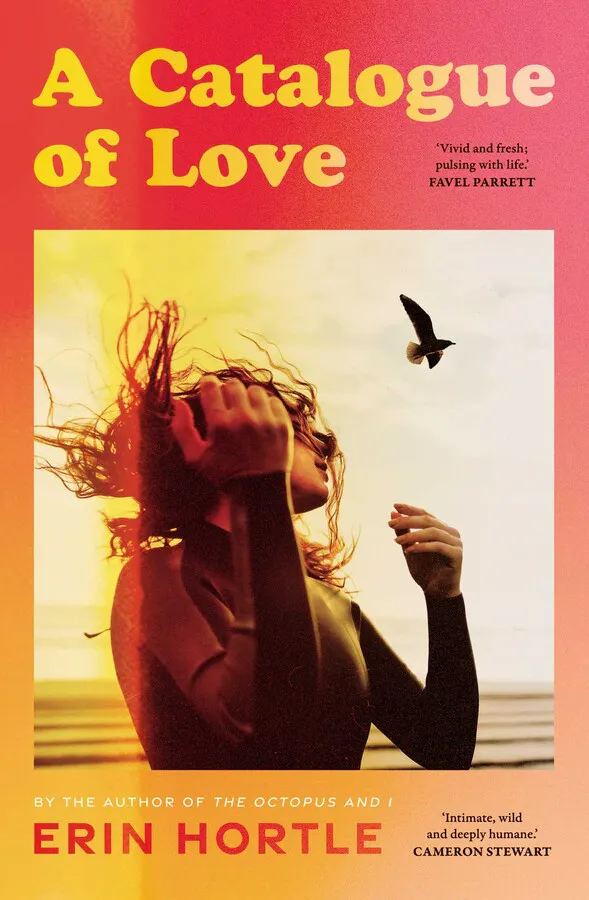
Surf culture, and surf writing, has always been something of a sausage-fest. Reading A Catalogue of Love as a fellow surfer and writer, Melissa Fagan finds much to appreciate about Erin Hortle’s literary effort to reclaim the waves.
Erin Hortle’s latest novel, A Catalogue of Love, opens with an instantly recognisable moment of female solidarity. Neika and her best friend Meg are in Melbourne, walking home together after ‘seeing some band at some pub’. They are twenty-one years old, Neika tells us, drunk and ‘maybe high’. They see a man walking towards them and they each reach for the other’s hand simultaneously, so that their fingers crash together. They giggle, ‘so quietly’, as the man passes, whispering to each other that they are glad the other is here. They are on edge, ‘because that’s how things are when you leave the safety of a late-night crowd and scurry down the dark streets of Melbourne, back to your burrow’.
This takes place before #MeToo, Neika tells us, ‘which just goes to show that women have been me too-ing in private forever’. Back at their share house, Meg opens up Deborah Levy’s Hot Milk and reads a verse from William Hughes Mearns’ poem ‘Antigonish’, where the speaker is haunted by a man on the stair ‘who wasn’t there’, and wishes for him to stay away. The young women busy themselves making toasties – a shared post-night-out ritual. They talk nonsense with each other, the way good friends do, especially after drinking and maybe getting high, but then the conversation turns reflective. Neika asks Meg, ‘[H]ave you ever been, like assaulted?’ Meg shrugs. ‘Not assaulted. Just, like, the usual.’ When Meg asks the same question in return, Neika says, ‘Oh you know, just the usual, too’.
These scenes are a prologue, self-contained and set apart from the rest of the book, which is divided into two parts, both narrated by twenty-eight-year-old Neika. Part One covers Neika’s childhood on Bruny Island from the age of five through to seventeen. Part Two unfolds in the recent past, over a couple of months; after ten years in Melbourne, Neika has come back to Tasmania to take up a postdoctoral position at the Institute of Marine and Antarctic Sciences (IMAS). A relationship has recently ended, and another, with her colleague, Nathanial, is in its fledgling stage, unfolding awkwardly and uncertainly, with bursts of embodied sensuality, while they collect data on short-tailed shearwater chicks and their burrows on Bruny.
As the book’s title suggests, A Catalogue of Love is about love in its many incarnations: parental, filial, queer, straight, human, non-human. Neika’s father is bisexual: her mother died when she was two, and a few years later her father fell in love with Sean, a kind neighbour who offers to mind Neika and her brother while her father takes time out to surf. Neika feels at home on Bruny; ‘understanding the weather and surf and, through this, Bruny’s place in the Southern Ocean was written into the fabric of me’. But when she discovers, at school, that Bruny is named after a Frenchman ‘who spent a mere month in the region’, she struggles to make sense of her ‘love for a stolen land’. Her childhood love of shearwaters, watching them ‘swarming and circling in thick flocks, wings held wide as they coasted on pocket of briny air, skimming the surface, veering up into the sky, spiralling slowly back down’, leads her to study marine science. She loves surfing but, as a teenager, is troubled by how dependent on it she feels, living ‘for the rush of air when I raced down the lines, for the spit of spray from the mouth of the barrel, for the times when I forced my body to go limp as the water tossed me about like I was nothing’. For her, as a motherless girl, the memory of her first period is inflected with catharsis that is ‘threaded through with embarrassment, loss and grief and the type of love that makes your throat ache’.
Like Lucy, Hortle’s protagonist in her first book, The Octopus and I, Neika can be droll, quirky and confident, insightful and kind, alarmingly honest – with herself and the reader – and unafraid to describe the female body in all its visceral glory. We are, at all times, privy to Neika’s internal monologue: her vacillations, her digressions, her anxious ruminations. As a result, I sometimes felt confused and unsettled while reading A Catalogue of Love. A catalogue is a system; it implies a certain order. Neika’s narration resists order. For instance, in terms of the overarching narrative, the opening scenes at first seem out of place, leading to nowhere: we don’t encounter twenty-one-year-old Neika again till much later, and then only in passing. So we are left wondering, or at least I was, for close to half the book, how scenes that depict what Evelyn Araluen called the ‘cartography of violence that girls map between each other’ fit in Neika’s catalogue.
In Uses of Literature (2008), feminist literary theorist Rita Felski warns that treating literature as ‘fundamentally different from the world and our other ways of making sense of the world’ comes at a cost. If in our reading we focus on the ways in which literature is separate from, rather than connected to, our lives, we may struggle ‘to explain how works of art arise from and move back into the social world’. A Catalogue of Love is a work that both rises from and moves back into the world, and my reading is very much informed by this. In interviews, Hortle has said the novel took six years to complete; what spurred her on in the end was an injury, a broken ankle, which rendered her incapable of working in paid employment and caring for her two young children. The injury gave her the time she needed to write, and so she wrote a book that poured out of her.
The first draft was composed as a letter written to an Australasian gannet. The gannet was based on Nigel, a real bird, who spent the last five years of his life alone on an island attempting to mate with a concrete replica, one of eighty erected by a group of scientists who hoped to start a new breeding colony. This poignant and experimental premise is reminiscent of The Octopus and I, which draws on a polyphony of human and more-than-human voices to explore the way relationality shapes us and embeds us within this complex and contradictory world we live in. Hortle abandoned the epistolary frame at the 50,000 word mark. Talking with Hannah Anderson and Nick Carroll on the We Shouldn’t Be Friends podcast, Hortle said that Nigel ‘became a rhetorical device’, which didn’t feel right. She didn’t want him to be a metaphor because ‘he is his own bird’.
Hortle has also said that A Catalogue of Love could be read as an attempt ‘to write beyond the masculine tropes that have dirtied or diminished or just plain misrepresented that thing that I love so much’. I have a long and complicated relationship with surfing and surf culture, which holds a central – or slightly off-centre – position within the Australian imagination, as well as my own. My twenty-first birthday party had a Puberty Blues theme and my first published story, ‘I hope I never’, was set in and around the surf beaches of Manly, Sydney (the title comes from a Split Enz song featured in the Puberty Blues film soundtrack). I surf now but did not surf when I was younger, despite wanting to, and despite having boyfriends who surfed; I fulfilled the wish by writing about it instead – or attempting to. That short story was an excerpt from a novel that remains unpublished.
For all these reasons, I am deeply invested in reading and critiquing A Catalogue of Love on its own multitudinous terms: as a book about the way girls and women intuitively look over their shoulder when walking home at night, especially after a few drinks; as a book about love and seabirds and surfing (and a woman who surfs!); and as a much-needed, long-awaited feminist intervention into surf writing.
‘I was twelve the first time it happened, the first time I flew through the ocean and burst through the sky.’ This is Neika, describing her first wave.
Not long after, under Sean’s tutelage, Neika learns to surf a wave that is barrelling, or tubing. Getting barrelled, or tubed, or pitted, or riding in the green room, is the surfer’s holy grail. The best surfers make it look easy, but it’s anything but. First of all, you need a perfect wave, a Goldilocks wave, that breaks fast and clean, forming a hollow tube that holds up long enough for a surfer to ride inside it. Surfing a barrel is counterintuitive. After a perfectly timed take-off, you have to slow down and wait. But if you wait too long you risk the wave closing out on your head.
Neika sees Sean as her mentor, and wants to be a shredder like him, the kind of surfer who attacks the wave as they ride it, ‘hack, slash, hack, slash’, the surfboard’s fins tearing the face ‘into shreds of spray’. She loves nothing more than racing down the line. But she fights the urge to shred, stalls, and holds her hand into the face of the wave. When the lip begins to curl she pulls her hand away, holding her board ‘against the upward whoosh of the sucking water and away from the crashing wall at my back, angling it towards the mouth of the tube’. She is spat out ‘in a rush of spray’, flicking off the wave in shock. She shouts to Sean, ‘I did it! I did it! I did it!’
In a 2008 essay, ‘In the Giant Green Cathedral’, Malcolm Knox suggests the experience of surfing ‘is too mercurial for memory, too slippery for words’, which ‘has left a literature of surfing that is a literature of experimentation and approximation, and ultimately differing degrees of failure’. Knox suggests, ‘If a reader wants to know what surfing feels like, isn’t the best thing to go and learn to surf?’ Well, yeah, sure, if they have the inclination and are able to. But if we’re talking about a literature of surfing, as Knox is, the argument is kind of redundant. For the non-surfer reading about the act of surfing, or a writer trying to use the tools at their disposal – words – to describe the act of surfing, the process is also mechanical. The details need to be specific and clear or a reader who doesn’t surf will be adrift, unable to locate themselves, to picture what is happening.
A reader who does surf also wants to know what surfing feels like within the frame of the reading experience. I’ve never been barrelled – not properly. What stayed with me after reading the passage of Neika’s first barrel was her jubilation, her feeling that she was becoming a surfer. ‘My new self was taking shape.’
Erin Hortle, like Neika, is a surfer. She grew up surfing the icy waters off the Tasmanian coast, and has lived and surfed on Bruny Island, where A Catalogue of Love is set. Hortle has an intimate and embodied understanding of surfing, surf culture, and the environments in which it takes place. In an interview with Lucie Cutting for ABC Hobart she says that A Catalogue of Love brings together her two great loves: writing and surfing. Growing up, she wasn’t sure she could combine them; she thought that ‘the feeling you got from surfing was beyond anything you could describe’. Then Hortle read Tim Winton’s Breath (2008) in her final year of high school. Winton had ‘written the poetry of the ocean in a way that I feel’, showing her it was possible.
Like Hortle, I loved Breath the first time I read it. I wasn’t yet a surfer, but I had a lifelong fascination with surfing, and the ocean; I was seduced, as James Bradley was – to quote his review for The Age when the novel first came out – by the ‘descriptions of the ocean and the littoral [which] break free of the page, revealing this landscape with a clarity and an intimacy that lets us see it anew’. I remember thinking Winton had pulled off the equivalent of a literary heist. On the surface, Breath is a straightforward story: the tale of Pikelet and Loonie, two young boys initiated into surfing and manhood by an older surfer, Sando. The book is also, at its core, a complete fucking downer. Winton tricked the broader populace into buying and reading and adoring it despite this. The critical acclaim was near universal. Inevitably, Breath was awarded the 2009 Miles Franklin from an all-male shortlist, or ‘sausage-fest’, as Angela Meyer called it.
Led by Dr Rebecca Olive, the AustLit project Waves of Fiction catalogues the subject of surfing in Australian literature. Olive acknowledges that Winton’s books – namely Breath and the Lockie Leonard young adult series (1990-1997) – and Kathy Lette’s and Gabrielle Carey’s Puberty Blues (1979) are the best-known works of fiction associated with surfing. But the data set reveals a longer and more diverse history of genres, forms, characters, and authors – to date more than 700 works have been identified. Notable entries include a number of works written by women, including the young adult novel, The Upwelling (2022), by First Nations author Lystra Rose, which won a suite of awards, including the 2023 NSW Premier’s Ethel Turner Prize for Young People’s Literature. Judith Wright’s poem ‘The Surfer’ (1945) is there, as are Fiona Capp’s novel and memoir, respectively, Night Surfing (1996) and That Oceanic Feeling (2003). It is worth noting that both of Capp’s works are now out of print.
Internationally, ‘best of’ lists of ‘surf lit’ are still dominated by male authors, as might be expected from surf magazines, but less so from places like Literary Hub – a reflection of the fact that surf culture remains deeply patriarchal. William Finnegan’s bestselling, Pulitzer Prize-winning Barbarian Days: A surfing life (2015) regularly tops the lists. As well as being a surfer, Finnegan has been a staff writer for The New Yorker since 1987; he knows his way around words. Amid the ghost-written biographies of former world champions, or tales of spiritual awakening, as a work of literary nonfiction, Barbarian Days is a stand-out: meditative, immersive, lyrical. But Finnegan’s women are daughters, wives, or sex objects – even if they surf (and usually they don’t). The story – Finnegan’s story – is premised on the unquestioned acceptance that a surfer is a he.
Hortle has acknowledged that the same is true of Winton’s fiction; for Winton, and his male characters, surfing is always coded as masculine. She has also written about how surfing, and surf culture, is generally a ‘sausage-fest’, with its localism, its initiation rites, its adrenaline- and testosterone-fuelled big-wave preoccupation. She explores this in her essay ‘How Do You Make Them Let You Belong?’, which won the 2018 University of Tasmania / Island Nonfiction Prize. In the essay, Hortle reflects on an interaction with a man, a stranger, while surfing a remote Tasmanian break with her partner. She tells the stranger that she has seen a dark shape. It’s an act of courtesy, of care. The man responds: ‘You see, this is why I don’t bring my girlfriend surfing. She’s always getting paranoid about sharks and shit too.’ Hortle is angry but tells herself to let her surfing speak for her. The man ends up going in, while Hortle keeps surfing, ‘channelling my irritation into the waves, hacking at them and hacking at them, until the whole petty encounter faded into my catalogue of memories’.
In A Catalogue of Love, teenage Neika also tries to let her surfing speak for her. It does, at least for a while, and she eventually gains a reputation as a shredder. She also questions why she is pushing herself so much, wonders what she is trying to prove. On a winter’s day ‘that stands out in my memory, among the blur of surfs that are the fabric of my life’, Neika is out in the surf with Sean. A man is paddling for a wave on her inside but he isn’t going to make it. Neika has priority. She is in perfect position but pulls back at the last minute. Sean asks her why and she tells him she was too deep but it wasn’t that: ‘I just suddenly and bodily hadn’t wanted to catch it’.
Neika can feel the all-male eyes of the other surfers assessing her, imagines them thinking ‘that girl can’t surf, that girl’s not up to this, she’s out of her depth’. So on the next wave she fights back the feeling and takes it. Another surfer, ‘a townie’, drops in on her and she has to straighten out, and as a result gets caught in the impact zone. Encouraged by one of the other locals, Neika paddles over to the man and says, ‘What the fuck?’ He replies, ‘Oh, were you going to make that? I didn’t think you were.’ (I’ve lost count of how many times a man in the surf has said this to me.) He tells her she can have the next one – even though she has priority over him anyway. She slices deep lines in the face, ‘rage surfing’. And then it is over, ‘and I hadn’t really enjoyed it at all’.
In Winton’s Breath, under Sando’s menacing tutelage, Pikelet and Loonie surf progressively bigger and riskier waves: Barneys, Old Smoky, Nautilus. In this way, as Malcolm Knox points out, Breath adheres to an archetypal surf narrative that tends towards the epic: ‘New, frightening challenges rear up. Once conquered, they unveil a newer, scarier challenge.’ In A Catalogue of Love, at the close of Part One, Hortle invokes this archetype, then abruptly turns it on its head, when Neika, now seventeen, attempts to surf Shippies, Shipstern Bluff – a wild, dangerous, heavy wave on the Tasman Peninsula.
These are some of the book’s most powerful passages. To access the wave, Neika must jump off a rock into a surging wall of water. For ages she stands at the edge, board under her arm, counting herself in over and over, then baulking. Finally in the water, she regrets it instantly, paddling towards the horizon, way beyond where the waves are breaking, into ‘no man’s land’. Glancing back, she sees ‘how the water churned and ran and cut up in swathes of current, sucking, pressing, pulling, swirling in the first wave’s wake’. The water is ‘speaking an unknown language’, which terrifies her more than the weight of the swell.
Neika gets talking with some other surfers, who ask her if she’s ‘that Bruny chick’. She acknowledges the way her identity has formed through the double helix of self and other: ‘I had been recognised as a surfer; I was a surfer out here; they knew I could surf. I would surf.’ But when she’s called into a wave, she takes it a moment too late, ‘so my fins didn’t grab the water. I hung in a moment of freefall, suspended between the sheer grin face of the war and the rugged grey face of the ship’s stern. Beneath me, water boiled over reef and above me was the blue of the sky.’ She wipes out, is held down, completely disoriented until she sees the glow of the surface and claws her way towards it. She doesn’t try again. ‘I paddled in towards the shore. I slunk in. Tripped and washed through the turbulent white water to the rocks, banging my knees, my board, my everything as I went’.
Neika’s ‘newer, scarier challenge’ comes not in the form of a monster set wave but a high school party she goes to that night. At the party she drinks ‘a lot of goon in a short space of time’ and tells people she paddled out at Shippies, ‘like I was cool for doing it, like I might do it again someday, or not, who cares’. Tom Mathers, whom she has ‘never really looked at twice in that way’, tells her she’s a tease and pulls her onto his lap, where ‘his hands start roaming’. She’s never been touched this way, so out of curiosity as much as anything, she goes along with it. Later, they stumble back to her house, to her room, just down the road. She wakes up the next day alone in her bed. There’s a lot of blood and she’s embarrassed that she may have perioded on him but also wonders whether he saw the blood and left, ‘As if a period is some kind of rape repellent. But maybe it wasn’t even rape, right? Because maybe I went along with it or maybe nothing happened at all.’
‘Just the usual’.
By this point, Neika’s father has landed his dream job with the Australian Antarctic Division and is spending more and more time in the place where ‘the way the wind carved sculptures from the snow [made] his soul soar and his heart thrum’. Her brother is in Melbourne at university. Later, in Part Two, we learn she couldn’t bring herself to talk about the incident with Sean, telling him whenever he would ask, ‘I’m fine. I’m fine’. We find out she had planned to study medicine at the University of Tasmania, then go back to Bruny as a GP, but she bombed her final high school exams. Instead ‘I would eat roast beef in a strange city miles from the surf and a whole body of water way from Tom Mathers’.
Neika continues to think back on that day as ‘The Day Probably Nothing Happened’, which she admits is strange, given it was such a turning point.
I reread Breath while writing this essay. Winton’s storytelling prowess remains impressive; as Holly Isemonger observes, ‘there is enough grit in the sentimentality and force in the narratives to make Winton’s tales feel real, raw and true’, at least for some people (‘they are likely a white guy, and often they are your dad’). This time, I became increasingly angry at Winton not only for making Breath a book about men doing something ‘pointless and elegant, as though nobody saw or cared’, but also about a fifteen-year-old boy who becomes a damaged man after he is groomed by a twenty-five-year-old woman. Eva, Sando’s girlfriend, is a former champion freestyle skier who now engages in erotic asphyxiation to recreate the death-defying thrill of her former life. With Sando away on a surf trip with Pikelet’s mate Loonie, Eva co-opts Pikelet into the practice. I was aware of this storyline the first time, but, like most readers, critics, and literary judges, was able to set it aside. I remembered the Eva storyline more from the film than my first reading of the book: the bed that’s cordoned off behind a translucent curtain, the thump thump thump of those perfectly-timed opening bars of Fleetwood Mac’s The Chain.
Pikelet is drawn to Eva in the same way and for the same reasons he is drawn to surf bigger and bigger waves: to combat the fear that he is, or might be considered to be, ordinary. The fear dominates Pikelet’s thinking, and his narration. In one of their early sessions together, Sando tests Loonie’s bravado, ‘You’ll be out there, thinkin: am I gonna die? Am I fit enough for this? Do I know what I’m doin? Am I solid? Or am I just… ordinary?’ Pikelet internalises the taunt, and in the school library he feeds himself on ‘lives that were not at all ordinary, about men who in normal domestic circumstances might be viewed as strange, reckless, unbalanced’.
‘What we did and what we were after, we told ourselves, was the extraordinary’, Pikelet tells us, and ‘extraordinary’ is how Eva is cast. She’s an elite athlete – or was – and as an American, is ‘driven by ambition in a way that no Australian could possibly understand’. Pikelet is drawn to her ‘warrior spirit […] her implacable need to win’. For Colleen McGloin, ‘Breath’s narrative positions readers to comply with a very specific view of Eva so that when her sexual deviance is introduced into the narrative, representations of her concur with narrative expectations already set in place’. This makes Eva’s behaviour seem plausible within the narrative world of Breath, but more broadly? In over ninety per cent of all sexual abuse cases, the perpetrators are male. Girls are two to three times as likely to experience sexual abuse, and women are much more likely to experience sexual assault. For girls and women, there is the everpresent threat of ‘the usual’ too, those everyday – yes, ordinary – experiences of sexual predation: the unwanted physical advances from a so-called friend, or the unquestioned entitlement of a man who sees you’ve drunk too much and seizes an opportunity, never asking, or thinking to ask, for consent. The feeling you’ve been violated without knowing exactly how, of wanting to remember, but also wanting to forget, the multitude of ways in which your wings have been clipped.
Through rereading Breath I came to see that the story of Pikelet and Eva is, as Nicolle Flint writes, ‘an unnecessary addition to, and distraction from, what is surely one of the greatest surfing novels ever written’. Both literally and figuratively, Breath is about life and death, the thin line between the two. Winton services this theme with multiple devices, at various points in the narrative: the adult Pikelet is a paramedic; his father had sleep apnoea; in an early scene, when Pikelet and Loonie meet, they spend the afternoon diving into the river, ‘kicking down time and again to the opaque depths of the Sawyer River to hold our breaths so long that our heads were full of stars’; and so on. Eva is an unnecessary addition, a tool that hammers home a central metaphor that was already firmly nailed. Reduced to a rhetorical device, she is not, and never allowed to be, her own bird.
Towards the end of A Catalogue of Love, Neika attempts to describe to her best friend Meg her view of herself but can’t quite articulate it: ‘I suspected she couldn’t see me the way I could, body curled into the foetal position and dusted liberally with yellow pollen, a million petals fanned around me: all those moments from that year – the things that never happened – were petals clustered together’. She reveals that she’s never told Meg about The Day Probably Nothing Happened. It seems implausible, given their intimacy, but also it is not. For women, stories of sexual abuse and assault are so common, they are barely worth telling. Neika herself ‘still wasn’t sure why I’d remained silent. I just… had. Perhaps it would have felt too much like a confession, and even after all these years I still wasn’t sure what I was confessing to. Maybe that was it.’ Unlike Breath’s adult Pikelet, whose damage spirals outwards, impacting his partners, friends and workmates, Neika internalises her trauma. It manifests as a haunting, a constant worry that she will one day run into Tom Mathers, ‘the man who wasn’t there’.
Neika’s recovery from ‘the usual’ has a long tail, which is threaded through the fabric of her life, at times visible, at other times hidden. Its constancy takes oxygen and energy away from the other narrative threads, all the loves, especially Neika’s love of the shearwaters and Bruny, as well as the very real threat (as opposed to a ghostly one of running into Tom) of climate change. It is hard to get past rape, past the scars we bore for years without ever realising they were there, or the lives we didn’t live because we didn’t know to expect any different. Perhaps, as Hortle wrote in her essay for Island, our belonging remains emergent, contingent, still-becoming. Perhaps her aspiration to write about joy, about an ocean of her own, has been undone by the realities of female existence. In this way, A Catalogue of Love makes sense of a feeling I have had for years but have struggled to acknowledge, let alone articulate: that of wanting to write about surfing on my own terms, on the ocean’s terms, but being dragged down, and held under, by surf culture’s misogynistic past. I keep having to write my way through it, again, before I can come up for air.
Through Neika, A Catalogue of Love is reaching for a new kind of surf narrative, one that is a hot mess of ideas and loves and themes and narrative time: a bag of mixed lollies (with too many liquorice all-sorts), or an upended washing basket of clean and dirty clothes. The messiness of Neika’s narration, as frustrating and hard to follow as it is at times, is consistent with her character, with the multiple traumas she has experienced in her twenty-eight years. Hortle gives Neika the space and time to become her own bird; in doing so A Catalogue of Love inverts the epic, masculine tropes of Breath, responding to Holly Isemonger’s lament that, despite being a high school ‘surf rat’ like Winton’s Lockie Leonard, she couldn’t see herself in the stories: ‘I’m not a girlfriend or a whore or a Madonna. I’m a mess and I surf and sometimes it’s hard (made harder by the fact I’m a woman).’
In the closing scenes of Breath, we see a middle-aged Pikelet sliding ‘down the long green walls into the bay to feel what [he] started out with, what [he] lost so quickly and for so long: the sweet momentum, the turning force underfoot, and those brief, rare moments of grace.’ It’s nostalgic, bittersweet: his best days are behind him. At the end of A Catalogue of Love, Neika is not yet thirty. She’s come home to Bruny. She’s passionate about her work, and is exploring a new relationship. The ghost of Tom Mathers has been vanquished. She still overthinks and vacillates, but is attempting to be guided by her body, her desire. For Neika, now, surfing is no longer just about shredding. It is more than a rare moment of grace. In one of the final scenes she paddles out into the surf with Sean ‘side by side’. We don’t see her catching a wave; it’s not about that. It’s about the ritual, the communality of a shared experience, the cool water, the damp sea air, the taste of salt on her lips, the ‘fluttering belts of bull kelp’ that brush against her feet as she duck-dives under a wave.
A Catalogue of Love, Neika’s ‘kinda-sorta memoir’, makes most sense when understood as an act of literary mimesis, a story still reaching for its final form. Through her uncertainty and imperfection, her state of still becoming, Neika points us towards an alternative future, one where it is possible to reemerge from a hold-down or ‘the usual’, recover our breath, and refocus our attention on what we love.