
[Perec] had a solution to Sylvie and Jerôme’s dissatisfaction and unhappiness – and that solution was Marxism. Perec had […] a theoretical standpoint and a worldview from which to criticise their form of life. I don’t. You know, my form of life is essentially that of Anna and Tom’s. I try to be a little more aware, a little bit more politically active, but ultimately, I have nowhere to judge them from.
A Sentimental Thingification
Jack Jeweller on Vincenzo Latronico
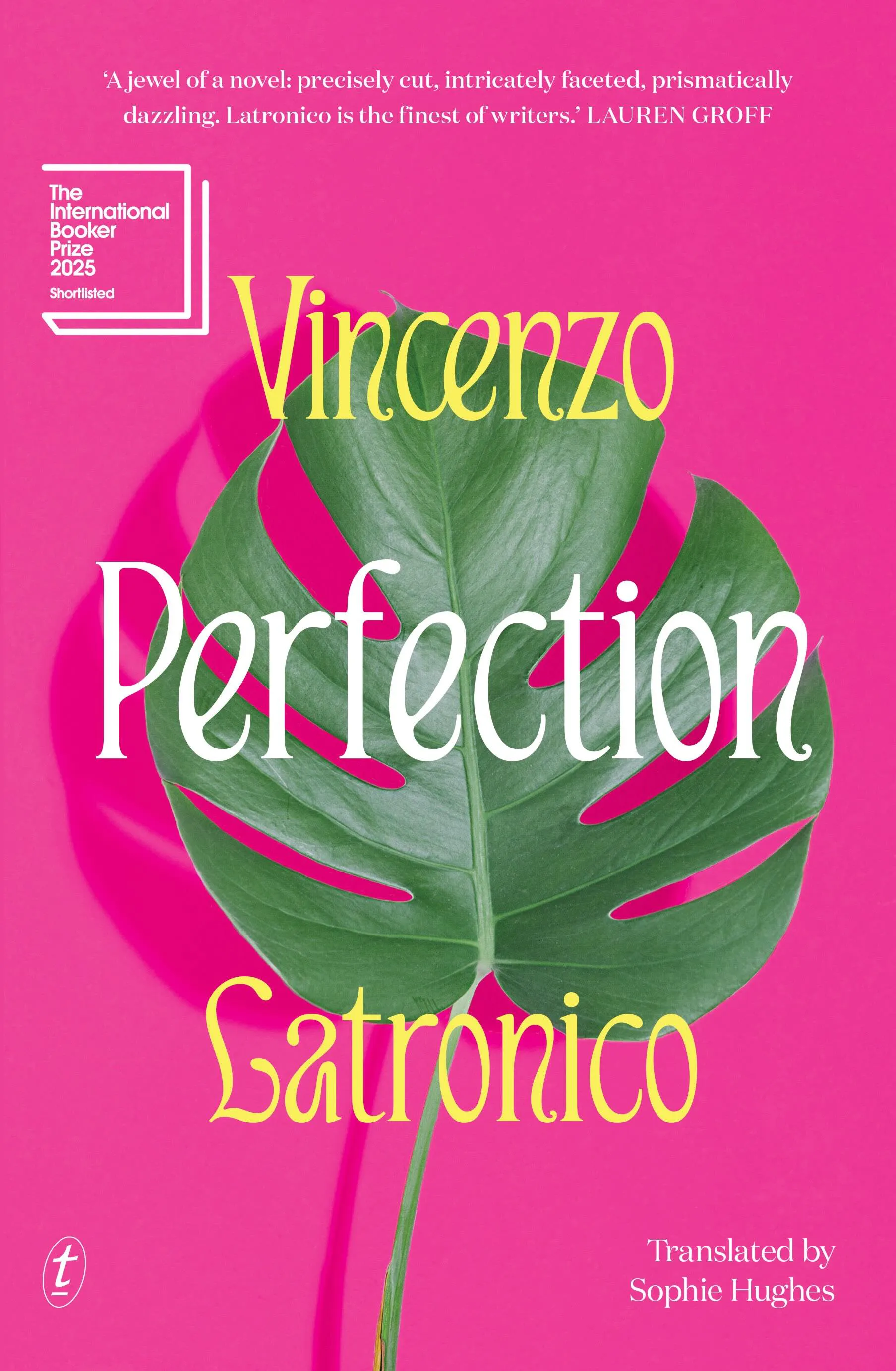
If literary merit is tied to originality, how do we judge a work that explicitly sets out to rewrite another? Reviewing Vincenzo Latronico’s novel Perfection, Jack Jeweller draws out its intertextual resonances with the work of Perec and Barthes.
Vincenzo Latronico’s novel Le perfezioni – translated from Italian by Sophie Hughes under the singular Perfection – was conceived, or perhaps a better term is aborted, during a Covid lockdown. After a number of failed attempts at writing a novel that captured the way the image-economy shapes our inner lives, Latronico set himself the task of rewriting Georges Perec’s first novel, Les Choses: Une histoire des années soixante (Things: A Story of the Sixties). In Things, Perec tells the story of Sylvie and Jérôme, a Parisian couple who are torn between a desire for higher standards of living and a realisation of the inauthenticity of their desired life. Perec’s biographer David Bellos noted that the alienating atmosphere of Things, saturated with guilt and melancholy, risked plunging Perec back into depression, a condition he had struggled with in his early twenties (during his depression, Perec himself had also abandoned a novel: Le Fou, a pastiche of Joyce he later filed as a ‘panic text’). In an interview with The New York Times, Latronico confessed to a similar struggle when rewriting the Perec, and to being pessimistic about the new work’s prospects. He recalls emailing his agent: ‘I’m sorry, this book is unpublishable. It has no dialogue. It has no plot. It’s a copy of another book’.
Latronico credits Perec in the acknowledgements of Perfection – ‘anything good in it owes a lot to him’. At the level of style, this is no false flag: the persistent use of ‘they’ to refer to novel’s protagonists Anna and Tom; the absence of dialogue (and any real plot for that matter); the modified quotations from Things; and the cyclical narrative movement – all mirror Perec’s prize-winning novel, only updated for the age of digital capitalism. Even the will-to-imitate is a debt to Perec: in an article titled ‘Emprunts á Flaubert’ (‘Borrowings from Flaubert’), Perec himself admitted that Things ‘was probably a matter of wanting to be Flaubert’, a desire confirmed by more than a dozen lifts from L'Education sentimentale. Chris Andrews notes that ‘Perec laid claim to intertextuality as a motor, and conceptualised original composition as emergence from a gap in a field of the already written’. Within this poststructuralist framework, a text’s meaning emerges through its relation to other texts via acts of reading, rather than deriving from an autonomous author as source. As such, writers are first readers of the cultural and literary texts out of which their own works are created.
Like Perec, Latronico uses not one source text but something resembling an interpretive grid. Perfection emerges from the space between four explicitly referenced texts, including Hans Magnus Enzensberger’s On the Inevitability of the Middle Class, Minae Mizumura’s The Fall of Language in the Age of English and Wilful Disregard by Lena Andersson. One square on the intertextual grid not announced by Latronico in any interviews or afterwords is Roland Barthes’ Mythologies. For Barthes, ‘the very principle of myth’ is that ‘it transforms history into nature’, contingency into necessity. In Perfection this ideological mode of signification is suggested in the description of Berlin as cultural capital of the Western world, where creatives like Anna and Tom move, as a matter of course, to reinvent themselves, a trend the narrator describes as having ‘the appearance of mythology’. To gloss this in Barthes’ terms, Berlin’s historically contingent configuration of post-Cold War urban development, migration, and gentrification is accepted by Anna and Tom as self-evident reality, or as the narrator puts it, ‘a community bound by a shared reality, or quasi-reality’. As a result, Berlin is ‘naturalised’ as a signifier of creativity, the obvious destination for ambitious creatives. Latronico uses irony to reveal this process of naturalisation while simultaneously showing Anna and Tom participating in the very forms of consumption and gentrification that sustain the myth.
Despite the overwhelming reception – and marketing – of Perfection as a sociological novel, Latronico has insisted that Perfection differs from Things in lacking a totalising critique of society:
Despite his claim to have no theoretical standpoint from which to judge Anna and Tom in Perfection, Marxism does seem to provide Latronico with some of the critical leverage he would seem to disavow. In the very same interview, for instance, he goes on to deploy the Marxist distinction between ‘use’ and ‘exchange value’ when criticising Anna and Tom’s attitudes toward sex (‘Instead of following the use value of sex – pleasure, desire – they start to place sex under the grid of the value exchange. How does it reflect on my self-image, the fact that I do or don’t do certain things?’).
Perec’s commitment to leftist politics is a matter of record. As his biographer David Bellos points out, Perec – whose mother was killed in the Holocaust – had such a thoroughgoing interest in Marxism that he even ‘put his Jewishness in the category of purely contingent facts’, instead choosing to understand the world through the antagonism between labour and capital, and the struggle against imperialist projects, a detail that explains his rejection of Zionism. However, like Latronico, Perec could also be coy about the theoretical ambitions of his fiction. In an interview published in Le Soir months before he died, Perec insisted that rather than foregrounding sociological or moral concerns, Things emphasised instead a ludic, citational, and rhetorical approach to writing. Perec’s Marxism didn’t simply provide him with a position from which to judge and indict consumer culture, or see Sylvie and Jérôme simply as fools (it is well known, for instance, that Perec wrote with a stack of Madame L’Express, a French women’s magazine, beside him). As Bellos has observed, while Perec was bothered by the fragmentation and discontinuity of life under capitalism, he failed to bring it to a satisfying narrative conclusion in Things, instead resolving only to show that fantasies of acquisitiveness are doomed to founder on the shoals of their own contradictions.
Coyness aside, where both Perec’s and Latronico’s novels do distinguish themselves from sociological critique is in their avoidance of the temptation to categorise or philosophise. Instead of offering an external, transcendent critique of the everyday, exemplified by the more abstract theorisations of le quotidien in Henri Lefebvre’s Critique of Everyday Life, they plunge the reader into the diurnal rhythms of their protagonist-couples, cataloguing advertisements, news stories, social media stories, political statements, commodities, and lifestyles. This desire to show things as they are, without the disclosure of any deeper reality, returns the reader back to Perec’s model, Flaubert, and the French realist and naturalist traditions, which sought to break with the illusory veil of conventional modes of representation and show things in their banality and meaninglessness.
Where Perec goes (with Flaubert), Latronico follows: in Perfection readers are presented with a one-dimensional cast of two. Anna and Tom are outlines without any psychological depth, surnames, or personal histories. In fact, Tom’s name suggests everyone’s first friend on Myspace, marking the beginning of the social media epoch for most millennials, whilst ‘Anna’ calls to mind ‘anonymous’. Except for a brief disagreement near the end of the novel where they fight about their decision to move to Sicily, their characters are not individuated. While they search for authenticity, their precarious existence revolves around slow cooking, chic interiors, and gallery hopping, with a number of failed tree-changes and an abortive trip to a sex club. They share this quest, with the exception of the sex club, in carefully curated social media posts, creating an illusion of happiness.
The absence of dialogue and linearity of the plot have much to do with the ‘flatness’ of the characterisation and the lack of individuation. Latronico has explained that he eschews dialogue, which is ‘essentially a device for revelation’, because ‘it encourages you to see differences instead of commonalities’. Much of the narrative exposition is thus left to the narrator. Whilst the narrator in Perfection does not have privileged access to Anna and Tom’s minds, he gives a stenographical record of the status symbols that they collect and display on social media: ‘Their families didn’t get it, but their friends did, and they expressed their approval through likes of their pictures of the canal, the abandoned airport and the honey-coloured floorboards’. Theirs is a lifestyle that is intended as a mark of distinction, an emblem of individualism, but that instead becomes symptomatic of a creeping homogeneity.
The narrator’s judgement of the banality of Anna and Tom’s aspirations is foregrounded when they move to Berlin: ‘Of course, just as the visual points of difference they sold to their clients were also sold to thousands of others by creative professionals all over the western world, an identical struggle for a different life motivated an entire sector of their generation.’ Perec’s acute vision of the dangers of acquisitiveness in Things, and its scathing account of how taste is inculcated in the middle class through advertising, is equalled by Latronico’s lucid description of how social media creates new desires:
[It] unlocked a whole world of differences they hadn’t even known existed. Dark, bluish-green kale and shiny emerald avocadoes would leap out against white enamel plates with a blue trim or light grey handmade ceramic bowls garnished with pomegranate seeds and flecks of balsamic glaze.
But the novel’s most trenchant critique of individualism comes when it is connected with the question of history, as the narrator describes how the post-war era translated the greatest catastrophe of the twentieth century into the language of individualism: ‘freedom had turned into abundance’.
As luck would have it, abundance is forever just out of Anna and Tom’s reach, a feeling that is captured in a plaintive tone when the narrator recalls the Berlin property boom in the nineties which they missed out on. This section digresses into a historical account of gentrification, and how the real estate listings in suburbs where Allied bombings occurred are denoted by the prefixes Alt and Neu:
Of course, it was history that hollowed out that space. Anna and Tom understood this, or at least they would have if they had ever thought it through. They could make vague connections between place names and crucial events from the previous century, and naturally they were aware of the Wall and the broken glass, but really their awareness didn’t exceed a few anecdotes rattled off to make it look like their life had more substance.
History is presented as an active force in this description, and the narrator interrogates Anna and Tom’s lack of historical awareness as a politically fraught subject. The history of Berlin is reduced to a kind of museum knowledge, whereby the Wall becomes a symbol of the Cold War, and the broken glass, Nazism. Anna and Tom don’t understand Berlin as a complex set of historical processes, including Weimar politics, fascism, post-war reconstruction, neoliberal urbanisation; instead, in the distortion of reality Barthes diagnosed as ‘myth’, ‘Berlin’ is a self-evident signifier. The narrator’s ironic tone points to this phenomenon, opening a space for Latronico’s judgement. The author’s own well-documented activism against gentrification in Italy, and the demoralising loss to developers which led him to seek out a less politically engaged life in Berlin, provides some context for the novel’s condemnations of Anna and Tom’s complacent relation to real estate, their opinions (‘squats had a quaint but ultimately outdated appeal’) couched in the language of advertising copy.
Anna and Tom’s biggest problem is that they can’t imagine a different future. History has lost the quality of becoming; it no longer unfolds dialectically, moving from one state to another through a series of antagonisms between colonial powers and resistance movements, capital and labour. This is partially because they belong to the middle class, a class constantly struggling with its own superfluousness; as Enzenberger puts it: ‘they are neither the ruling nor exploited class, but the class in between, the class left over, the floating remainder’. But it is also because history has been shattered and dispersed into the one-dimensional realm of their social media feed, where the political has retreated back into the personal, and ideologies have been flattened out to the point that any opposition to, or refusal of, the systems of capital and empire has been co-opted by those very systems. They are living in a time where resistance has become individualised, aestheticised, and commodified, transformed into an identity marker rather than a transformative collective force.
In a conspicuous reference to Things, Anna and Tom lament the lack of political solutions that were available to Sylvie and Jérôme’s generation when confronting the crises of their own time. The narrator describes how ‘they would have liked to have been in their twenties during the summer of sixty-eight or when the Wall fell’. However, it is not the mention of the sixties alone that refers the reader back to Sylvie and Jérôme’s generation, but also the nostalgia itself. In Things the narrator describes Sylvie and Jérôme similarly pining for a time when political problems were less complex:
They would have liked to have been twenty during the Spanish Civil War or the Resistance: in fact, they talked about it a great deal; it seemed to them that the problems facing people then, the problems they imagined people facing, were clearer, even if the need to respond had turned out to be more pressing […] Their nostalgia was slightly hypocritical. The Algerian war had begun with them and was being pursued before their very eyes; they took action on occasions, but they rarely felt obliged to do so.
This section of Perec’s novel is paraphrased by Latronico who has some choice words for Anna and Tom’s inability to connect the migrant crisis with their own privileged status as migrant workers (a status Barthes might suggest is buried beneath the ubiquitous and deceptively neutral term ‘expat’):
That nostalgia was a little hypocritical. The migration crisis had hovered at the edges of the headlines for years, but they had dismissed it as a Mediterranean problem, and therefore no longer theirs. It didn't concern them in Berlin, or only in the theoretical way injustices committed far away could be said to concern them.
Such passages locate Perfection and Things alongside Flaubert’s Sentimental Education within the same intertextual network insofar as all three novels explore the same problem: the complicity of the middle class in the political problems of its day.
In Things Sylvie and Jérôme are temporarily distracted from their dreams of wealth and take a militant anti-fascist position in opposition to the Algerian War. For them, beneath the distorted images of history produced by life under consumer capitalism lies a capital H-history with a coherent social reality: ‘they decided that they detested hierarchies, and that solutions, miraculous or other, would come from elsewhere, from the world, from History’. They are swept up by struggles of the resistance, spanning the Algiers putsch to the Charonne metro massacre, as they experience the actual violence of the period. But they are forced to admit that their ‘structured set of thoughts’ are more utopian than practical and, conceding that they have little chance of practical success, they eventually abandon their militancy in an anti-fascist meeting following an assassination attempt at Issy-les-Molineaux.
In the corresponding section of Perfection where Anna and Tom become disaffected with politics, violence has been reduced to pure image – most potently in the photograph of a drowned migrant child lying face down on the beach: ‘the image had the symbolic power of history-making photographs […] To Anna and Tom it seemed destined to define their age, like Tank Man or Napalm Girl’. The infamous image renders history legible, coming to represent a broader social and political reality, moving them to action: ‘Overnight, the activism on their social media trickled down into the real city, and Anna and Tom let themselves be carried along by it’. This tear in the linear temporal fabric of their online lives briefly halts their pursuit of self-optimisation. They go on to participate in organising support for refugees before confronting the truth that, much like Sylvie and Jérôme, they have little practical value in the economy and, in another direct mirroring of Perec’s narrative, they declare their disengagement from politics in a meeting; this time it is not an anti-fascist one, but a refugee-action committee.
What follows Anna and Tom’s depoliticisation is boredom – a mood that looms behind their lives from the outset, one that develops slowly as the narrative loops through monotonous cycles of the couple’s growing disaffection. In The Fundamental Concepts of Metaphysics, Heidegger gives an account of the temporal experience of boredom – and while a Heideggerian reading of Latronico’s characterisation of Anna and Tom’s post-political boredom may seem pedantic (boring, even), it helps explain the existential predicament foreclosing their participation in an authentic life.
Fulfilled by their lives as digital creatives, they initially exist in a state that is ‘the opposite of boredom, when time seems to stand still. Which had to mean it was fun.’ But their frame of mind is soon overtaken by a new mood, one that describes twenty years of their inner lives being shaped by the internet’s ‘constellation of distractions’. In this condition the distinction between the professional and the personal disappears, and ‘on social media, just as on InDesign, time evaporated’. This state of distraction correlates with Heidegger’s first type of boredom, situational boredom, in which the person is bored by a particular thing, object, or person in their environment. Here the cause is external to the subject, and the boredom itself is characterised by a desire to escape the situation. In this state, time, scientifically measurable and discrete, is experienced as something alien, something which continues with indifference to the subject’s will; here, time is something the bored person does not have, but rather, is subject to (the example Heidegger gives is waiting for a train). At best this form of boredom may teach the person experiencing it something about patience, but it cannot reveal anything existentially meaningful. Situational boredom characterises Anna and Tom’s hours of doomscrolling, looking at ‘the apartment, kale salad or kitten of someone living two blocks or two continents away’.
After the migrant crisis Anna and Tom notice a new social stratum that can afford shinier things than they can. They are priced out of Berlin and no longer able to afford the luxury goods that gave them a mark of distinction. They resolve to travel abroad, deciding on Lisbon, but not only is the move ineffectual, it precipitates an existential crisis characterised by a new kind of boredom – ‘They had rediscovered time, but somehow it felt like time wasted. Enthusiasm eluded them, always just out of reach’ – that corresponds with Heidegger’s ‘second form, [in which] by contrast, we ultimately waste time and leave our self standing’. That is, the individual now has time but doesn’t know what to do with it – the source of boredom now comes from within, not the environment. They experience a sense of being fully absorbed in the present, a result of being disconnected from who they were in the past, which forecloses any authentic future projects of self-realisation.
Unlike situational boredom which has a specific object (food, cigars, or company), this is a sense of being bored with something we can’t identify – a boredom that we might experience, for instance, in unthinkingly observing social norms like (to use Heidegger’s example) ‘attending parties’, that is, in thinking like the herd, and not as an authentic individual. In another departure from situational boredom, this new state is less affective than cognitive – the individual thereby has an awareness that they are bored, giving it an existential dimension. Tellingly, after Anna and Tom escape Berlin, the narrator echoes this explicit recognition, ‘In Lisbon, Anna and Tom were bored.’ They find the homogeneity in Lisbon stifling: the galleries are no different to those in Berlin, adorned with the same Helvetica Neue font on the windows: ‘it was all different, which is what they had wanted; and yet it was all somehow the same’.
Their crisis reaches its nadir as they try to fill the void with novelty and relocate yet again, this time to Noto, in Sicily. Here, the sensation of driving through the Mediterranean hills at first feels like an adventure, but the fascination quickly transforms into a numbness, the landscape losing its splendour and beginning to look like any other. The romantic seaside meals and idle wandering do nothing to break the monotony; it is ‘the unhappiest [period] of their relationship’. Despite the abundance of time, they remain stuck in a perpetual present, condemned to repeat their boring lives. Desperate for a fix, they return to Berlin hoping to recover some shred of meaning.
Unlike the second kind of boredom, Heidegger’s third, and most profound, form of boredom is not incapacitating but motivating, providing the bored with an opportunity to project themselves onto their existential horizons, and thus giving them a chance to achieve authenticity. In this kind of future-oriented reckoning with time, the bored are propelled to become the authors of their own fate. Profound boredom provides the coordinates for understanding the final section of Perfection, to which Latronico gives the title of ‘Future’.
In the final section, things look grim for Anna and Tom. They are more bored with their jobs in Berlin than they have ever been, wondering how long it will be until ‘a neural network can carry out most of their work’. The existential trap they’ve fallen into is hinted at by their inability to disentangle the actual past, and their unhappy months in Sicily, from the nostalgia they feel when reflecting on it. All this changes, however, when Anna and Tom receive news of a deceased uncle. The narrator proclaims, ‘Luck – but it will not be luck exactly – will be on their side’ – a modified line from a moment in Things when Sylvie and Jérôme land twin executive roles in a firm: ‘their luck – but it will not be luck exactly – will be in’.
Despite using the same line to mark precisely the same point in his narrative when the couple’s fortunes change, Latronico titles this section of his novel ‘Future’ rather than, as Perec did, ‘Epilogue’. To understand the significance of this subtle shift in emphasis, we need to recall Sylvie and Jérôme’s fantasy about inheriting from an uncle by the name of Mr Palmgrease:
‘Dear Sir
Your uncle, Mr Palmgrease, having died intestate …’
and they would pass their hands over their faces, not believing their eyes and thinking they were still dreaming; they would open the window wide.
It is as if in calling this section in Perfection ‘Future’ Latronico were recreating a world in which Sylvie and Jérôme’s dreams become reality. In this alternate timeline, the couple’s life goals reach an apotheosis in a project in which Anna and Tom are both client and designer, their brief – to create a luxury guesthouse on their inherited estate. This looks to be their final triumph, a real escape from the boredom and the misery of monotonous work, but this too turns out to be an illusion.
Instead of becoming attuned to the demand of profound boredom to make their own meaning of the life circumstances into which they’ve been ‘thrown’, Anna and Tom are unable to distinguish themselves from the herd, failing to transform the vision of Anna’s uncle into one that is truly theirs. Whilst what they conceive departs from her uncle’s own plans of entertaining his friends on the estate in retirement, their scheme is grounded in the same kind of transactional morality they have been trapped in all along: ‘Of course, there will be no reason those friends cannot instead be paying guests.’ This failure of imagination is a failure to confront the real source of their boredom. Heidegger insists that ‘[o]nly those who can truly give themselves a burden are free’, and this is precisely what Anna and Tom are incapable of. What might have been assumed as a burden of inheritance, a demand to imagine a future free of the acquisitiveness of the middle class, becomes another superficial escape.
While in name ‘Future’ marks a linear progression from the opening chapter’s ‘Present’, in substance the final section of the novel describes a predicament just as empty as those that preceded it. Anna and Tom become exhausted from the upkeep of the guest house, too tired to even drink their Franciacorta wine. As it was for Sylvie and Jérôme, capitalism offers a false promise of happiness. Where for Perec’s couple the consummation of their desires ‘is quite simply tasteless’, for Latronico’s couple the hollowness of their existence is somewhat bleaker. Their indifference is resolved by a good review one of their guests leaves that is shared with over three hundred thousand followers: ‘It’s all completely perfect, the story will say, It’s just like in the pictures.’ Whilst Perec closes his novel with an ironic comment about how Sylvie and Jérôme’s taste is not merely an expression of their individual taste but rather, in the Marxist tradition, an expression of class relations and their complicity in the system they once opposed, Latronico’s ending shows Anna and Tom’s life continuing to be suborned by the algorithm.
In Perfection digital capitalism has perfected the technology of earlier forms of capitalism, controlling not only taste but the very behaviour of individuals, through complex data-driven technology. The deprivation of an authentic future described by Latronico is perhaps best captured by Shoshana Zuboff when she writes in The Age of Surveillance Capitalism that:
These new architectures feed on our fellow feeling to exploit and ultimately to suffocate the individually sensed inwardness that is the wellspring of personal autonomy and moral judgment, the first-person voice, the will to will, and the sense of an inalienable right to the future tense.
When taken together, the final chapter and the ending of the novel combine to suggest a grammatical tense – the future-perfect – that is indicative of the very closed existential loop in which Anna and Tom find themselves. Already past and complete, their future is effectively closed off from the possibility of change.
A more cynical critic might be tempted to accuse Latronico of merely rebooting Perec’s Things in a nostalgic pastiche of the original where history and the past have been flattened out into a simulacrum, making it an inferior copy – an image without any reference to the world as it is today. But Perfection is not only an apt update of Things, one that reflects the current form of digital capitalism as distinct from the version of consumer capitalism described by Perec, its references to Things are also well-handled, sensitively navigating the intertextual grid that both promises and defers a return to the original.
Like Perec, Latronico doesn’t work within a conventionally realist framework so much as an expanded definition of rhetoric that originates in the work of Perec’s mentor, Roland Barthes. It was Barthes who emphasised, over rhetoric’s conventional narrow conception as the art of persuasion in legal and political discourse, the descriptive enchantments of its epideictic mode. Writers like Perec and Latronico prioritise what Barthes famously called ‘reality effects’: the appeal of concrete reality, the experience of ‘being there’ in such details as light falling on a book cover, or the shade of blue cast on a face by a smartphone, over their narrative signification. Perec’s most innovative use of this rhetorical effect is found in his descriptions of consumer society borrowed from Madame L’Express:
In Paris, the first money gaily earned by the sweat of their brows, Sylvie spent on shopping: a knitted silk bodice from Cornuel, an imported lambswool twinset, a straight, formal skirt, extremely soft plaited leather shoes, and a big silk headscarf with a peacock-and-foliage pattern.
What Perec found in the cultural code of these magazines wasn’t just a realist snapshot of sixties Parisian tastes, but a text that allowed him to play with the rhetoric of advertising and bourgeois morality (‘the sweat of their brows’) common to the emerging consumer society.
While Perfection picks up on such rhetorical effects, it defers a wholesale return to Things by deploying the codes of art writing, rather than advertising. Instead of Madame L’Express, think the art magazine Frieze, for which Latronico has penned numerous articles, including one on the Italian city of Matera:
On the train journey from Rome to Matera, the landscape slowly dries up. Two hours south of the capital, vineyards and orchards give way to the wavy grid of olive trees that covers most of Puglia. Two hours further on and the hills get steeper, the rocky dirt streaked with patches of sun-scorched brush. Atop one of those hills sits the old town of Matera, located a few dozen kilometres inland from the arch in Italy’s boot.
It is not hard to detect this detached style in the paragraph describing the estate Anna and Tom inherit from Anna’s uncle, which Hughes has translated as:
The estate will consist of a farmhouse, barn and granary, plus a scattering of small outbuildings tucked in among the olive groves in the arid, Sirocco-swept hills. The yellowing limestone will be embroidered with creepers; the land will be enclosed by a dry-stone wall that will run alongside the dirt road leading down to the coast. The air will smell of heat, dust, wild fennel and salt; the arid mineral soil will lend a sharpness to the wine and oil produced there.
The self-effacing style of both pictorial passages can be traced back to Denis Diderot’s ekphrastic descriptions, which Bernard Vouilloux has argued offer no more than a ‘verbal double of the picture’, through to American critic Leo Steinberg, who argued that, in successful criticism, ‘the picture seemed to confess itself and the interpreter disappeared’. As Latronico recalls, ‘I was trained by reviewing for the art magazine Frieze. I’d be giving my opinion on works of art and my editor would say: “No: describe the pieces in detail and make your opinion transpire from the way you describe them.”’
Yet this anti-expressivist ambition to let the thing described speak for itself does always convey something subjective; the interpreter cannot entirely vanish. In the passage from Perfection, the repeated use of the future tense makes the image of the estate a conjectural as much as an actual description, a product of desire as much as verisimilitude. As such, the repetition of ‘arid’ – which might equally be applied to the landscape around Matera (though Latronico, in Hughes’ rendering, refrains from using any such summative word) – is perhaps telling, evocative of the barrenness, boringness, and futility of the couple’s fantasy of escape. Nonetheless, by drawing upon a rhetorical mode from art criticism, Latronico rearranges and reworks pre-existing linguistic, cultural, and literary material in an intertextual gambit that frees him from the pressure of personal expression. The novel’s historical and autobiographical details become impersonalised. On this reading the authorial self is not prior to cultural forms, it is formed by the linguistic and cultural world one is already embedded in.
The conflation of reality with rhetorical effect is not without its problems. A more materialist Marxist critic might argue that Barthes’ variety of post-structuralism wrongly treats all politics as discourse, concealing very real power relations that have very real consequences. In fact, this exact argument was used to criticise Perec when, in a review of Things for Les Temps modernes, Annie Leclerc scathingly remarked that she felt too tempted by the dreams of Sylvie and Jérôme, and that the novel failed to provide a coherent analysis of the root of evil, followed by a thinly veiled threat: ‘Althusserians do not hold him guiltless he who saith Marx’s name in vain.’ One could easily imagine a contemporary Tankie publishing a similar criticism of Latronico on their Substack today. But this criticism papers over the material conditions of discourse that are patently on display in Perfection. What can a novelist do in the face of government propaganda and corporate advertising, and the powerful and oppressive discursive regimes they belong to? What they can do – and what Perfection does do – is describe the material realities of platform capitalism, gentrification, remote work, and the global creative economy. In doing so the novel remains faithful to Barthes’ insights from Mythologies by exposing the workings of ideology that normalises economic and political exploitation. Put plainly, Perfection’s textuality – its aesthetic form – does not replace politics. It is the means by which politics becomes visible.