
had his arms crossed in front of his face to protect himself and an expression of terror that was almost cartoonish. It reminded the policewoman of a Renaissance painting she’d seen in a gallery in the Perth CBD of a prophet facing a hovering angel.
A Shape Close to a Life
Daniel Davis Wood on Alan Fyfe’s Accidental-Renaissance Artistry
Need fiction be ‘relatable’ in order to move us? Dissecting the poetic and art-referential aesthetics of Alan Fyfe’s T and The Cross Thieves, Daniel Davis Wood foregrounds other, perhaps counterintuitive, ways to a reader’s heart.
Every so often, some perverse serendipity arranges someone’s misfortunes into a mock masterpiece. On the streets of Manchester, brawlers in a drunken stupor are subdued by police whose hi-vis jackets radiate a heavenly glow. On the New York subway, an exhausted mother falls asleep in the pose of an ersatz Madonna flanked by her slumbering children. Along the wild coast of Lesbos, as islanders on the rocks reach out to help refugees in a boat, the touching of fingertips suggests the ceiling of the Sistine Chapel. In each case, an onlooker captures the moment on camera, and the result is so recognisably artful – the colours so vibrant, the shading so haunting, the participants seemingly intentionally positioned – that it looks like a Botticelli brought to life. Search online for ‘accidental Renaissance’ and you’ll find photos like these on Instagram feeds, subreddits, and Pinterest boards that aggregate the genre’s highlights. I’ll warn you, though, that they become more disquieting the longer you look. That’s because they’re so visually arresting to begin with. While their surface aesthetics offer immediate gratification, over time, their subjects’ quiet suffering starts to seep through.
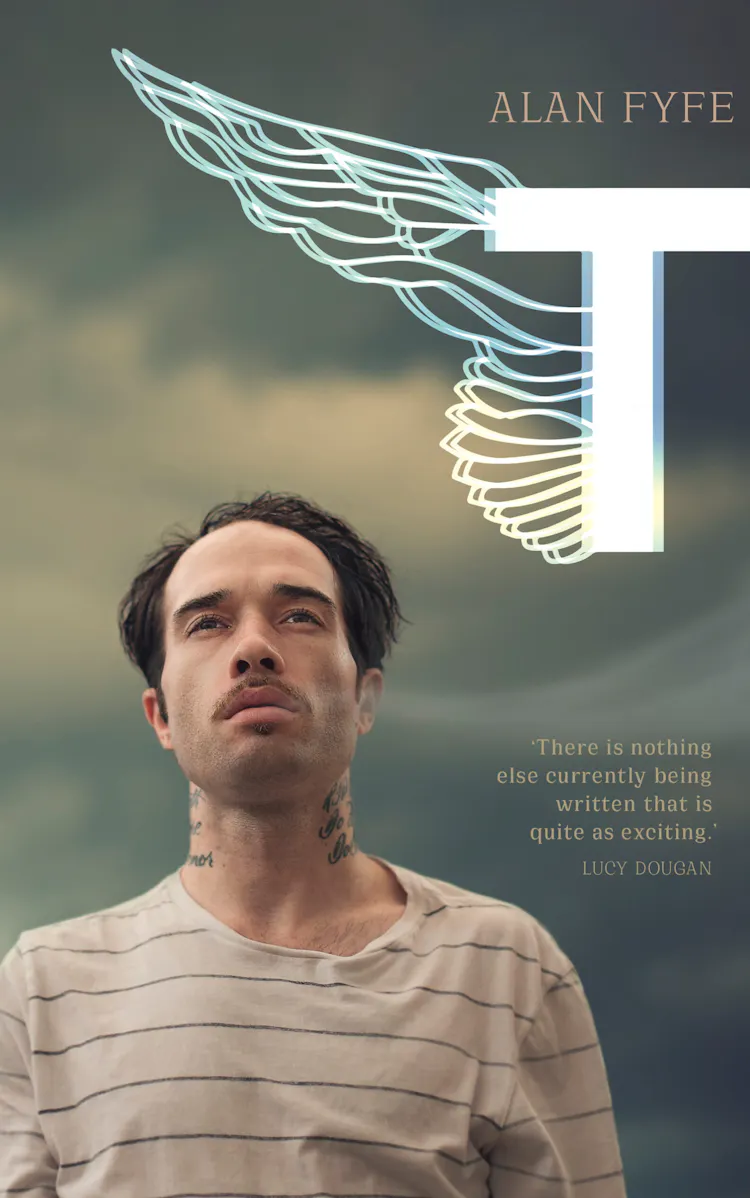
It feels odd, but not amiss, to say that the novels of Alan Fyfe often read like literary manifestations of accidental Renaissance art. It’s odd because Fyfe’s stomping ground of Mandurah, WA doesn’t typically serve as a locale for art, literary or otherwise; it’s apt because his 2002 debut, T, begins with an invocation of the aesthetics of the Renaissance. The opening scene depicts a botched attempt to extract a corpse from a site of squalor, a filthy squat inside ‘a corrugated tin half-silo, high on stilts’. The dead man is Gulp, Mandurah’s erstwhile meth dealer, and transporting him are two medics, one at either end of a gurney. As the medics struggle to carry the body down a makeshift staircase, ‘thin slats nailed between two diagonal props with no handrails’, all hell breaks loose. One medic’s shifting weight snaps the steps beneath his feet. The other loses his grip on the gurney and upends it. Suddenly, shockingly, the corpse is airborne. A policewoman looks on as Gulp rises skyward ‘very quickly, though it must have taken less than a second’, before gravity seizes him again and bears him down on the medic who stumbled. ‘The medic’, writes Fyfe,
Fyfe doesn’t openly identify the artist behind that specific painting, but this isn’t too surprising: he barely identifies his own characters. The eponymous hero of T, for instance, was at one time known as Timothy. That was before meth addiction attenuated his life – destroyed his career as a journalist, decayed his very name – and led him to Lori-Bird, his on-again, off-again lover, whose modicum of self-respect complicates her feelings for him, ‘the saddest cunt of all’. And most of T’s associates are fellow addicts whose names, like Gulp’s, have also been pared back to glottal and nasal placeholders: Cardo, Gobbo, Brick, Tongue. For me, what’s significant in T isn’t the identification of characters via naming, but the difficulty of an identification with them via the novel’s implicit positionings. T permits its readers only a minimal closeness to its characters, ultimately holding us at a distance from them by maintaining its own distance from us. In a sense, T repurposes a technique that usually generates dramatic irony and instead generates something else: something which, bereft of irony, is at first startling, then disquieting, true to the spirit of ‘accidental Renaissance’ art.
How is this effect achieved? To begin with, Fyfe’s dialogue – or slang dialect – gives readers access to the milieu of his desperadoes. We’re allowed, in effect, to eavesdrop on conversations that unfold in what Gulp calls the ‘drug vernacular’. Addicts scrounge for cash to ‘pay the crystal bill’. They fire up ‘the glass barbecue’, preparing to ‘dance with Tina’ (‘Get it? Tina – Christina – Crystal’), and finally, when they drop out, they build ‘castles [...] at the end of the glass tube’. But then, gilding their chatter with more poetic prose, Fyfe’s narratorial voice reverses the proximity we’ve gained. For them, an object of cultural significance isn’t an artistic one: in conversation, they revere works like Screw It, Let’s Do It by Richard Branson more than anything else. Yet, as readers, we’re made aware that they’re inside a novel whose structure echoes Bruegel’s Landscape with the Fall of Icarus – a comparatively refined touchstone, invoked by name and described in the text. In other words, the narratorial voice cleaves us from the characters by employing a frame of reference that notably exceeds theirs. Then, as if to extend our distance, it speaks in a register that assumes, and reinforces, our status as outside observers of their world. Occasional asides deliver advice on cooking meth (prep involves ‘never allowing the flame to make contact with the glass’) along with explanations of its effects (it has ‘excellent abilities with time distortion’). Flights of lyricism theorise the dynamics of the high (‘there is a very beautiful point in a proper [meth] binge where chemical energy finally outstrips physical energy’) and philosophise on how the drug distorts a reliable perception of reality (‘some use of practical metaphysics is hard to avoid’). ‘In the crystal tunnel,’ we’re told,
nothing matters much but the loose/tight forming of inspired whims. The way they connect and flow in and out of each other, like a line moving to make a pattern – crossing and swirling and coming back to meet itself again and again, the inside of a mind about the shape of a Celtic tattoo.
This is evocative and sonically measured prose, showing the hand of a writer who publishes poetry as well. It’s also abstract, thin on descriptive detail. There’s a sensuousness to its rhythms and images, but no conveyance of sensory experience. It affords no understanding of how it feels, in one’s body, to ride a high and suffer a crash, or to bend in craven service to the demands of an addiction. In T, then, whatever Fyfe’s project might be, it’s a project at a tangent to the straightforwardly humanist aim of stirring pity for the downtrodden. Despite the closeness we gain to Fyfe’s characters as they interact, it’s difficult to invest much sympathy in their affairs. His conspicuous aesthetics seem intended to jolt us, time and again, back into a position of detached spectatorship. However intriguing the characters’ dilemmas might be, they’re subjected to a literary artistry that repeatedly beckons for attention – that frustrates any easy immersion in the narrative drama and that is, for this reason, invigorating.
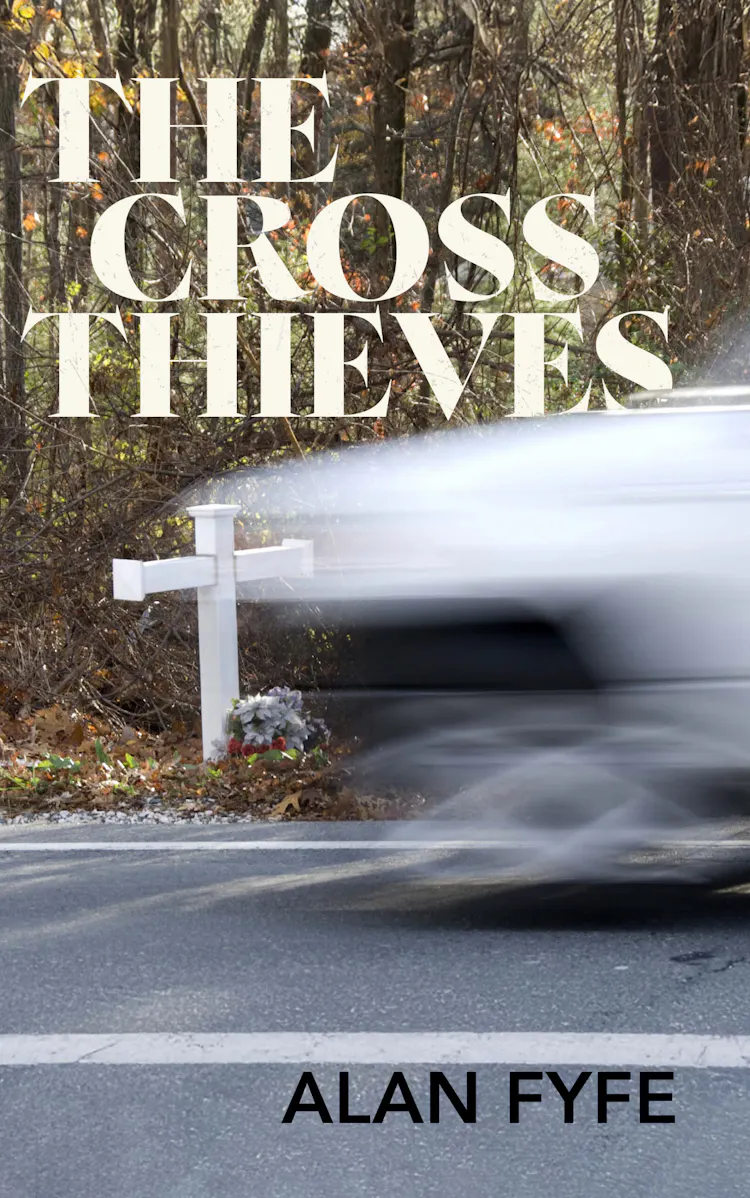
In his latest novel, The Cross Thieves (2026), Fyfe continues and complicates the project he began in T, returning to Mandurah’s shabbier quarters and revisiting familiar faces – Gulp reappears, alive and well. That said, The Cross Thieves isn’t strictly a continuation of T. Rather, it’s a sort of skewed prequel, though it requires no knowledge of the earlier novel.
Taking centre stage in The Cross Thieves are two misfits, Gark and Pell, a pair of luckless brothers for whom ‘shit-boring and surviving would have satisfied either of them to the point of happiness’. Penniless and desperate, they live in a ‘shack on the outskirts of Mandurah [...] a square asbestos box [they’d] found unoccupied a year before’. They’re ‘the kind of men who’d beg a two-dollar coin from you in any urban centre’, and they’re increasingly ravenous, deranged by a hunger they can’t quell. As their deprivations tempt them into petty criminality, they become entangled with another set of brothers, the Stanleys, reputed ‘rough cunts’ who trade in black market goods. Soon enough, Gark and Pell learn that one of the Stanleys has lately died, and that his siblings have memorialised him by installing a steel crucifix on the family property. As events lead Gark and Pell to raise a grievance against the Stanleys, they lash out from a combination of spite, wounded pride, and misplaced chivalry, and make off with the cross. They dislodge it at the base and bolt, fleeing through the slums of Mandurah, navigating a series of vaguely picaresque incidents in a haphazard attempt to elude the Stanley brothers’ vengeance. But there’s more to The Cross Thieves than a fugitive story with a linear chronology. The brothers’ narrative is interspersed with epistolary texts, decades-old letters that record exchanges between Gark and Pell’s late mother, Ellie, and her estranged sister Molly. Although raised in a fundamentalist Christian family, the two women followed different paths in life: Molly towards more liberal beliefs, Ellie not so much. Juxtaposed against the actions of Gark and Pell, the sincerity of the sisters’ explorations of faith makes the brothers look blasphemous and frequently absurd.
This narrative setup is clearly rich with potential for striking imagery. The shouldered cross, borne by an outcast, is one of Western painting’s most reliable subjects, and Fyfe appropriates it by describing his outcasts in terms specific to visual art. When the narratorial voice introduces Gark and Pell, it observes that they form ‘an unlikely tableau’, both of them being laid low by their hunger: Gark is unmoving, maybe unconscious; Pell is ‘too eaten up with worry to leave his brother alone’. But while the tableau, in stained glass or fresco, is the go-to form for visual representations of the stations of the cross, The Cross Thieves has something else in mind with regard to artistic effect. There’s neither grace nor divine grandeur to Gark and Pell’s escapades. Ellie’s letters to Molly express the hopes she once held for their salvation, but the brothers’ ignoble circumstances don’t permit anything so lofty. The proximal source of their misery is a withheld welfare payment: an event so bureaucratic, so mundane, that it shackles their shenanigans to the realm of the slapstick, not the sublime. In consequence, as Fyfe tries to catch them on the run using the rhetoric of art, they are rendered faintly ridiculous, cast as ‘two knights-errant’, or else as performers ‘in some modern-art parody of a passion play’. For the definitive word on their appearance, however, it’s Gulp who deflates any spiritual pretensions by observing how farcical they look: ‘What a fucken scene, lads,’ he says. ‘What a fucken high-concept cartoon you’re in. Must be art.’
In T, Fyfe orchestrates a delicate triangulation – distancing characters from readers and positioning both at a distance from the narratorial voice who hovers over them. But in The Cross Thieves, he triangulates with starker distinctions. For one thing, he gives the narratorial voice an identity of its own, construing it as a non-interventionist ‘I’ that isn’t a participant in events but also doesn’t survey them from above. This voice drifts through the spaces between extended third-person sequences, intermittently breaking the fourth wall to address us as readers and to question our capacity for sympathy. In the opening paragraph, it promises to tell us the brothers’ story ‘if you’ve got the right heart to hear it’, and throughout the novel it reconsiders whether we have ‘the right kind of heart’ to proceed. For another thing, though, Fyfe triangulates more forcefully than in T by making The Cross Thieves more conspicuously aestheticised, more openly artful, particularly in his command over the way that physical activity plays out in the mind’s eye.
To be sure, T is replete with strikingly visual figurations, with rhetoric that moves like a painter’s brushstrokes: floaters in the eyes are ‘electric tadpoles’, for instance, and T leaps off a couch ‘like water popping off hot oil’. But, aside from Gulp’s airborne misadventure, the novel boasts only one set-piece with strong optics. It arrives when T is ‘peaking’ and seems to hallucinate the suicide of an ex-dealer, Ashley, who later turns out to have actually died. T is driving at the time, prowling the streets of Mandurah, when he glimpses Ashley falling from a height – not from a building, but from the heavens – with results that would be simply grotesque if Fyfe’s offbeat poeticisation didn’t give them a comic strain as well:
T had time to get out of his car and stand watching before the shape in the clear sky came close enough to confirm it was a human body. Ashley wasn’t struggling – he held his arms out, fingers stretched in the rushing air, and when he was near enough for T to make out his face, his eyes were closed and he was smiling as if in a good sleep. He thumped, face first, into a lawn, breaking the surface and pushing a little way into the soil so the back of his body peeked up over the edge of the grass like a cake rising out of its tin in the oven. T took a step closer and saw blood welling around the still form in the Ashley-shaped hole.
By comparison, the central set-piece of The Cross Thieves, at a full twelve pages in length, is more expansive, more animated, and more pointedly presented. It contains its imagery within de facto frames that allow events to unfold sequentially, in the manner of a triptych. These events occur at a ‘house-wrecking party’ thrown by associates of Gark and Pell, friends who’ve invited a crowd to destroy the rental home they’re being kicked out of. As soon as Gark and Pell arrive, Fyfe’s sentences grow taut with metrical control and vibrant with idiosyncratic images. The rental is ‘a sea-green weatherboard’ emanating a ‘milky-electric glow’ into the night. The party in the backyard is a haze of ‘woodsmoke’ lit up by ‘a fire the size of a decent banksia bush’ and ‘lemon and mandarin trees [growing] in wild, time-gnarled shapes with bright fruit sparking in the night-smudged outlines’. The hosts, Astrid and Joel, are both carnival workers, ‘barely dressed, stripped down to underwear’, and tattooed ‘so prodigious[ly] the ink might as well have been clothing.’ As fresh blood stains Gark’s hands and feet – he has run to the party, shoeless, hauling the cross – Astrid is appalled by ‘the fucken stigmata’ and invites him indoors. There, she feeds him, offering him ‘a round object wrapped in foil’ that bears ‘the scent of smoked and caramelised starch’, while with his gaze he notes the specifics of the dereliction all around. He observes a makeshift door between rooms without one – ‘an old-fashioned blanket with a negative graphic of a lion standing on rocks’ – and spots ‘where drafts had rattled and chipped louvre windows over low board walls [and] filmy lace curtains from another time were hung’.
But Fyfe has hardly established the visuals of the scene before he unleashes the chaos of the party-goers to dismantle and destroy it. He does, moreover, this while tracking Gark’s staggered movements through the carnage via a series of discrete and bounded incidents. First, indoors, Gark hears the crowd outside before he gets any visual input: he picks up ‘the indistinct rumble of many voices’, ‘a crash like something heavy thrown against a sheet-wall’, a silence, a ‘lesser hum’, then a sound ‘like a slap on meat’. When he heads out to see the action, he enters a scene that is designated as a ‘scene’ and rendered in painterly terms. The yard ‘stretche[s] far enough to grid a painter-perspective onto the distant back fence’, and the free indirect style attributes this perspective to Gark as he scans the scene to locate its edges: on his left, a side fence; on his right, ‘party-goers [...] standing still, watching something’. But suddenly, after a paragraph break, Gark is in the scene he was just surveying – like a figure with a presence across two panels of a triptych, though the gap between the panels swallows the figure’s transition from one to the next – and then he ‘hustle[s] his way to the front of the mob’ to prepare to repeat the feat. A few paragraphs later, sure enough, ‘Gark was in the melee with a jump’, having made a literal leap from panel to panel, again without a transition or even a transitive verb. At this point, he retrieves Pell and they vacate the yard in language that connotes an escape from the final frame: ‘the brothers’, Fyfe concludes, ‘edged from the scene’. And although this pinpointing of technical manoeuvres doesn’t preserve the flow of the energy across these twelve pages, the entire sequence is stunningly drawn, richly animated and textured with firelight and chiaroscuro. Vandalism driven by rage is rarely depicted with such a sense of twisted glee – an attitude exemplified best by Joel, who stomps on the wreckage and is left ‘clown-grinning from his destruction dance’.
It’s at the end of The Cross Thieves that Fyfe makes clear the mechanics of his artistry. Closing the book with a candid author’s afterword, he explicitly locates his characters at a remove from his presumptive readers and puts a label to a core component of his aesthetic scheme, thereby illustrating the triangulation he has arranged. His positioning of his readers is, he admits, generally directed towards a social purpose: it’s an exercise in consciousness-raising on behalf of those who lack comparative socio-economic security. He began drafting The Cross Thieves on ‘an impulse to write a neo-epic about people suffering food insecurity’, and accordingly he indulges in ‘a few preachy paragraphs’ on that subject. But then, backtracking, he adds a disclaimer, disavowing the notion that ‘a novel can change much’, because any novel’s social purpose is subservient to ‘the aesthetic demands that an author immerse and excite a reader’. And, immersivity and excitement aside, he also confesses to imposing another aesthetic demand on himself: The Cross Thieves, he says, ‘is written in a little known (and very old) structure called ring composition. It’s not very important that you know what that is, just that it’s bloody hard to do.’
That’s an aside worth dwelling on when it comes from a poet who opts to leave a poetic term undefined. By ‘ring composition’, he means chiastic structure; by ‘very old’, he means that it dates back at least to Hesiod and Homer. In practice, despite its name, ring composition has as much to do with symmetry as with circularity. The Cross Thieves comprises thirteen chapters arranged proportionally and symmetrically: A, B, C, D, E, and F, then X in central place, followed by F, E, D, C, B, and A. Each chapter ends with an imagistic or figurative gesture back to how it began, usually in the epistolary exchanges between Ellie and Molly that appear after the narrative action. As a result, the hinge point between any two successive chapters, where one closes and the next opens, refers retrospectively to the inception of the first while also anticipating the second. Across the novel as a whole, as the chapters ascend to X and then cascade down from it, the intertwining of small circularities produces a sense of harmonic balance. So, ultimately, not only scene by scene but in its architectural totality, The Cross Thieves generates effects for its readers that keep us contemplatively apart from the restless, breathless brothers it follows.
When I hear a novel calling on me, periodically, to notice and appreciate its aesthetics, to feel my distance from people it wants me to regard as artistic subjects, I wonder: what is the novel doing to me? By aestheticising its characters’ experiences, divesting them of emotional effect, the novel reduces my capacity to respond intensely to their dilemmas and care deeply about them. In precisely this way, though, Fyfe’s novels simulate, rather than dramatise, the numbness that defines their characters’ days, only to shock me out of my own anaesthetised state with a call to recognise the heavy toll of a lifetime’s numbness on these people. Midway through T, for example, when T is at rock-bottom, estranged from Lori-Bird, sleeping in Gulp’s old squat, haunted by the dead man’s ghost, there’s a moment where the narratorial voice comments plainly on his desensitisation: ‘He was alone, for the most part, but felt love. He was, in any real sense, homeless, but felt safe. It all took a shape close to a life.’ Ostensible feelings of love and safety in these circumstances have a palliative quality to them, perhaps even a self-deceptive or wilfully delusional one. There’s a recognition of the fact that T’s circumstances are dire – delivered coolly, unsentimentally – but neither he nor the narratorial voice registers the feeling of his extreme abandonment and precarity. How, then, can such a denuded existence take ‘a shape close to a life’? By any measure, T isn’t living: he’s barely surviving, in destitution, in extremis. From day to day, he nurses only those desires that don’t run too far past twilight: desires for meth and company, mostly, constrained by a time horizon that doesn’t allow the cultivation of hopes for a more stable future. His is a state of absolute hopelessness, but also – crucially – one that seems to lack the abject despair that true hopelessness entails.
In The Cross Thieves, Gark and Pell are in a similar situation, unable to see beyond the here-and-now of their hunger, to dream of better days on the other side of their next meal. To live lives as withered as these is to live episodically, with no conviction that one’s existence has a span exceeding twenty-four hours. By rights, this should breed a paralysing desolation of the soul, and yet, again, Fyfe doesn’t let them feel any such thing. They don’t seize up or collapse. They just persist, day by day, obliged to do so by the blunt fact of their own ongoingness. They carry on without thought, not heroically, not even in a spirit of stoic fortitude against hardship. Despair, for them, doesn’t show up as something to be seduced by or to struggle against. Rather than a force that wracks them, it’s simply absent from their considerations, as equally absent as hope. Nor does Fyfe let any sense of it inflect the mood of the narratorial voice or drag down the buoyant prose. As a result, while The Cross Thieves rests upon a vast substratum of despair, it withholds somatic cues for readers to notice this – no kick in the guts, no quickening pulse – so that noticing becomes instead a colder, more intellectual activity. One must step back from the characters’ nominal pursuits to see the abyss they are skirting around, to tune in to the menacing hum that the narratorial voice glosses with figurative flair. Despair lies within a cavern of the unacknowledged and unsaid. By the pressure of its containment there, it has the energy to fuel The Cross Thieves without escaping into either the characters’ psyches or Fyfe’s style.
For some readers – those who anticipate a sympathetic bond with characters, forged through lyrical turns of phrase – this may stand as a failing of T and The Cross Thieves. And Fyfe himself may also see it that way if, despite his disclaimer, he is in fact aiming to use readerly sympathy as a force for social change. But as an exercise in literary art, sustained across two novels, it looks to me more like an unusual and unsettling accomplishment: at first startling, then slowly disquieting, as per my description above. If it leaves me ultimately unmoved to emotional extremes, despite the extremity of events recounted, I am yet moved in a different way. By convention, we tend to say that life unfolds, like time, along a course resembling a line – a line that undulates according to life’s highs and lows. Other shapes are possible, though – interlaced ringlets or Celtic tattoo, Renaissance tableau or panelled panorama. Fyfe’s characters may follow trajectories that take a shape only ‘close’ to a life, but there’s not necessarily a shortfall in that: I marvel at corpses becoming angels, no-hopers becoming penitent pilgrims, and distresses transfigured by the artful reshaping of the lives they afflict.