

the element that looms largest for me through a particular impression […] of ‘down-town’ seen and felt from the inside. ‘Felt’ – I use that word, I dare say, all presumptuously, for a relation to matters of magnitude and mystery that I could begin neither to measure nor to penetrate, hovering about them only in magnanimous wonder, staring at them as at a world of immovably-closed doors behind which immense ‘material’ lurked, material for the artist, the painter of life, as we say, who shouldn’t have begun so early and so fatally to fall away from possible initiations.
Fencing Paper Apparitions
Joel Keith on the ‘late’ Susan Howe
The American poet Susan Howe is known for archival collages. Reviewing her most recent book, Joel Keith reads Howe’s visual-verbal splicing through Said’s ‘lateness’ and the agricultural imaginary that has long enclosed settler American writing.

Henry James saw the first skyscraper of his life in 1904, on a visit to New York. This was during the trip that formed the basis for his 1907 essay collection, The American Scene – his first time back in the continent of his birth since emigrating to Europe in 1875, at thirty-two. Skyscrapers, and the extent to which they dwarf church spires, shocked him: ‘Crowned with not only no history, but with no credible possibility of time for history, and consecrated by no uses save the commercial at any cost’, they rise ‘like extravagant pins in a cushion already overplanted’ and (as James fumbles again through his dresser drawer) make the city resemble ‘some colossal hair-comb turned upward and […] deprived of half its teeth’. These ‘monsters of the mere market’ are, James writes,
This is, perhaps, a condition all artists must end up facing – all artists who live long enough to become ‘malicious old men like Frost, or maniacal old men like Pound’, as Elizabeth Bishop witheringly put it in a letter mourning the death of Dylan Thomas.
Edward Said, in the book he was working on at the time of his death at sixty-seven, published as On Late Style (2006) and edited by Michael Wood, gives this condition a name: lateness. There are, Said proposes, two main forms that artistic lateness can take. In its first and, to Said, less interesting form, lateness manifests in ‘a special maturity, a new spirit of reconciliation and serenity’ – a good example, for our purposes, might be the late work of Wallace Stevens. Then there is the kind of lateness Theodor Adorno finds in Beethoven: ‘artistic lateness not as harmony and resolution but as intransigence, difficulty, and unresolved contradiction’ – something altogether more malicious and maniacal. This is the kind that interests Said. Such lateness, Said writes, ‘is in, but oddly apart from the present’, ‘a kind of self-imposed exile’ characterised by, ‘above all, a sort of deliberate unproductiveness going against’.
As Said’s argument progresses, that first, serene form of lateness – or ‘maturity’ – entirely drops away, and the words ‘late’ and ‘lateness’ come to refer exclusively to the second kind. These ‘late’ qualities, Said argues, arise out of the artist’s consciousness of mortality – but this need not mean late works of art must take on death as their explicit subject. Far from it: ‘Death’, Said quotes Adorno, ‘is imposed only on created beings, not on works of art, and thus it has appeared in art only in a refracted mode, as allegory’ – in tears, fissures, immovably closed doors. This results in what Adorno himself terms ‘late style’: a style in which the artist’s subjectivity, with an ‘irascible gesture’,
takes leave of the works themselves. It breaks their bonds, not in order to express itself, but in order, expressionless, to cast off the appearance of art. Of the works themselves it leaves only fragments behind, and communicates itself, like a cipher, only through the blank spaces from which it has disengaged itself.
In drawing out an account of lateness itself from these remarks, Said begins to recognise it, strangely, in the work of artists and writers who are not, themselves, late in life. One such writer is Adorno himself ‘because so much of what he does militated ferociously against his own time’. How then to make sense of those writers who, like Adorno, arrive at lateness early? Said does not quite pose this question; but reading him a little against his own grain, we might take this line to be a good enough reply: ‘lateness includes the idea that one cannot really go beyond lateness at all, cannot transcend or lift oneself out of lateness, but can only deepen the lateness’. It follows that for one, as it were, born late – such as Adorno – the task of deepening one’s own peculiar lateness may become the central work of one’s life.

The American poet Susan Howe has, perhaps, always been the late Susan Howe: in, but oddly apart from the present, transmitting, like a cipher, messages gleaned from the gaps in the American archive – gaps into which, like Pyramus and Thisbe, she speaks, then presses her ear. A latecomer to poetry, she was a visual artist first, and an actor before that (very briefly, and mostly to please her mother); this makes her a few years older than the rest of the Language poets with whom she is often associated, her sensibilities shaped, she has said, not by the ‘political rage and courage’ of university campuses during the late sixties, but earlier, by modernism and ‘artists’ writings […] people like Reinhardt, Finlay, Judd, Smithson’. She has taught at Stanford, Princeton, and Wesleyan, but arrived in the academy late, too, having never studied at university, a decision she has called her biggest mistake. And though she’s never irascible, Howe has always written poems that remain ‘unreconciled, uncoopted by a higher synthesis’, to borrow Said’s phrase, her eye cast back, like Orpheus’, towards receding, irretrievable figures: Mary Rowlandson, Hope Atherton, Charles Peirce, Emily Dickinson. All, in their own ways, are figures of that ‘latest’ of qualities – exile: Rowlandson, abducted and restored, author of one of the first American captivity narratives; Atherton, a minister who got lost in the woods while accompanying a genocidal settler militia; Peirce, the eccentric colleague of William James, brilliant but neglected, fleeing from debtors; Dickinson, an avant-garde of one, alone in her room.
It was not, however, until her poem ‘118 Westerly Terrace’, collected in 2007’s Souls of the Labadie Tract, that she turned her eye directly towards old age. Titled after Wallace Stevens’ last home address, the poem is addressed to Stevens’ ghost, whom Howe pursues, and takes its epigraph from James’ 1908 story ‘The Jolly Corner’, about a man, Spencer Brydon, who returns to New York after living in Europe for three decades in order to look at the two properties he owns there. One of these properties has recently collapsed, and Brydon begins to oversee its reconstruction as a ‘tall mass of flats’ – leading a friend to remark that, if he had only stayed home decades ago, ‘he would have anticipated the inventor of the sky-scraper.’
When Howe invokes the skyscraper later in the poem, we hear in it a doubled echo – of Brydon and, through Brydon, James himself – that transforms the word into an emblem of lateness:
For a first skyscraper one
second glass tower small
introjected guilt parallel
shadow hand signal over
window frame curtain of
house with smug facade
[page break]
I address you at random
on the subject of doors
Of dim hearsay old age
exile –
Howe was then a year younger than James had been on his return to New York; reading this passage, one recalls James’ own words on ‘doors’, ‘old age’, and ‘exile’ – subjects he locates, like Howe, in the image of the skyscraper. What – besides offices – lurks behind these skyscrapers’ ‘world full of immovably closed doors’? The future, perhaps – a future for which his own sensibility, James recognises, is woefully unsuited, whose pace is accelerating precisely as he finds his syntax slowing; the future and, therefore, the past – the past in which he might have chosen to stay in America and become more assimilated to the age. But the past is no more retrievable to James than the dead Stevens is to Howe, and Howe’s poem ends with Stevens retreating – Eurydice to Howe’s Orpheus – separated from his pursuer by a pane of glass: a window, not a door, but nevertheless, immovably closed.
At the time, seven collections into her career, one might have encountered this poem as an example of her late work. Yet not only has Howe continued to write in the eighteen years since, she has, like Yeats (in whose plays her mother once performed), gone on to develop a whole new poetic idiom late in life – the beginnings of which we might locate in the poem that closes Souls, ‘Fragment of the Wedding Dress of Sarah Pierpont Edwards’. Howe had experimented with collage before; she had also included, in poems, facsimiles of archival manuscripts. It was in this short poem, however, that she first cut up and spliced facsimiles of manuscripts into the collages themselves. What Chelsea Jennings has dubbed Howe’s ‘facsimile aesthetic’ – or, to borrow a term Howe uses in ‘Rabbit-Duck illusion’, her ‘scissor self’ – has become the defining mode of Howe’s twenty-first-century work. Two of the four poems in her next book, Debths (2017), are such collage poems, as is the long title poem at the centre of her subsequent book, Concordance (2020).
Like many of its predecessors, Howe’s latest collection starts with an introductory prose poem, ‘Penitential Cries’, that not only lends the book its title, but also establishes its central setting (Yale’s Sterling Memorial Library), introduces its key themes, and calls on its muses, among them: Wallace Stevens, John Donne, the French mystic Marguerite Porete, and the figures of Orpheus and Eurydice, as characterised by Alvin Lucier, H.D., and Jean Cocteau. The book concludes with two short poems, ‘The Deserted Shelf’ and ‘Chipping Sparrow’, only the latter of which is lineated. At its heart is Howe’s vastest, most intricate collage poem yet: ‘Sterling Park in the Dark’.
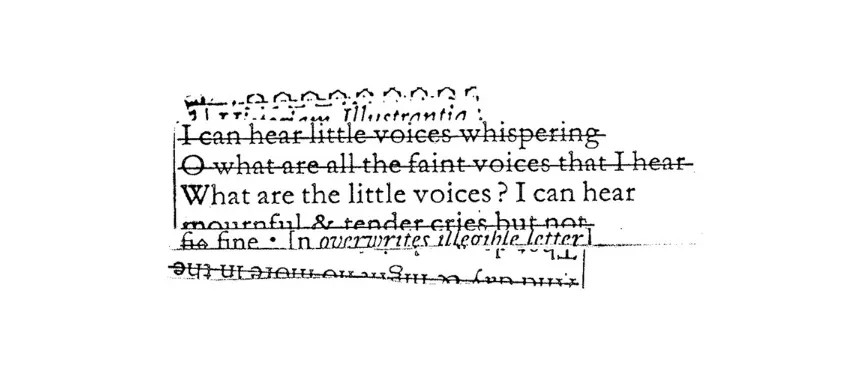
How to go about reading such a poem? Is ‘reading’ even what one does with it? ‘Sterling Park’ is impossible to paraphrase, summarise, or translate; at best, one can only begin to describe it, as one might a work of visual art. It is split into two sections, one twenty and the other thirty pages long. Each page consists of text collaged from (‘among other sources’) The Variorum Edition of the Poetry of John Donne, Goethe’s The Metamorphosis of Plants, and The Complete Letters of Henry James, except for a page in the first section which is blank (as Howe once remarked to Lyn Keller: ‘I would say that the most beautiful thing of all is a page before the word interrupts it’), and one in the second section which features a picture of a sailboat captioned, enigmatically, ‘EXIT’ (Howe’s first husband, the sculptor David von Schlegell, was an avid sailor; the sailboat epitomising for Howe the nexus between beauty and utility that she also discerned between poetry and archival documents). Often, the text on a given page is arranged into what has been Howe’s signature typographical shape since her visual art days: a small rectangle at the page’s centre. This may principally be because one must first establish a convention in order to break it; in terms of shape, the poem is freer than any in Howe’s oeuvre.
In his 1950 essay, ‘Projective Verse’, Charles Olson enjoined poets to ‘start from the smallest particle of all, the syllable’. Howe has always gone smaller: she incorporates into ‘Sterling Park’ not only words, but numbers, symbols, ‘fragment letter-bits’, scansions, and fields of punctuation evoking waves, landscapes, and shards of rock – even thin black lines arising from the ‘many leaves compacted’ in her scanner (Goethe’s phrase, Howe’s pun). We might be tempted, in the face of all this, to read ‘Sterling Park’ not as a poem at all, but as a drawing, ‘a complex of marks’, as Alain Badiou put it in his essay on Stevens:
These marks have no place. Why? Because in a true drawing, a creative one, the marks, the traces, the lines, are not included or closeted in the background. On the contrary, the marks, the lines – the forms, if you will – create the background as an open space.
But this is, I think, only part of the story.
Take a different poem – Eugen Gomringer’s ‘silencio’ (1954), which Howe placed as the epigraph to her first published essay, ‘The End of Art’ (1974):
silencio silencio silencio
silencio silencio
silencio silencio silencio
Gomringer’s poem resembles a kind of drawing: a drawing of an enclosure. Without this enclosure, the page is simply an object with qualities – proportion, hue, texture, smell – an object that happens to be absent marks. With it, the page’s very unmarked sections become a kind of mark whose meaning is: Absence. In this sense, the poem does indeed ‘[create] as its place an empty surface’, to use Badiou’s phrase – as any poem does. Gomringer’s poem, however, goes a step further by taking that procedure of drawing as its subject: self-consciously guiding our attention so that the enactment of the procedure becomes descriptive of it; turning it into a kind of joke, with the ‘blank’ space at the centre serving as the poem’s punchline.
Yet this joke would make no sense if we did not already read the poem as a poem: that is to say, as a field of sound surrounded by silence. For it is precisely by attributing to the printed text the meaning – ‘silencio’ – which we have been taught to attribute to its opposite, the blank page, that Gomringer’s poem is able to ironise, and thereby expose and denaturalise, the occluded operation of ‘drawing’ that underwrites all print literature, and our perception of print as print: a procedure that creates the page as blank by blinding us to those qualities it must, in fact, like any physical object, possess; or, to recast the problem in terms of sound, by deafening us to, in Howe’s phrase, ‘[t]he way a particular grain of paper speaks without our knowing’. ‘silencio’, then, is not a drawing, but a poem containing drawing (to adapt maniacal Pound’s famous formulation about ‘history’) – or, to put it another way: a poem that draws, and, in drawing, speaks. That doesn’t seem a bad definition of concrete poetry in general – taken, perhaps, in conjunction with the definition given by the iconic Fitzroy poet thalia: ‘a revolt against [the] transparency of the word’. Howe, like Gomringer, like thalia, revolts against the transparency of the word by using words to draw, and by drawing in order to speak. But who exactly is speaking?
‘Documents resemble people talking in sleep’, Howe writes in ‘Arisbe’, collected in 1999’s Pierce Arrow; we might, then, think of ‘Sterling Park’ as transcribing a kind of archival dream-babble. An anecdote recounted by Howe in ‘Penitential Cries’, about her time working in community radio during the Vietnam War, provides an instructive analogy:
We had a steel editing block with a flat groove intersected by a thin vertical edge for splicing with a single-edge razor. There was an overhead light because we needed to follow the rhythm of breath of each reader in order to pick up the next word, following with a bit of breath to ride the feedback. When WBAI FM was short on funds, we re-purposed tape spools that were erased. Often under the surface splicing and reconnecting I became aware of quick pshpshphsh hesitant alphabetic ghost difficulties hurrying along their apparitional way
This anecdote points us towards another difference between Howe’s poem and drawing as defined by Badiou: namely, that just as those re-purposed spools of tape are not truly silent, but haunted by spirits that have been imperfectly erased, the page, as Rachel Blau DuPlessis has observed of Howe, ‘is not neutral. Not blank, and not neutral. It is a territory.’
With our eye on the text, we ask who is speaking; turning our eye to the page itself, we now ask where? Inquiring, with Michael Farrell, ‘What forces diagram the whiteness?’ And with Olson, ‘what stalks/this silence’?
‘Strip furlong field // Feet on someone else’s wheat // Easy market access’, Howe writes in her 1989 poem, ‘A Bibliography of the King’s Book or, Eikon Basilike’. These lines may read like a concise summation of American colonisation. In fact, the poem is about the execution of King Charles I; the lines describe the expropriation, through enclosure, of British lands – pastures, meadows, woods, fens – previously held in common. Prior to this process, peasants were afforded a kind of parcellised sovereignty: while their lands were owned by lords, to whom they were forced to pay tax, these lands were held in common, managed at once independently (peasants were assigned individual ‘strips’ of field) and collectively (to work these strips required cooperative ploughing, tilling) by the peasants themselves. They did so according to traditional customs in which ‘wastes’ – undeveloped lands, often awkward, narrow stretches along creeks or roadsides, used informally for foraging, personal farming and grazing (as in John Clare: ‘the scrubby waste / Where grass is pincered short by sheep’) – were understood as necessary, biodiversity was high, and crops were rotated to give arable land time to regenerate in order to remain nutrient-rich.
As Jesse Goldstein writes in ‘Terra Economica: Waste and the Production of Enclosed Nature’, forests, fields, meadows, all kinds of commons were ‘collapsed into a general category of unused or inefficiently used lands, interchangeably called waste or commons’, and, to borrow a phrase Howe uses in an early poem, ‘impaled by a netting of fences’ and hedges. The legislatively sanctioned and systematic dispossession of peasants’ land was critical in the transformation of Britain’s economy from a feudal to a capitalist one. Goldstein observes that ‘fences and hedges’ not only ‘provided a new visible demarcation of absolute space’ (enclosure is as much a kind of mark-making as it is an economic process), but also effected ‘an invisible transformation […] of the intrinsic nature of these spaces, materially and conceptually, as waste available to become capital’. Waste, then, not in the sense of ‘common wastes’, but of ‘wasted commons’: ‘a landscape of wasted potential, in which all of the world is potentially, or not yet, capital’. Just as for Badiou ‘the blank page as a background does not exist, because it is created as such […] by the marks’, for Goldstein, enclosure’s way of reading landscape solely with regards to its potential value alters – in fact produces – the ‘nature’ of that land itself, as both universal means and universal condition of capitalist production.
A year after publishing ‘Eikon’, Howe remarked in an interview: ‘Isn’t it bitterly ironic that many [British settlers] were fleeing the devastation caused by the enclosure laws in Britain, and the first thing they did here was to put up fences?’ Howe’s phrase, ‘bitterly ironic’, feels affectively right but analytically misleading. It was, after all, precisely the American landscape’s lack of fences that rendered it, in the colonial imaginary as well as under British law, ‘waste land’ free for the taking. ‘As for the Natiues in New England, they inclose noe Land, neither haue any setled habytation, nor any tame Cattle to improue the Land by’, wrote John Winthrop, no dispossessed peasant but soon-to-be-governor of the Massachusetts Bay Colony, in 1629; as such, they ‘haue noe other but a Naturall’ – as opposed to Civil – ‘Right to those Countries’. ‘The whole earthe is the Lordes garden: and he hathe given it to the sons of men to be tilld and improved by them: why then should we […] suffer whole countrys […] to lye waste without any improvement?’ Enclosure, for many settlers, was both damnation and salvation: the original sin which cast them from the garden, and the key that would grant them ownership over a new one.

Wallace Stevens writes in ‘The Creations of Sound’: ‘speech is not dirty silence / Clarified. It is silence made still dirtier’. A line in this poem – ‘By the spontaneous particulars of sound’ – gives Howe the name for her 2014 book-length essay, Spontaneous Particulars: The Telepathy of Archives. If a blank page is silence, then Howe’s essay is a paean to the many ways such silence can be dirty: to ‘soils and cross-outs’, to ‘rag paper color […] grown deeper and richer’, to ‘paper brown with oxidation’, to – here she quotes from James’ The American Scene – ‘“the very dust, pre-historic but still pungent, of the old”’. In 1993, Howe wrote:
A margin is a border, edge, brink, or verge of land […] In books the margin is the edge of a page, left blank or to be filled in with notes […] Maybe margins shelter the inapprehensible Imaginary of poetry.
(A passage perhaps ghosted by William James: ‘There is a verge of the mind which these things haunt’.) A ‘verge of land’ is a waste, and here, two decades later, Howe names it as such: ‘This meanly magnificent “waste” exists on a scale beyond actual use.’ The word, ‘waste’, suggests itself to at least two readings here. In the first, ‘research libraries and special collections’ are figured as a kind of wasted commons bordering print literature, which Howe, in her transvaluation, declares instead to be more like common wastes. Scare quotes decry the word’s negative modern connotations, post-enclosure and post-Eliot; the sentence asserts these wastes’ value as sovereign, as separate from productivity (Howe, like Clare, likes to demolish fences in her poems – ‘fence blown down in a winter storm’ [Howe], ‘fence demolished rails / Loaded with weeds’ [Clare] – and locates, in wastes, a reflection of her own poetic ‘unproductiveness going against’). In these wastes, she suspects, the ‘visionary spirit’ of poetry, ‘a deposit from a future yet to come’, resides. In the second reading, this ‘waste’ is figured as a kind of unwanted literary byproduct, or excrement: as dung, manure, soil. ‘During the 1850s, when the Republic was breaking apart, newly exposed soil from abandoned narratives was as rich and fresh as a natural meadow’, Howe writes in The Birth-mark (1993); in Souls of the Labadie Tract: ‘Often a damaged edition’s semi-decay is the soil in which I thrive.’
Literary and agricultural production have long been bound together in metaphor (verse, let us remember, has its root in the Latin vertere, which can refer to the turning of a plough, and culture in a Latin verb meaning ‘to cultivate’, as Tom Ford and Justin Clemens have noted, investigating the poetics of terra nullius); in America, the connection has often been literal. Robert Frost had his apple orchard, Dickinson her flower garden, Thoreau his bean field – all wrote with fingernails lodged, at times, with so-called New English soil. Much has been made of Herman Melville’s years at sea, which began when he was nineteen and ended when, at twenty-five, he settled in New York. He also lived – less famously, but for twice as long: from 1850 until 1863 – as a farmer in New England. ‘As if borrowing’, in Jerry Allen’s words, ‘from the natural laws governing the operation of [Arrowhead Farm]’, he wrote all his short fiction (except for Billy Budd) there – while harbouring, as James Schuyler put it after giving a reading in Melville’s restored barn, a ‘– well, crush is not the word, but let it stand – on Hawthorne’, his next-door neighbour. Hawthorne himself had briefly ‘put his hand to the plough’, as Henry James tells us in his ‘little book on Hawthorne’ (published in 1879), as an unenthusiastic member of a short-lived Transcendentalist commune, Brook Farm, in 1841. This experience formed the basis for Hawthorne’s story, ‘The Blithedale Romance’, published in 1852, shortly after Melville had moved in next door and begun to till and soil his own fields.
Was it all the farming New England’s writers did that led them and their critics to describe the cultivation of a distinctly American literature with so much agricultural metaphor? Emerson, in an 1837 address at Cambridge, predicted such a literature must inevitably emerge because ‘the millions that around us are rushing into life, cannot always be fed on the sere remains of foreign harvests’. James regretted, in Hawthorne, that he had not gotten to hear Emerson (his brother William’s godfather) give his 1838 address at the Harvard Divinity School. For James, the Transcendentalist movement of which Emerson was the ‘admirable and exquisite’ peak represented the flowering of a seed that
could only have sprouted in the soil peculiar to the general locality of which I speak – the soil of the New England morality, gently raked and refreshed by an imported culture.
James’ ‘gently raked and refreshed’ seems an appalling euphemism for colonial conquest, settlement, and terraforming. Yet the ‘soil’ to which James refers is not New England’s actual soil, but the ‘soil of [its] morality’: comprised not of dirt, but of sedimentary layers of cultural history – meaning, always, settler history. It has taken the French and German tilling of New England’s moral soil (by George Sand, Goethe, and others) for Transcendentalism to sprout; but Transcendentalism itself is, so to speak, indigenous to it. It is this soil, too, that James talks about when he declares, in the book’s opening passages, that ‘the flower of art blooms only where the soil is deep’ – meaning: ‘it takes a great deal of history to produce a little literature’. There is still, though, a violence being performed by the above passage – a violence one cannot help but feel; a subtler, more complex violence than it initially appears. In it, ‘the soil of the New England morality’ is quaintly laid, like mulch, atop the literal ‘soil peculiar to the general locality’ of New England itself – killing the grasses beneath and burying with them whatever history the land may or may not have had; symbolically, as with literal mulch, these layers merge and fuse together in James’ treatment of them. Yet the process leaves more than a trace (what doesn’t in James?) and one can still sense what lies buried, like the arrowheads after which Melville named his farm, below.
This process of mulching America’s landscape with settler culture happened in an oddly literal way. Marjorie Perloff identifies three ‘codes’ governing Howe’s work: ‘the historical, the mythic, and the linguistic – all three, it should be added, as informed by an urgent, if highly individual, female perspective’. Are these truly three separate codes, or three ways of looking at one? As for the linguistic and the historical, Emerson wrote that for the etymologist, ‘language is the archives of history, and, if we must say it, a sort of tomb of the muses’; Howe is – perhaps surprisingly – not especially interested in etymology, but she is intensely interested in the sounds of words, and how these sounds might preserve and reveal ‘things of experience in their passage between languages’. The distinction between the linguistic and the mythic is even trickier in an American context – given that, as Richard Slotkin observes in Regeneration Through Violence (1973),
the self-baptized ‘American people’ […] first saw light in the age of the printing press […] American myths – tales of heroes in particular – frequently turn out to be the work of literary hacks or of promoters seeking to sell American real estate by mythologizing the landscape.
Puritans’ access to, and enthusiasm for, printing technology made American myth unique in a couple of ways. Firstly, unlike oral myth, ‘myth as literature is subject to the movements of the literary marketplace’; to appropriate a line from Howe’s ‘Arisbe’, ‘the unreal real thing that is in money enters into language and determines it’. The repetitions essential to transforming stories into myths, ‘visions that compel belief’ (as Slotkin calls them), which typically unfold over countless generations, are yoked to the desires of the market and radically accelerated, disseminated in print. Narratives ‘viable as a bestseller or as a vehicle for religious or commercial persuasions’ – tales of frontier wars, and captivity narratives like Mary Rowlandson’s – are ‘imitated by more or less professional writers’ and circulated widely, maintaining ‘a set of tacit assumptions on the nature of human experience, on human and divine motivations, on moral values, and on the nature of reality’.
This process of myth-making goes hand in hand with enclosure; as Howe tells it, it is a kind of enclosure: surrounding land – figured, in the settler imaginary, as wilderness, ‘chaos’, aligned with the Indian and the feminine – with language, through the act of renaming, which opens the land up for capitalist exploitation. ‘Naming delimits the open and defines dominance’, Howe writes in a 1987 essay on Charles Olson; ‘Each product in a Capitalist system must have a certified trademark […] In the history of the Americas, Christian connotation nullified aboriginal tradition.’ Elsewhere, she fuses these conjoined processes into a single word: ‘thefthe’.
By renaming America’s landscape and mapping onto it their own myths, settlers, Slotkin writes, established their sense of ‘emotional title’ to it; indeed, ‘land speculators used [frontier war myths] as advertising ploys’ to drive up land values. As with enclosure, American myth-making produces the potential it then seeks to rationally control and sell, while concealing the bloodiness through which it has often been effected. After the Pequot War of 1636-1638 – noted by Barry O’Connell as ‘the first deliberately genocidal war conducted by the English in North America’, whose body count then-governor John Winthrop placed between eight and nine hundred – the name ‘Pequot’ was declared extinct, and survivors prohibited from using it. The Pequot River was renamed the Thames, the village known as Pequot renamed New London.
But American myth also develops as tangible organic material: material destined eventually to be deposited, as waste paper, in the basements of research libraries and special collections across the continent. Here, like any buried organic matter, it decays in dirty silence – browning with oxidation, growing deeper and richer, giving off the dust, pre-historic but still pungent, of the old – laid, like mulch, atop the land it was, in some cases, written to sell. From it blooms the flower of American art. So – like an obscure, persistent weed – does Howe.

In a letter quoted by Perloff, Howe describes how she used ‘the strict boundaries of fences, lots, and row numbers etc. against the unmapped wilderness they were interrupting’ as ‘metaphors for grammar’ in her 1990 collection, Singularities. We might describe the poems in that collection, and many of her early books, as enacting, in order to critique, the procedure of ‘drawing’ (enclosure) that underwrites the creation of privately-owned ‘American’ land: enclosing the ‘open field’ of the page with text, only to syntactically and typographically twist and tear those enclosures apart, and cast us back out, like Mary Rowlandson or Hope Atherton, into the page, whose margins stand in for the ‘waste wilderness’ (Howe’s phrase) that borders the American settler imaginary.
These were major, radically innovative poems. Yet they were working within a tradition (or two). Formally, they drew from Howe’s early influences in abstract expressionism – Reinhardt, Finlay, Judd, Smithson – as well as, of course, the poetry of Gomringer. And Howe was not the first American poet to draw an analogy between the enclosures of land, and the enclosures of verse – a favourite of the Transcendentalists. One finds it in Emerson’s essays, as well as Thoreau’s Walden:
I have frequently seen a poet withdraw, having enjoyed the most valuable part of a farm, while the crusty farmer supposed that he had got a few wild apples only. Why, the owner does not know it for many years when a poet has put his farm in rhyme, the most admirable kind of fence… (emphasis mine)
Howe, though, seems properly conscious of its settler-colonial valence. One senses that this consciousness is a major source, along with her gender, of the estrangement she feels from the house of settler American poetry. Yet this is, inescapably, the house in which she grew up – which makes her estrangement an essentially familial one.
She recalls, in her biographical essay ‘Frame Structures’ (1995), sitting as a child
in the dining room of Longfellow House eating lunch on one side of a roped-off area while the resident poet-caretaker guided sightseers single-file along the other side of the barrier pointing out ornaments, furnishings, portraits, structural details; as if we were ghosts.
Throughout her life, this house has taken many forms – Longfellow House, 118 Westerly Terrace, the Sterling Memorial Library – though the library remains her preferred haunt. In the library, Howe is (at turns) a Dickinsonian hunter, roaming in Sovereign Woods; an autodidact, forced to ‘beg for admission every year with username and forgotten password’ because she never attended college (as she notes in ‘The Deserted Shelf’); at least two types of bird, a magpie and a ‘library cormorant’ (a term she borrows from Coleridge), and possibly a dove; but in all cases, again and again, she is a ‘trespasser’. ‘The structure displays and contains acquisitive violence, the rapacious “fetching” involved in collecting’, she has written of Yale’s Beinecke Rare Book and Manuscript Library; ‘and, on the other hand, it radiates a sense of peace’.
In Penitential Cries, however, this peace is more tenuous than it ever was before. Take this passage from the title poem, in which she narrates her arrival at the Sterling Memorial Library, and her difficult entrance into it:
Even if senses die down in old age and certain intensities are gone, my catastrophic thinking remains in place. Nevertheless I made an almost first post-Pandemic drive on I-95 from Guilford to Sterling Memorial Library in New Haven without a crash. This time I was hunting for Alvin Lucier’s ‘So you (Hermes, Orpheus, Eurydice)’, based on H.D.’s early poem ‘Eurydice’, and Fintan O’ Toole’s A Traitor’s Kiss: The Life of Richard Brinsley Sheridan. The wind was blowing so strongly I could barely get the heavy doors to the High Street entrance open what with the books I was carrying while clutching my cane. Once safely inside I passed along glassy walls of the new Poorvu Pedagogy Center for Teaching and Learning. The Center offers guidance on how instructors can adapt their teaching to ongoing developments in AI. Here various technology-enabled learning programs are distributed across muffled corridors of new money power. Crisis liquidity, well-mitigated risk, Ivy League endowments, notable portfolio adjustments, stakes in Alphabet incorporated, other bull markets
Notwithstanding the fact that seeing ‘AI’ in a Susan Howe poem feels a bit like seeing a plastic bag wrapped around the head of a turtle, it’s not too much of a stretch, I think, to hear echoes in this passages not just of Book III of William Carlos Williams’ Paterson, ‘The Library’ (‘Pull at the doors […] doors that the wind holds, wrenches / from our arms’), but also of James’ confrontation with New York’s skyscrapers. Howe is similarly met with doors almost too heavy for her to open, clutching her cane and weighed down with books. Both writers are confronted with ‘monsters of the mere market’ – the Poorvu Pedagogy Center offering guidance on AI, the unscrupulous management of Ivy League endowments (Yale’s $40.7 billion endowment includes stakes, not just in Alphabet incorporated, but in Raytheon, Boeing, and Lockheed Martin through a variety of ETFs) – which increasingly appear, as James puts it, ‘consecrated by no uses save the commercial at any cost’. They are confronted, in a word, with their own lateness: and in order to meet the demands of this confrontation, they must forge a new idiom – a late style.
For Howe, this means becoming a poet by the definition given by Cocteau’s Orpheus, facing the underworld tribunal that will decide his fate: ‘to write, without being a writer’. She declares, in a phrase evoking that sailboat captioned ‘EXIT.’: ‘Tacking against the winds of time I can only cut and quote.’

So that’s what Howe makes of her situation, as a self-professed ‘widow pariah’ with ‘vitae punctuated with references to enclosure’, ‘not yet forced to go paperless’. What, though, are we to make of it? That is: what exactly are we, in this colony, supposed to do with a new book of poetry by a poet of Howe’s generation of American avant-gardists, a quarter of the way into the twenty-first century? We are still, thankfully, getting such books; moreover, some of them – by Howe and, say, Rae Armantrout – are as accomplished and inventive as any work these poets have ever done. But as vital as their work remains, it can surely no longer be called avant-garde – not since Armantrout won her Pulitzer and Charles Bernstein, co-founder of the journal, L=A=N=G=U=A=G=E, from which the Language poets (willingly or unwillingly) took their name, became a regular contributor to Poetry Magazine. The former journal, let us remember, ran for only thirteen issues, from 1978 to 1981; the latter tends, these days, only to publish avant-gardists once they have tripped and fallen into university chairs.
As for where exactly the avant-garde is in American poetry – well, it may not be where we want it to be. Adam Shatz recently observed that ‘America is the avant-garde of reaction’, and it may be the case that, in 2026, reaction is the site of America’s real poetic avant-garde – the place where language is being taken to its furthest, strangest extremes, the place where we glimpse its future: White House press briefings timed to rig online betting websites; Reddit and Truth Social threads; neural networks guzzling up water basins and the literary canon in order to ghostwrite job applications, high-fantasy pornography, suicide letters for teenagers, and lists of Palestinian and Iranian schools to drop bombs on. Never would an avant-garde have been so immediately, globally consequential; but then, never would an avant-garde, not even Futurism, have been so hostile to the very continuation of life on earth. And never would an avant-garde have produced writing anywhere near as overwhelmingly bad, at so great a cost, on such an unthinkable scale – a scale against which the eclectic miniaturism of Howe, and the whip-smart pointillism of Armantrout, stand in defiant relief.
As readers in Australia, then, we may take Howe’s book as evidence that, as Shatz observes, not one but many countries may be said to exist in ‘that lunatic that lovely land’ (June Jordan’s phrase) we call America; and as the furthest point reached in an instructive, eccentric, lifelong working-out of the problem posed to settler poets the world over: namely, how to come to terms with, without becoming unthinkingly complicit in, a literary inheritance whose troubling beauty is inseparable from the appalling violence that beauty has so often erased and, indeed, helped to effect.
And as readers in 2026? ‘A poem is a glass through which light is conveyed to us’, and Howe’s late work might be taken as a lens through which to view the work that came before it. Viewing it this way, we might be able to ask: what if ‘avant-garde’ was never the right term – that is, the most useful term – to apply to the Language school at all? What if Howe’s generation of poets, who took themselves (broadly) to be doing something new, are better understood to have accomplished something late, as in late Beethoven – in but oddly apart from the present, engaged above all in a sort of deliberate unproductiveness going against?
This is roughly how Eliot Weinberger predicted we might come to view them, as long ago as 1984. ‘It may well be’, Weinberger wrote,
that the group of very fine poets born between 1935 and 1945 (Ronald Johnson, Clayton Eshleman, Clark Coolidge, Karin Lessing, Robert Kelly, Susan Howe, Gustaf Sobin, Rachel DuPlessis, Michael Palmer, among others) represents the last generation of modernism in America. It is not difficult to imagine that history, if it exists, will telescope the chronology and see their considerable accomplishments as of a piece with that of Pound, Williams, and H.D.; Reznikoff, Oppen, Zukofsky, and Rexroth; Olson, Bronk, and Duncan; and so many others. (my emphasis)
Viewed from this angle, those qualities that seemed new in the work of these poets – its difficulty, its rejection of poetic unity in favour of irreconcilable fragments, its pervading sense, inherited (in part) from the Vietnam War, of catastrophe – reveal themselves, all along, to have been qualities of lateness: the lateness of the modernism of which they are the last possible part; the lateness, indeed, of modernity itself. No wonder, then, that some of these poets are currently writing what may be their best work as octogenarians. All their style has been late style; now, finally, late in life, their style and subject meet.

To read a poem by Howe is, almost inevitably, to construct a theory about it – one has to bring to it so much of oneself. But we should be cautious. ‘The theorizing mind tends always to the over-simplification of its materials’, as William James says, and these sorts of critical jaunts always end up demonstrating, above all, ‘how much the question of definition tends to become a dispute about names’. Any explication of a poem by Howe, however convincing, has a way of covering up the very things that drew one to read her in the first place: her stylistic range, her wounding accuracy, her flashes of lyrical and pictorial beauty; ‘a plus, a thisness, that feeling alone can account for’, in (William) James’ phrase; her poetry itself.
So let us finally say, as the great Pam Brown lately has: ‘fuck “late style”’. The gift of these poems is not what they reveal about other, earlier poems; their gift is the gift George Oppen once saw in a herd of wild deer: ‘That they are there!’ That these poems are here is not, after all, to be taken for granted (though they are not, in fact, here in Australia – at least, not in any bookshop I have seen). In the months since I received my review copy of this book, its final poem, ‘Chipping Sparrow’, was published in Poetry – Howe’s first poem in the magazine, at eighty-eight – with a dedication my copy of the poem does not have: ‘To Fanny Howe’.
There is nothing irascible or maniacal about this last poem. It has, as Howe has said of the poems in Stevens’ last collection, The Rock, something of the quality of a psalm, though its closest point of comparison might be found in certain late poems of Oppen’s. It is as if the images Howe has worked with all her life have been submerged in running water and returned, decades later, as small, perfect, polished phrases: dense, mysterious, and exact. The poem concludes with the sound, as she puts it earlier in the poem, of ‘Bird and pencil dining’, followed by a stranded en dash, used to mark a break between sections. That is to say, the poem does not conclude, but continues on, into the particular silence it has made for itself:
There was little in
work but did go on
–
Civil fortification
years awayaway
whishth chipping
–
Its little ongoing work.
