Pynchon’s cultural influence is at once widespread and subterranean. Gravity’s Rainbow (1973) consecrated his reputation, with its demanding excess, anarchic narrative construction, and depiction of World War II-era Europe as a Boschian hellscape. More recently, Pynchon has attracted popular attention, thanks to filmmaker Paul Thomas Anderson taking his novels to Hollywood. Anderson’s faithful adaptation of Inherent Vice (2009) was one for the initiated with its mumbled, cryptic dialogue and wholesale embrace of convoluted plotting. One Battle After Another critiques American immigration control by transplanting Vineland’s (1990) insurrection, revolution, and fondness for explosives into blockbuster thriller format. But even before these film adaptations, Pynchon was, if not widely read, widely known enough to reference: in 2014 at a rally in Iowa, Joe Biden quoted one of Pynchon’s Proverbs for Paranoids from Gravity’s Rainbow: ‘if they can get you asking the wrong questions, they don’t have to worry about the answers.’
Worrying times indeed when the U.S. Vice President (and later, President) invokes the paranoid imagination. Although, analysing Gravity’s Rainbow in 1989, Leo Bersani observed that ‘all the paranoid thinking in the novel is probably justified, and therefore – at least in the traditional sense of the word – not really paranoid at all’. Seen this way, paranoia is closer to enlightenment than delusion. The foundational irony of Gravity’s Rainbow is the uncertainty about whether paranoia is a deranged mental state in the individual or a deranged world-system. By quoting Pynchon’s proverb, Biden suggested the latter.
To be sure, a swift glance over recent history reveals phenomena that demonstrate paranoia’s dual potential – as either delusion or enlightenment. QAnon, the Epstein files, the flagrant public activism of far-right extremists, or LLMs playing the Turing test every day in universities and workplaces alike – all of them denote eerie parallels to the outlandish conspiracies that weave through Pynchon’s fictions. The fact that Pynchon’s paranoia helps us comprehend the present shouldn’t be understated. Look around: polyphonic worldviews; strange and dangerous people in high places; a decentralised information network built on surveillance that governs human activity and increasingly seeks ways to influence and profit from those behaviours. Who better to guide us through these overwhelming times than the old man himself? But in addition to the prophetic value of Pynchon’s work, his writing offers a counterhistory of the twentieth century, and thus, new ways of understanding the past.
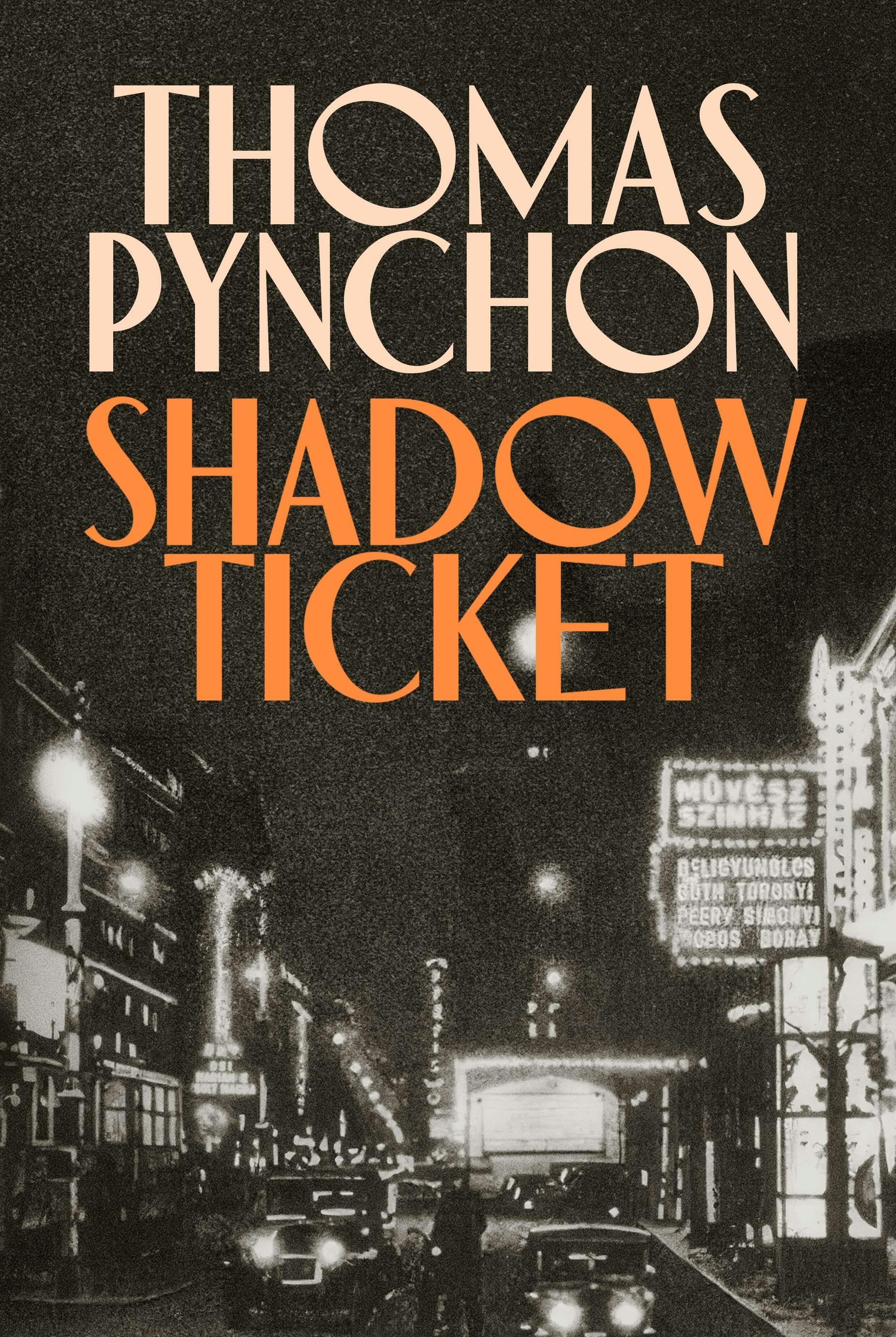
Shadow Ticket is a breezy detective pastiche à la Inherent Vice and Bleeding Edge, in which investigators of dubious aptitude become entangled in conspiracies too elaborate to figure out. It begins in 1932 Milwaukee, where The Great Depression and Prohibition provide fertile grounds for radical ideology to bloom. Guiding us through the heyday of riots, mass unemployment, and organised crime syndicates is Hicks McTaggart, an ex-strikebreaker working as a private eye for the Unamalgamated Ops agency and Pynchon’s dimmest detective to date.
In the first chapter, Hicks is given the ‘simple assignment’ (or ‘ticket’ in P.I. slang) of locating runaway Daphne Airmont, daughter of Bruno Airmont, a.k.a. the ‘Al Capone of Cheese’. The alleged ‘simplicity’ of the job is an ironic wink. On the very same page, a ‘sudden commotion’ brings another plot to the fore: the hooch van of one Stuffy Keegan, outlaw liquor merchant, has been bombed, and Hicks is given another ticket to investigate.
Many other tickets will be thrust upon Hicks, none accepted willingly. Diversion, rather than development, is the logic that governs a Pynchon novel. A line from the nightmare scene that opens Gravity’s Rainbow provides us with a helpful lens: ‘this is not disentanglement from, but a progressive knotting into’. Thus, Pynchon eschews the familiar shapes of narrative (the pyramid, the circle, the line) and plots his novels out like circuit boards – networks of irregular nodes, thin-wired pathways, no clear beginnings or ends.
The second half of Shadow Ticket sends Hicks out of Depression-era America to Hungary and Eastern Europe, where Daphne Airmont has allegedly fled with her clarinet-playing lover. Meanwhile, Stuffy Keegan, pursued by unknown operatives, leaves Milwaukee in an Austro-Hungarian U-boat lurking in Lake Michigan, an improbability at least partially based on fact. When Hicks arrives in Hungary, the plot loosens even further as we tour pre-WWII Eastern Europe, usually on motorbikes, with diminishing regard for scene-setting or verisimilitude. Hicks struggles to sort out his multiplying tickets: an Interpol officer enlists him, hoping that Daphne will lure Bruno, also at large, out of hiding; renegade groups of Nazis terrorise the countryside, seemingly without retribution; desperate exit plans are formed by local Jewish people; and objects start to disappear and reappear in instances of theosophical phenomena known as asporting and apporting, respectively.
Just like Hicks, we are caught in a web with no spider. This free-floating, associative, ragged plot logic bestows upon Pynchon enormous license to explore a wide range of subjects. These include the rise of fascism and antisemitism in Europe and the U.S., the links between dairy-industry monopolies and organised crime, the history of private investigators, labour disputes, the geopolitical and economic instability of Hungary following the Treaty of Trianon, and the various technological and mechanical innovations of the day. As William Logan quipped in a review of Against the Day, Pynchon ‘does everything possible to prevent the reader from taking his novels seriously’. And so these weighty subjects are nestled among characters breaking out into song, bizarro names like Glow Tripforth del Vasto and Zoltán von Kiss, coincidental reunions, carnivalesque set pieces, and gutter jokes.
Pynchon’s earlier novels fused surface-level goofiness with Rabelaisian obscenity to render atrocity as ridiculous. And as with Rabelais, each jest was dead serious. For example, in trying to explain what Gravity’s Rainbow is about, I could say that a V-2 missile strikes the precise location where Tyrone Slothrop has just had sex, and that the book is a wild goose chase – secret operatives hunting down Slothrop, while Slothrop is unable to keep it in his pants. But doing so would overlook the ironic underside of Pynchon’s absurd premise. ‘Oh sure,’ you can hear the author coolly suggest, ‘and the other reasons for bombing people make sense?’ The humour in Shadow Ticket is, assuredly, lighter, but it does contain Pynchon’s funniest scene, which occurs when, one drunken night, Bruno Airmont, the ‘Al Capone of Cheese’, runs into the real Al Capone: