
My mother neared the end of her pregnancy with me during summer, when the heat stretched into the forties. Sweaty and heavy, she was fed up with waiting, so she went up to the piggery to help my father dig a trench, in the hope that her waters would break.
In the Still of the Page
Adele Dumont on Jessica White’s ecobiographical writing and paying attention
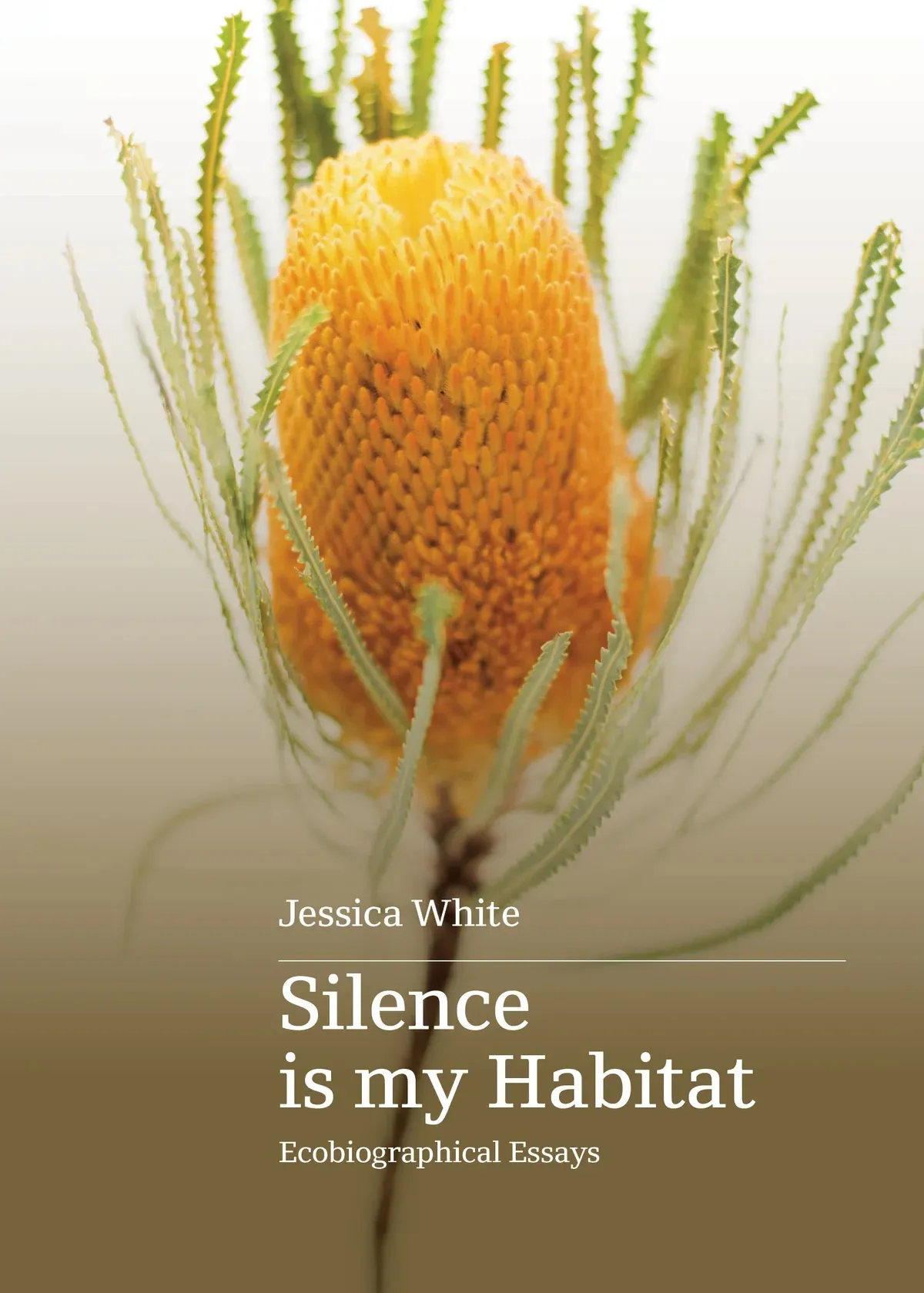
Reviewing Jessica White’s Silence is my Habitat, Adele Dumont traces the interweaving of nature, bodies, disability, and history throughout the collection – and what the essays say about the value of stillness, attention, and care.
I: NATURE
Jessica White’s portrait of her early childhood on a remote farming community in northern New South Wales is one thoroughly grounded in place. She and her brothers build forts from ti-tree branches, and small dams from mud and twigs. She helps her father channel sheep into their pens. On bus trips, the vibrations of the corrugated roads and the cattle grids travel through her body. Human and nature are enmeshed: ‘The soft grass on the creek’s banks, the speckled stones and the twisting water all lodged beneath my skin.’
This rural world is very recognisable to me, having grown up on citrus orchards in western New South Wales. As a girl, I was intimately familiar with the sprawling, overgrown trees. Their leaves: waxy and foresty-smelling. Their blossoms: pea-sized buds, elongating with all their secret growth cocooned within, until they opened into five petals crowning a compact cluster of stamen. The swelling fruits: first green, then orange, then green again, to protect themselves from the sun. I knew the exact consistency of the soil, too, just how much water to add to form something pliable, the texture such that if one looked closely one could see, imprinted, the lines of my small palms.
That we are bound up with our physical surrounds is a truth, I suspect, that many young children understand at a bodily level. It’s a truth that seems to have embedded itself in White, and that is central to Silence is my Habitat.
As a young woman, White encountered – quite serendipitously – the writings of nineteenth-century botanist Georgiana Molloy. She was struck both by Molloy’s courage in leaving England for Australia, and her descriptions of Australian flora, which shift in tone from disinterest to rapture. In the years since, White has travelled to Molloy’s native Cumbria; to Scotland’s lochs and peninsulas, to retrace Molloy’s steps; and to the coastal southwest region of Western Australia (Wadandi Noongar Boodja), where Molloy landed with her husband in 1830.
White’s approach to research and to history strikes me as beautifully embodied. It’s one which understands the power of place to mould a person, and which stands in contrast to three existing biographies of Molloy, none of which convey the significance of the Wadandi Noongar region to Molloy. White wants to write ‘something which detailed the imbrication of Molloy’s self with her environment, and which accorded weight to the plants that shaped her’. White’s use of the word ‘imbrication’ is fitting, conjuring as it does overlapping patterns in nature: pebbles on riverbeds aligning to dip upstream; the scales of fish, and reptiles, and pinecones. It’s also an apt image, I think, for White’s essays in this book, where nature, bodies, disability and history all intersect and tesselate in intricate ways.
White says she ‘reached out for a word to grasp this synergy of self and environment’ and landed on ecobiography. The term, notes White, first appeared in 1996, in an essay by Cecilia Konchar Farr and Philip Snyder; they write that in an ecobiography, it is ‘impossible to tell where the Self ends and Nature begins’. White may have been led to this form via Molloy, but the main subject of her ecobiography is not Molloy. It is White herself. My child-self, the one so at home in the orchards, doesn’t find the notion of ecobiography a peculiar or abstract concept, though I do find it telling that the word isn’t in wider use.
Through her descriptions of family members, White describes various possible orientations to the natural world. Her mother, for instance, took great pride in her garden, tending lovingly to her irises and roses, her children all the while ‘in her orbit’. Having migrated from Christchurch, she also found gardening a way to ground and orient herself in rural Australia, which seemed a ‘strange place’ after the ordered, suburban streets of her hometown. White’s father had a farmer’s broad, practical understanding of the land. He knew about cloud formations and locusts, about crutching sheep and feeding pigs. White is excellent at sketching the enmeshment of family, animals, physical labour, and place:
Georgiana Molloy, for her part, had a more scientific approach, collecting tiny seeds and specimens for the English horticulturalist, Captain James Mangles. What struck me is that White doesn’t judge one of these approaches – horticultural, agricultural, or taxonomical – as more valid or more authentic than any other. And underpinning this, always, is Indigenous knowledge and care for Country.
At times this acknowledgement is done explicitly: White details specific seasonal connections Wadandi people draw between the land and the sea in their country, like the flowering of the acacia coinciding with the migration of whales. At other points, it is more subtle, like when she describes her own growing awareness, as a child on the farm, that ‘before the land was fenced, many other feet were cooled by the stones and water’.
This ancient reality and history doesn’t obliterate or diminish her family’s – or Molloy’s – ways of connecting to the natural world. This is not an easy tension to hold, but White does so with a lightness of touch. I was reminded here of John Kinsella, who descends from a long line of farmers on the Western Australian wheatbelt. He grew up shooting rabbits and trapping birds, and recognises the real sense of belonging farmers have, not knowing any other place. But this belonging is of course fraught, since ‘the European rural is laid over the Aboriginal land’. In his region, European farming methods have devastated the land: vast tracts have been laid to waste by salinity. Writes White:
I think about my forebears and the way they tore up Country, so tightly bound with story and family, the way that they pulled out tree after tree, clearing the land so hard that it sweated salt.
I find it difficult to reconcile this history with my mother’s practices of watering her pot plants and spreading mulch on the vegetables, with my father’s sowing and watching the wheat, and yet they are connected.
That the grasses and creek-water ‘lodged beneath’ White’s skin is true not only in the figurative sense. White introduces the onset of her disability thus:
Perhaps my nails were rimmed with dirt from digging, and perhaps that is how a shred of bacteria, whose ancestors were the first forms of life on earth four billion years ago, entered my body one spring morning a few months before my fourth birthday.
The sentence is remarkable for the way it contains the ancient and the present; the cosmic and the commonplace. White goes on to explain how she contracted bacterial meningitis, which left her with no hearing in her left ear and half in her right.
In a curious looping, the natural environment may be responsible for White’s deafness, and White’s deafness heightens her relationship with these same surrounds. Since she cannot fully or easily participate in conversations with hearing people, as a child, she turns ‘observant and quiet’. Her attention turns to ‘a honeyeater’s beak digging into a nearby grevillea, the morning sun on my forearms, the thick scent of flowering oleanders’. She observes how pigs on the farm get slaughtered, and kangaroos shot, and wonders where she fits in the ‘hierarchy of animals’, since ‘I wasn’t seen as fully human by people who laughed at me when I misheard what they were saying’. But there is scant self-pity here, more a sense that these people are misguided; if she feels a kinship with animals she wonders ‘if this was such a bad thing’ after all.
Other essays in the collection invoke the natural world in a more figurative way. In ‘The Breath Goes Now’, which charts her mother’s declining health, she braids together arboreal imagery when describing the human respiratory system: a lung resembles an upside-down tree, the windpipe a trunk, the alveoli bunches of leaves. She worries that with more frequent bushfires, trees won’t be able to ‘catch their breath’. The kind nurses who treat her mother remind her of the mycelium in roots, ‘connecting the community out of sight’. In ‘Quintessence’ the golden orb spider is real, but its web – silken, sturdy, ‘built to last for years’ – becomes a delicate metaphor for her relationship with her partner Bruce (who is fascinated by the creatures).
Like Sarah Sentilles with her book Stranger Care, and Lucy Jones with Matrescence, White is positioning her own narrative within the context of a wider ecology, illustrating our interdependence with other species. Sentilles writes of her and her husband’s experience fostering a newborn baby. Her personal narrative is spliced with intricate descriptions of the natural world – female hornbills, fungal root systems, and ‘mother trees’. Jones writes of the monumental shifts – physiological and psychological – that motherhood brings. She too interweaves depictions of the natural world: slime mould, vampire bats, and eels.
Both Sentilles and Jones complicate assumptions about biology and the nuclear family; both suggest we humans might stand to learn from other species, with their alternative models of kinship and caregiving. But with each, I had the sense they were using the natural world primarily to think through aspects of the human one. What sets White’s work apart, I think, is that the human and the non-human are inseparable, and given equal weight. As a writer, she may exploit the metaphorical potential of the natural world, but this never feels in the least contrived or abstract. Her creek feels first and foremost a creek; her animals, before they are turned into metaphor, are flesh, fur, and blood. It feels, always, that White is drawing from a familiar realm, within reach: that the natural world is always speaking to her, in both physically tangible and poetic ways.
II: SENSES
White’s writing is rich and open to the world, and this is thanks to the aliveness of her senses. Perhaps this is especially striking for me since I’ve long equated my own condition with a sharp narrowing of sensory experience.
In my own case, as a result of my decades-long trichotillomania, my fingers have developed extreme dexterity. They can detect through touch alone with almost perfect accuracy whether an individual hair on my head has its root attached or is on its way to shedding, and know how to remove the former kind so the root stays intact (for this is one of the strange details that my illness has fixated on and deemed important). When my urges to pull rise up, it’s become second nature to me to keep track of precisely who is where, and to know whether I am in their field of vision, all so I know whether I can pull without being seen. And part of this tracking is through sound. I wrote, in the memoir of my illness, that ‘I have developed the hearing of an animal’. My senses are heightened, but in a manner so extreme that it becomes a narrowing. My field of attention becomes so constricted that I become oblivious to anything beyond it.
But White’s hearing loss means her other senses are heightened, and it seems to me her field of attention is enlarged. The technical explanation for this, says White, is ‘cross-modal plasticity’: deprived of information from one sense, the brain will try to compensate through the other senses. This phenomenon is evident throughout White’s writing, which feels intensely physical. There is the warmed flank of a whippet; the sting of hand-sanitiser on her hands (cracked from too much hand-washing). Smells are particularly present. To be able to tell when her flatmates are up in the mornings, she learns to detect the aroma of their shampoo and the coffee on the stove. The farm is especially dense with scent. Her ‘smellscape’ she says, is ‘like light and dark’: the petrichor smell of soil after rain; the odour on dogs when they’ve found a sheep carcass in a paddock, or on a cat when she’s been rolling on licheny rock (or, alternatively, in sheep shit).
And sound is not absent from White’s writing. She notes how colonisers introduced British songbirds to Australia, to replicate the soundscapes they’d left behind, and in this way to render their new homes less foreign. For her, too, sound has this grounding function. As White grieves her mother, black cockatoo calls are ‘a small foothold’; a ‘place’ where she is ‘held’. And on trips to the east coast, the sounds of whipbirds connect her back to family.
White reminds us of the importance of sound in natural environments, citing various studies from the field of ecoacoustics. In the Great Barrier Reef, for example, baby fish use the snapping, chirping sounds of shrimp and damselfish to locate good habitats, but the reef of late has ‘become too quiet’. Even soil makes sound: specialised microphones can hear earthworms’ movements. Not surprisingly, healthier soils are associated with a higher diversity of noise.
‘If ecosystems are quiet’, White concludes, ‘it seems that we should pay attention to them’. And it is this attention that White models in her essays. Amid the rich sensory detail of her writing, I was reminded that appreciating the natural world is only partly a question of auditory or visual or olfactory ability. In our age of distraction, such appreciation requires us first to rest our attention.
Writer Mary Gaitskill believes that paying attention to the physical world has become extremely undervalued (among writers, but also in life). It saddens her that people at once express concern about climate change but aren’t interested in ‘other humans’ visions of what the planet they want to save looks, feels and sounds like, and […] even less interested in writing or just noticing what it looks like to them’. I suspect she’d find some reassurance in White’s vision, in her quiet attention and care for the world.
White does not frame silence as a lack or absence. It can be restorative and precious, conducive to writerly focus. A deaf colleague of hers removes his cochlear when he ‘enters the space of thinking, reading and writing’, and White does the same with her hearing aid. I do a version of this, trying to muffle external noise by playing Spotify’s Thunderstorm tracks through my headphones. I also find the slight paradox interesting: how sensory restriction can sometimes help facilitate the sensory richness of one’s writing.
Fiona Murphy, in The Shape of Sound, describes with startling clarity the daily clutter of noise, the immense cognitive effort required for a deaf person to contend with so much of it. White too makes plain the struggle of existing in a world made for hearing people. She is routinely beset by anxiety: at misunderstanding people, or not hearing them at all; at needing to ask people to repeat themselves. She relies on reading people’s faces, an exhausting process.
An especially interesting strand of White’s memoir is her experience of the pandemic. Many have noted how this period played havoc with all our senses: social distancing creating ‘touch hunger’ and shrinking our perceived personal space; the disruption of routines making time feel by turns compressed or oddly dilated. For White, people’s masked faces added a further layer of struggle. But when it came to the ‘Zoom fatigue’ many people described – the lag in communication, the decoding, the intense concentration – White couldn’t help but relish people’s frustration. ‘Without the pandemic, they would never understand what it’s like to be deaf’. A similar sentiment is described by Fiona Wright, who on account of her chronic illness was used to the world feeling ‘uncomfortable, unreliable, unstable’, and felt a strange solace when everyone had to suddenly adjust to working from home, something which, by that point, she’d been doing for years.
But the pandemic for White is analogous to deafness in another, more positive way, offering reprieve, and release. DeafSpace is an established concept in architecture and design, describing an approach which uses space, acoustics, and colour in ways that benefit deaf people. White proposes an analogue to this: Deaf Time –
a condition of stillness and watchfulness.
Would a return to Deaf Time, to deaf moments, to the time of Covid-19 and the time of childhood, help with slowing down?
I found this framing beautiful. And sad because it made it clear to me that so much of White’s struggle is not inherently about her deafness, but about society’s failure to accommodate her. Of course this is the tenet of the social model of disability. But it is White’s achievement to sketch, in vivid detail, what this means.
Recoiling at the over-used phrase ‘new normal’, Wright says in her essay, ‘On Being a Precedent’, ‘I hate how normal we find the idea of normal, how many other narratives and experiences and people it excludes and elides and diminishes.’ In White’s case, since hearing is the assumed, ‘normal’ state, ‘I am always pushing myself into the world of the hearing, and always accommodating’.
Maybe I was more conscious of it in the days I read White’s book, but I wondered why we did think we needed so much noise. The local library I sat in had a coffee shop with commercial radio, and I turned my Thunderstorms track up to the highest volume to drown it out, unsuccessfully. I would opt for the quiet carriage on trains that had them, but even there, people played YouTube videos without headphones. If society were more comfortable with stillness, and silence, and quiet spaces, it might benefit us all.
III: WRITING, READING, BOOKS
I remember reading somewhere that there are two kinds of reader: the sort that treats books as a pleasurable pastime, and the sort that needs books, that couldn’t conceive of a life without them. I suspect the same might apply to writers – that there are those who not only need to read words but to generate them – who turn to the page for solace and for a place to express the otherwise inexpressible.
When she was younger, says White, absorbing herself in books, and connecting to characters, was a way to ignore her ‘chronic longing for other people’, like ‘dry air waiting for the touch of rain’. In the weeks following her mother’s death, the days are ‘crushing in their formlessness’, and again, writing helps her through. When she is haunted by a longing for a child, she immerses herself in reading and writing as well.
She describes doing archival research, where she doesn’t need to strain to hear people’s voices, or to focus intently on reading their lips. ‘It’s easier for me to hear people in the archive’. I love this use of the verb ‘hear’ – the idea of a voice on the page being more audible, less fraught.
One senses, as White recounts researching Molloy, more than just intellectual curiosity – something like kinship. Molloy lost two of her children; White lost a sibling very young. Molloy turns to the natural world to ‘dispel the sad blank’ her children’s deaths occasioned. For White, the natural world factors into her own thinking about children, albeit differently, through concern for the environmental impact of bringing new life into the world. There is also the satisfaction that both White and Molloy take in their work; a sense of ‘purpose and vocation’. In 1840 Molloy wrote, ‘when I sally forth either on foot or Horseback, I feel quite elastic in mind and Step’.
White’s deafness is what draws her to the world of books, and it is this world that helps her situate her experiences within a larger history. She writes that she ‘met’ Maud Praed in the archive, the verb here speaking to the personal nature of the encounter. In reading how deafness shaped Maud’s life in the late nineteenth and early twentieth century, she sees how it has formed hers, too. Despite both women being born a century apart, history reverberates in, for example, ongoing assumptions around the primacy of speech, and the need to integrate deaf children into hearing society – beliefs which mean that White is raised oral-deaf and never learns to sign. (Fiona Murphy, too, recounts imbibing similar beliefs, at points proud of having ‘beaten’ her deafness.)
I have some sense of how White might have felt, encountering these women on the page. At the time of writing my own book, I had never met someone with my condition, and so when I came across Bezoar by Guadalupe Nettel, which describes my compulsions with extreme precision, it stopped me in my tracks.
For White, it is through words that she is able to curb her sense of isolation – to connect to her ‘flock’; ‘through writing we join those who have flown before us’.
She finds parallels everywhere. Poring over Maud’s letters, she recognises her own obsessive letter-writing tendencies, and her tendency to people-please. In Fiona Murphy’s work, she finds ‘a mirror’ for her own experiences. Reading Donna McDonald, she identifies with her ‘sense of not really being in either the world of the hearing or the deaf’ and is moved to write to McDonald directly. When it comes to the natural world, she connects to contemporary Australian writers like James Bradley. If there is a loneliness to our predicaments, perhaps this is the strange silver lining; this depth of connection to people in books, speaking across place and time.
I’ll share here that before I met Jessica White through this book, I met her in person. We sat beside one another at a formal dinner at the National Library. She was warm, vivacious, and funny, and she put me at ease. When my boyfriend, seated on my other side, jumped up mid-meal to fix some ceiling panels, which had chosen that inopportune moment to collapse, she laughed.
Now, I have the feeling, of having ‘met’ White twice, but on each occasion for the first time. Here is another kind of meeting, one that is only possible in the quiet of the page.
For the longest time I resisted writing about my condition – partly because the shame of it cut so deep, partly because I felt it had already stolen so much from me that I didn’t want it to intrude into the space of my writing. While White is now open about her identity as a deaf writer, she shares her initial resistance to writing about it. It was later in life that she saw how, actually, deafness was ‘in all the gaps in my life’.
Such resistance, it turns out, is not uncommon, as White details in her discussion of well-known writers, paying attention to their deafness. Having majored in Australian literature, I found the names White mentions – Judith Wright, Henry Lawson, Les Murray – very familiar. But although we applied all manner of theory and lenses in class, there was never any mention of disability.
Although Judith Wright, in an interview, claimed that her deafness wasn’t an important part of her life, White refutes this: while most criticism of Henry Lawson’s work failed to acknowledge his deafness, Wright explicitly recognises its impact. In her book on Lawson she refers to the isolation deaf people are forced into, and that this isolation ‘spurs imagination’. For White, Wright’s deafness is also connected to the idea of ‘negative poetics’, the idea of the limits of language when it comes to writing about the natural world, and she proposes that Wright, by virtue of her deafness, had an acute awareness of these limitations.
Elsewhere, White observes that, although Patricia Carlon’s deafness was not really known about during her career, and although Carlon’s characters are not deaf, many aspects of her work were likely informed by her deafness, like the themes of secrecy, passing, hiding.
It is fascinating to me to revisit these writers with this new framing; to think about all the hidden or overlooked histories that churn beneath official, published ones.
Fascinating, too, to think that in an earlier era, a book like White’s might never have come to exist. But now – in the slightly magical way that literature permits – we gain access to White’s sensorium, and to that of her forebears. Silence is my Habitat is testament to the power of the written word to integrate all parts of us, across time, including the omitted, the hidden, and the unseen, and to bring these into the light.