
One day I noticed the word fourteen in a novel I was reading. The
next day it happened again, in a newspaper article, then a TV show,
a film, then another book. Fourteen. 14. I did not go looking for it. It
came to me. Now I can’t look away.
Piecing Together in the Afterlife
Rosalind Moran on the challenge of writing trauma
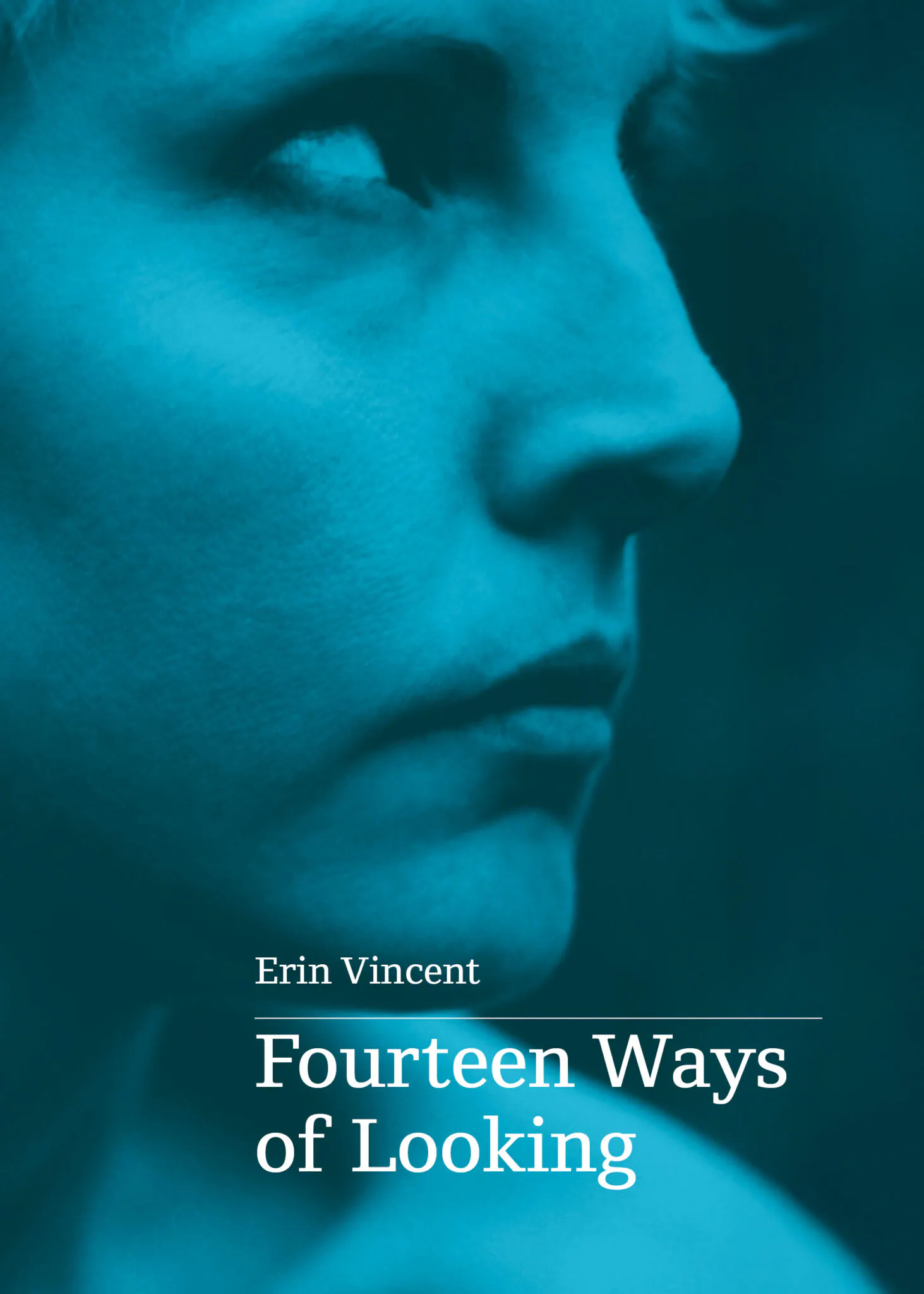
Fourteen Ways of Looking is Erin Vincent’s second book about her parents’ death and the indelible mark it has left on her life. Rosalind Moran observes how the work’s fragmentary composition provides a fitting vessel for trauma’s expression.
‘At fourteen there were no words.’
So writes Erin Vincent in Fourteen Ways of Looking, her first full-length creative work since Grief Girl, which was published in 2007. When Vincent was fourteen, her parents were hit by a speeding truck while crossing the road, with her mother dying at the scene and her father following four weeks later. She, her seventeen-year-old sister, and her three-year-old brother were left orphaned. It is no wonder that, in the face of such tragedy, and at such a young age, Vincent struggled to find words to capture the extent of her grief, or to advocate for herself in the aftermath of her parents’ death. In Fourteen Ways of Looking, however, Vincent works to piece back together her sensations and memories from when she was fourteen, and give voice to what hitherto had been largely unspeakable.
This book is not Vincent’s first attempt to capture her experiences; however, it manages to be understated and poignant in ways that the more narratively conventional Grief Girl arguably does not. Grief Girl is narrated from Vincent’s perspective as a fourteen-year-old experiencing the aforementioned traumatic event; on writing the book, Vincent explains, ‘I decided to write Grief Girl in my 14-18 year old voice, so when you read it you feel like you’re there with me.’ By contrast, Fourteen Ways of Looking is written from a more distanced, adult vantage point, offering a less immediate perspective that is in many ways more nuanced: here, Vincent is writing not only about her experiences, but also about the act of remembering and seeking to write about them. Jeanette Winterson has done something comparable, exploring the traumas of her own childhood in the semi-autobiographical novel Oranges Are Not the Only Fruit (1985), then revisiting these in her memoir Why be Happy When You Could be Normal? (2011). Although Oranges and Normal cover similar ground, Winterson in Normal offers an enlarged perspective in which she writes not only about her childhood, but also about the experiences of reflecting on, living with, and writing about it – both previously in Oranges and in the then-present moment of writing Normal. Normal consequently recontextualises Winterson’s life, ultimately conveying a more frank and emotionally open perspective on the experiences that she transfigured into a half-fiction, a personal fable, in Oranges. Vincent’s Fourteen Ways of Looking functions similarly in relation to Grief Girl.
Fourteen Ways of Looking is experimental and nonlinear, self-reflexive and ruminative and searching, its very structure mirroring psychological turmoil. The book’s style and form amplify the emotions within its pages. Told in fragments, it is a book compiled of sensations, memories, observations – some from Vincent in the present, and others based on recollections or notes that she has jotted down over the years, the number ‘fourteen’ having for her taken on a haunting quality, perennially drawing her attention. In Fourteen Ways of Looking, Vincent returns to the number repeatedly, circling around it, as if by identifying it in its myriad contexts she might finally find a pattern, a reason, as to why the tragedy befell her family when she was a teen.
Fourteen Ways of Looking is a mixture of memoir and found documents: lists, instructions, quotes, serendipitous discoveries. ‘It is advised that sutures be removed within fourteen days.’ ‘“I Thought That I Could Not Be Hurt” was Plath’s first tragic poem, written at age fourteen.’ ‘In the list of permission credits for The Penguin Book of Oulipo the number 14 is missing.’ And the like. The reader encounters these passages much, one speculates, as the author might have done – in a disconnected way, each one drawing the eye and gaining greater significance precisely owing to the mindset observing it. Indeed, through her work, Vincent shares her personal connection to and preoccupations with the number fourteen, and the reader thus comes to view the number as she does.
This is an effective stylistic decision on the author’s part. It draws author and reader closer together, allowing the reader a window into another person’s grief and thought processes; and it also brings the reader on board for the author’s potentially lifelong project – both conscious and subconscious – of seeking some deeper meaning in this arbitrary number and the events accompanying it that came to shape her life.
How does one make sense of a tragedy when there are no plausible explanations for the injustice of it? Part of the poignancy of Fourteen Ways of Looking comes from the adult perspective through which it is told, the author interrogating tragedy a full four decades after its inciting incident occurred and realising, repeatedly, that it fundamentally does not make sense. ‘When I was fourteen people told us everything happens for a reason,’ she writes – a sentence capturing how quick people can be to search for explanations, causes. Yet as the very structure, or lack thereof, of the book shows, sometimes there are neither reasons nor justifications, and to articulate these in the face of horror is to speak platitudes. Even to impose a narrative structure on such events might imply a sequence of cause and effect that simply does not exist.
Thus, the removal of clear chronology from Fourteen Ways of Looking is one of its greatest strengths, and not solely because it captures the dissolution of time one may experience as the result of trauma – the presentness of the past. The removal of chronological structure also captures how extremely traumatic incidents, such as life-altering accidents or disasters, often exist beyond the cause-and-effect way of thinking so prevalent in many people’s understandings of the world. Indeed, the non-sequential presentation and nature of the text’s fragments mirror the tumult of an uncommonly terrible event and its aftermath. How could it happen? There will never be sufficiently convincing reasons; sense to make of it; a moral or a lesson to take away; a narrative arc.
The departure from linear storytelling in Fourteen Ways of Looking will be familiar to readers of modern creative nonfiction, not to mention memoirs such as Maggie Nelson’s The Argonauts and Carmen Maria Machado’s In the Dream House. However, Vincent’s decision to write in this way also echoes an ideological shift that took place much earlier than the 2010s – specifically, in the early and mid-twentieth century – and which resulted in a seismic shift in writing practices. In Unlikely Stories: Causality and the Nature of Modern Narrative (1997), literary scholar Brian Richardson posits that the structures and underlying beliefs authors incorporate into writing fiction have developed alongside human understandings of cause, with these evolving – especially in European and Western literary traditions – ‘from indigenous notions of preordained fate, destiny, and doom to Christian beliefs of providence to eighteenth- and nineteenth-century mechanistic concepts of determinism to, most recently, relatively modern ideas of chance, randomness, and indeterminism’. He argues that the experimentalism of modernist and postmodernist fictions runs parallel with changing mores and beliefs over the course of the twentieth century, following society’s shift away from the mechanistic determinism of the Enlightenment, towards belief in indeterminism and chaos.
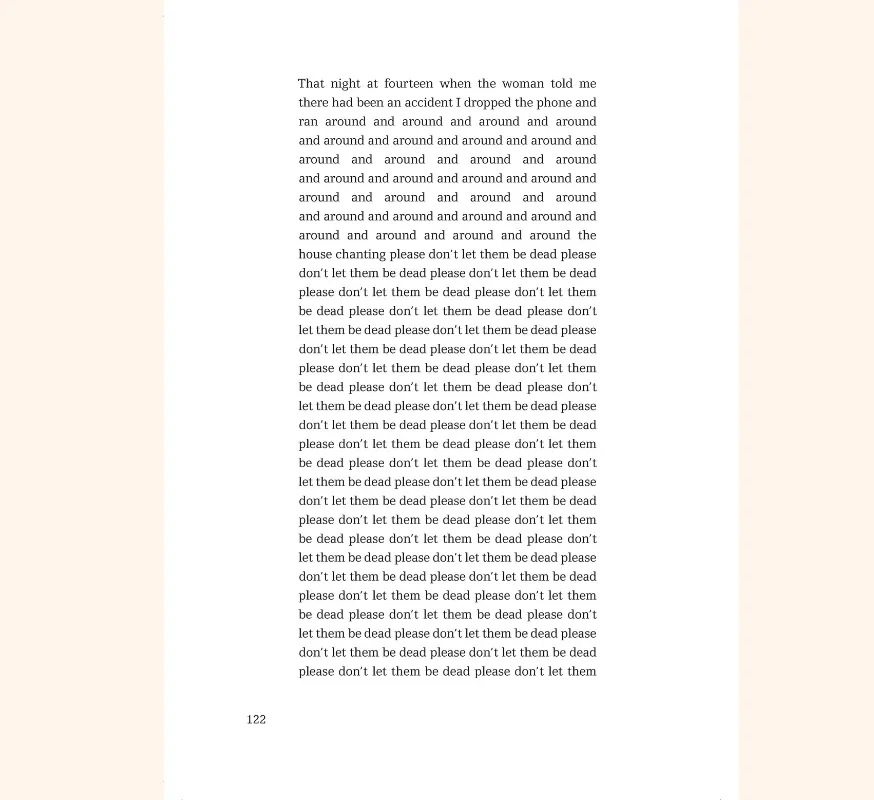
Indeed, Fourteen Ways of Looking not only emblematises the move away from the notion that stories must make sense, but also a loss of faith. Her parents’ deaths changed Vincent’s relationship with God – and her belief in there being any god at all – permanently. ‘At fourteen I still believed in God,’ she writes. ‘I knew He existed because He had punished me. He had heard that voice and decided to make me pay. Later I would drop the capital H.’ She writes of bargaining with God – bargaining that runs throughout Grief Girl’s opening scene, where fourteen-year-old Erin learns that her parents have been involved in an accident and repeatedly entreats God to spare their lives, with pleas such as ‘I pray. Please, God. Don’t let them be dead. I’m begging you. I’ll do anything’.
In Fourteen Ways of Looking, the bargaining remains, but Vincent’s disillusionment with a purportedly omnipotent, rational creator is captured more succinctly – as well as with an undertone of accusation:
At fourteen I called God.
God said, Sorry, wrong number.
[…]
At fourteen I called God.
God said, Sorry, please hold.
[…]
At fourteen I called God.
[…]
At fourteen I called God.
God didn’t even bother saying sorry.
[…]
At fourteen I called God.
God didn’t pick up.
Where Grief Girl opens with Vincent repeatedly seeking to converse with God, Fourteen Ways of Looking shows her as being, above all, in conversation with her current and past selves. Looking back on her younger self, Vincent is able to bring new perspective to the experiences she lived through as a teenager, as well as to how these experiences have continued to permeate her life and her ways of seeing. For instance, reflecting on her childhood innocence being cut short, she writes: ‘By fourteen I’d stopped wearing my Little House on the Prairie cap to bed and yelling out “Night Ma! Night Pa!”’ Unlike those who experience a more gradual transition into adulthood, Vincent lost such innocence almost overnight. Fourteen Ways of Looking captures what it can be like to exist in this no-man’s land between innocence and experience; especially tragic too, by consequence, are the hints scattered here and there that various adults encroached on and exploited her during this period of vulnerability.
Fourteen Ways of Looking is hardly an easy book to read. It goes by quickly, the spaces and silences between the fragmented passages taking up much of its pages. Yet it is also – insomuch as a book can be – a gut punch. From the moment the book opens with the unsettling, evocative image conjured up by the words, ‘At fourteen I saw my mother fly,’ followed by a description of Yves Klein jumping out of a window for the sake of creating the perfect photograph, one knows one is in for a confronting reading experience – one that blends death with art, and childhood memories with adult sensibility and precision.
Vincent seems to choose every word with care, keeping passages short, allowing the reader the mere glimpse of a memory or an observation before moving smoothly to the next artefact. This writing style is highly effective in telling this particular story: by keeping her prose so measured, so steady and calm, there is immense power in the moments when Vincent occasionally loosens her grip, permitting the uncontrollability of grief to coalesce directly on the page. For example, it is a shock after so many pages of such deliberately restricted, controlled, tempered prose, to encounter a wall of text that so viscerally captures the experience of trauma – and the inability of words or verbal expression to ever truly do it justice:
Paradoxically, the very qualities for which I argue the book deserves praise might also offer the most compelling reasons for viewing it through a more critical lens. A side-effect of writing a highly non-narrative text composed of fragments is that it demands different metrics by which to judge the book’s composition – for the artistry of more conventional composition and structuring is less applicable. Who is anyone to say whether the sentence describing Chapter 14 of the Book of Job – a standalone fragment in Vincent’s book – ought to come earlier or later than the observation ‘On April 14, 1938, Ugo Cerletti and Lucio Bini gave the first electroconvulsive treatment for mental illness, namely schizophrenia’?
Fourteen Ways of Looking is a tapestry of such passages, and while many do serve to amplify the pieces of memoir with which they are interspersed, many others seem to exist primarily to juxtapose haphazardly with these autobiographical passages, thereby evoking the incongruousness of seeking to continue living while coexisting with grief. Yet this technique is effective overall, and in keeping with the text’s subject. Indeed, the unpredictability of this tapestry, and the disorder of its pieces, speaks to the text’s broader thematic mission: that of conveying the impression of being within a puzzle that the author is seeking to piece together. As Vincent herself writes:
As I try to put this book together I am in a jumble; I can’t keep my
thoughts straight. It’s as though someone has thrown an old, faded
5,000-piece puzzle on the floor and told me to solve it without
seeing the picture on the box. Oh, and they’ve said I have a limited
time to put it together and if I fail I’ll be failing myself and my past
and my mother. Now go. The clock is ticking.
Nevertheless, there is a picture on the box – and it grows more apparent as the book progresses. In turn, it also largely dispels possible criticisms about the book’s non-linearity and lack of typical storytelling hallmarks: character progression, plot development, and the like. Specifically, Fourteen Ways of Looking gradually reveals itself to be a tale not least about Vincent’s mother, and about seeking to write back to her and rediscover her through this parsing of memories and artefacts.
The absence of both of Vincent’s parents is palpable throughout the book, yet it is the mother who appears lesser known in some ways, posing more of an enduring enigma to her daughter. Small details throughout the text reveal telling aspects of the relationship between Vincent’s parents which would not necessarily have been evident to a child, but which take on new meaning when recalled and re-examined from an adult perspective. This lends the story a searching quality as it becomes clear that Vincent is in part writing to understand not only her own experiences, but also to recover insights into her mother – to whom the book is dedicated, along with Vincent’s husband.
This image of a puzzle, and of Vincent’s efforts to piece together fragments in a way that renders the sum of these greater than their parts, thus offers a key to understanding the book she has written and what she is seeking to create – or reconstruct – through rewriting her personal experiences. Rather than write an overtly character-driven or plot-driven book, or even a more traditional autobiographical narrative replete with detail, Vincent has chosen to gather together the puzzle pieces of memories and serendipitous discoveries connected to both her and her mother, in order to sketch a portrait of them both, and of the connection between them. Tragedy imploded the possibility of Vincent coming to know her mother as well or as extensively as she would otherwise likely have done, particularly in adulthood. Consequently, she seeks to reconstruct some version of her mother via fragments, unstable and inconclusive though these are. Reconstructing a disappeared loved one through literature has precedents: Virginia Woolf’s To The Lighthouse, published almost a century ago in 1927, was written in part out of a similar desire (Woolf’s words, incidentally, feature in multiple fragments throughout Vincent’s work, including at its close). In this vein, Fourteen Ways of Looking seeks to come closer to the reality of a person through the fragments they leave behind and the fragments in which their presence can still be perceived, even when this person is absent.
‘At fourteen I found a lottery ticket in my mother’s copy of Erica Jong’s Fear of Flying’, recalls Vincent in a passage harking back to the book’s opening, revealing faint patterns in the turmoil.
On my mother’s ticket was one [handwritten] word – Alone.’
I wonder, was it a desire to be alone or a feeling of aloneness?
Both, I imagine.
Throughout the book, Vincent wonders: who was this person, really, who died at an age that Vincent herself has lived and passed? This in turn prompts further challenging questions. How can or should a book – or memoir specifically – represent a person who is to some extent unknowable? Can a person be known through the objects they leave behind: the oddly personal book collections, or the cassette tape marked Mum’s Tarot Session? And how does one go about seeking to understand a lost parent from an adult-to-adult perspective, rather than looking at them solely – or at least primarily – from one’s position as their child?
As readers, we do not necessarily come away with a sense that Vincent’s mother can ever truly be known through the objects she left behind – or at least, not in any definite sense. Something Vincent’s memoir does offer, however, is a representation of a person that is inconclusive enough that it allows for the possibility – and indeed, the likelihood – that Vincent’s mother was, like all people, more than the simple labels and biographical details that would have been used to describe her, whether she had lived or died. Death and biography can have a way of flattening people. To again invoke Woolf, who was vocal in her criticism of the kind of biography that emphasised the most overt, measurable aspects of a person’s life over their interiority and contradictions, biographies can risk being akin to ‘wax figures now preserved in Westminster Abbey, that were carried in funeral processions through the street — effigies that have only a smooth superficial likeness to the body in the coffin’.
In Fourteen Ways of Looking, however, Vincent successfully avoids creating such simulacra. Indeed, by not making claims to certainty about her mother’s inner world, she effectively imbues that interiority with the mystery and obliqueness that characterises interiority in real life. Towards the end of Fourteen Ways of Looking, Vincent writes, ‘Is that what I am trying to do, resurrect life? And if so. Theirs or mine?’ It is a question that speaks to many aspects of the book: the intermingling of children’s identities with those of their parents, for example; and the impression that this is a book written from a life that also necessarily exists as an afterlife, in the sense that part of one ceases to exist in the same way when a very close loved one leaves or disappears.
Yet perhaps Vincent, with her ‘Theirs or mine?’ question, is operating here within an unnecessary binary. As her careful depiction of her mother shows, the boundaries between what does or doesn’t form identity are porous; resurrection, too, speaks to a space between life and death, or to the possibility that one can embody death and life simultaneously. In Fourteen Ways of Looking, the present intermingles with the past as Vincent’s own memories, reflections, and artefacts mingle with traces of her mother. All books are, to some extent, a shared resurrection between the author and their subjects. Inherently incomplete and opaque though lives are, literature, at least, offers one way of helping them endure and resurge through their encounters with readers and others.