Our work is made possible through the support of the following organisations:

SRB logoSRB logoSRB logoSRB logo

Seasick

Erin Scudder on Loribelle Spirovski, abjection, and cruise ships

Email to a friendEmail

Cruises are often marketed as floating wonderlands of leisure and luxury, but what unsettling racial and socioeconomic inequalities do they lay bare? Erin Scudder takes us aboard Loribelle Spirovski’s White Hibiscus to navigate the surfacing of personal and collective national trauma occasioned by its ship setting.

Loribelle Spirovski’s first book, described by the publisher as a poetic memoir, plays out in a boat-bound world that is marketed as a perfectly constructed luxury experience. This is typical of such journeys at sea: ‘The promise of a cruise’, writes Vimala Mangat in a Gazettely review, ‘is a meticulously crafted fantasy of indulgence. It suggests boundless buffets, carefree days by the pool, and an escape from the mundane.’ One scene in White Hibiscus captures an instance in which the messaging around idyllic harmony is deafeningly asserted: ‘While passengers disembarked’, the narrator observes, ‘“What a Wonderful World” / played so loudly / over the speakers / that you could do / nothing but sit / and wait for it to finish.’

But the narrator on this journey, Loribelle, is not having such a carefree time. Within this floating world, her nausea is omnipresent and diffuse. Its steady, staccato recurrence through the story springs up in relation to many different situations and encounters, symbolising the multifaceted ways in which abjection – that uneasy, queasy awareness of ever present but potentially permeable boundaries – inflects her journey. Aboard the ship and beyond it, the demarcations between classes, ethnic identities, and personal and public spaces aren’t as simple or as stable as they seem. Nor is Loribelle’s present life a water-tight state: past memories and trauma seep into it, like a leak in steerage, eventually demanding attention.

The cruise ship is one example of what Michel Foucault refers to as a heterotopia, meaning: a place that is a world unto itself, closed off from the world around it, which contains or reflects elements of the larger, shut-out world, even as it distorts and complicates the relationships between those elements. A cruise ship, for example, contains – in floating suspension – a gamut of spaces: those designed for hidden labour and performative servitude, like galley kitchens and reception desks, and those designed for private pleasure and performative holidaymaking, like luxury cabins and swim-up bars. Cruise ships also carry a full socio-occupational spectrum of people, from toilet cleaners to ultra-wealthy clientele. On the face of it, these delimited spaces and hierarchical strata are distinct and impermeable: they may interface with each other but are not permitted to leak into each other or change positions. ‘Our life is still governed,’ Foucault writes in his essay on heterotopias, ‘by a certain number of oppositions that remain inviolable, that our institutions and practices have not yet dared to break down […] for example between private space and public space, between family space and social space, between cultural space and useful space, between the space of leisure and that of work’.

Certainly, most clientele aboard the ship in White Hibiscus seem invested in defending supposedly inviolable spaces and distinctions. When Covid arrives on board, it functions less as a crisis than as a chance to redouble existing commitments to these boundaries and oppositions. A particular kind of elitist social distancing, for example, is already in place: ‘The passengers’, Loribelle tells us, ‘reluctant to be / in too close a proximity / to others – always kept / a polite distance. / I noticed that if they sensed / a crowd forming / they instinctively stepped back / waiting for numbers to disperse / – That’s how you can tell if the clientele is a luxury one.’ Guests are also already metaphorically masked. The wealthy, for example, costume themselves and signify their status in designer labels. The narrator refers to them at one point using sartorial synecdoche, a single sly instance of repetition hinting at the mundane sameness of this exercise: ‘Prada Bag / Ralph Lauren sweater / Chanel espadrilles / Saint Laurent bag / Gucci shirt / Chanel espadrilles.’ The staff uniforms, on the other hand, mask identity complexity under cover of single nationality. ‘Each crew member’, the narrator tells us, ‘had a name badge / identifying their country of origin / so we were waited on by both / Mark Canada and Mark Philippines.’

Perhaps because of the symbolic masking and default distancing already in place, the introduction of surgical masks on the ship becomes ‘quickly and quietly / ordinary’. Compliance with quarantine protocol now infuses, but does not change, established norms around protected personal space: ‘Whenever there were more / than four in a room’ following the Captain’s pandemic announcement, the narrator tells us, ‘guests / would / fumble inside pockets pull / masks / across mouths / look into laps.’

And yet, in heterotopias like this one, the dividing walls between oppositions and dearly defended distinctions can – at least temporarily – weaken or break down. The abject, as described by Julia Kristeva in her essay on the Powers of Horror, lives in this breach: the blurring, the discomfiting overlap, the disconcerting threat of cross-pollination. That which disturbs the division between self and not self is abject, and results in the uncomfortable sense that our own borders are unstable and permeable. This happens, for example, when we bleed, vomit, or transgress social norms, since blood, vomit, and taboo relationships destabilise our sense of what belongs to or can pass in and out of the body or in and out of established groups. The abject, Kristeva writes, is that which ‘does not respect borders, positions, [or] rules’. In heterotopic narrative settings, such as the cruise ship, gastroenteric events – like nausea, defecation, or emesis – can work to signal the point at which this happens: the moment where rigid categories and identities are breached, blurred, or inverted. And the presence of the abject in heterotopic settings provokes discomfort, not just disgust, because it reminds us how precarious and permeable our own identities, statuses, personal spaces, and physical boundaries really are. 

In White Hibiscus, Loribelle has to negotiate a set of uncomfortable borderlands related to socioeconomic strata, ethno-communal identity, and sexual trauma: tilting seasick through hybrid crowds and empty function spaces, she occupies the uneasy overlap between guest and crew,  European and Filipina, and the traumatised self / individual purged of trauma. Technically travelling for work, rather than for leisure, she and her husband don’t quite belong to the category of paying guests, whose showy wealth and dismissive, oversimplistic approach to ethnic identity unsettles Loribelle. Socioeconomically, she therefore finds herself in the position of almost belonging to that which both rejects and appalls her. Similarly, she relates to but does not belong to the group of Filipino crew members (Loribelle the narrator, like Spirovski the author, was born to a Filipina mother and then-Yugoslavian father). There is an unspoken connective membrane between her and the crew, and some quantity of mutual recognition leaks across this membrane – but it nonetheless remains in place, an uncomfortable reminder of her ongoing, untranscendable, part-insider, part-outsider status. And she also is marooned in a liminal territory related to the sexual assault that she endured as a child, unable to forget but equally unable to fully remember and deliver herself from what happened.

There is a potent scene – half real, half dream – in which she envisions her trauma made manifest in the form of a ‘large black mass’ that rises from the floor of the ship’s empty ballroom in the middle of the night; but even as she looks upon it, she is aware that it is both inside and outside her, never fully leaving her through expulsion or expression. As she looks at this thing, both horrified and magnetised, ‘the nausea,’ Loribelle says, ‘was a solid thing / in my chest / as though / the onyx child / standing before me / had its twin / inside / my ribcage’.

Other narratives that take place aboard cruise ships – like Ruben Ӧstlund’s 2022 film Triangle of Sadness, say, or Netflix’s 2025 documentary Trainwreck: Poop Cruise – use nausea and gastrotheatrics, but to different, if spectacular, effect. Triangle of Sadness centres its narrative around catastrophic expulsion: following a comprehensive portrayal of violent seasickness on board, surviving guests are spewed onto a beach, where power dynamics are radically, if temporarily, reshuffled. Here, vomiting and diarrhoea are confined to a single part of the narrative, delivering blunt-force symbolism to signal the abject social reordering underway, but they are not further leveraged for meaning. Trainwreck: Poop Cruise, alternatively, is concerned with grotesque containment: following a failure of power and waste disposal mechanisms, the guests and their shit have nowhere to go but closer and closer to each other. Here, the accrual of bodily waste escalates in tandem with an equivalent, opposite disintegration of previous social norms: the story’s deployment of the bodily unpleasant takes the form of a culminating crescendo. But White Hibiscus defies the narrative impulse to fully contain or expel, fully silence or tell, fully commit to insider or outsider status, fully deliver on a fantasy or completely descend into chaos. Instead, it keeps us in the realm of nausea throughout: the spaces in between, the borderland of me and not-me, the imminent feeling of queasiness that never leads to complete relief.
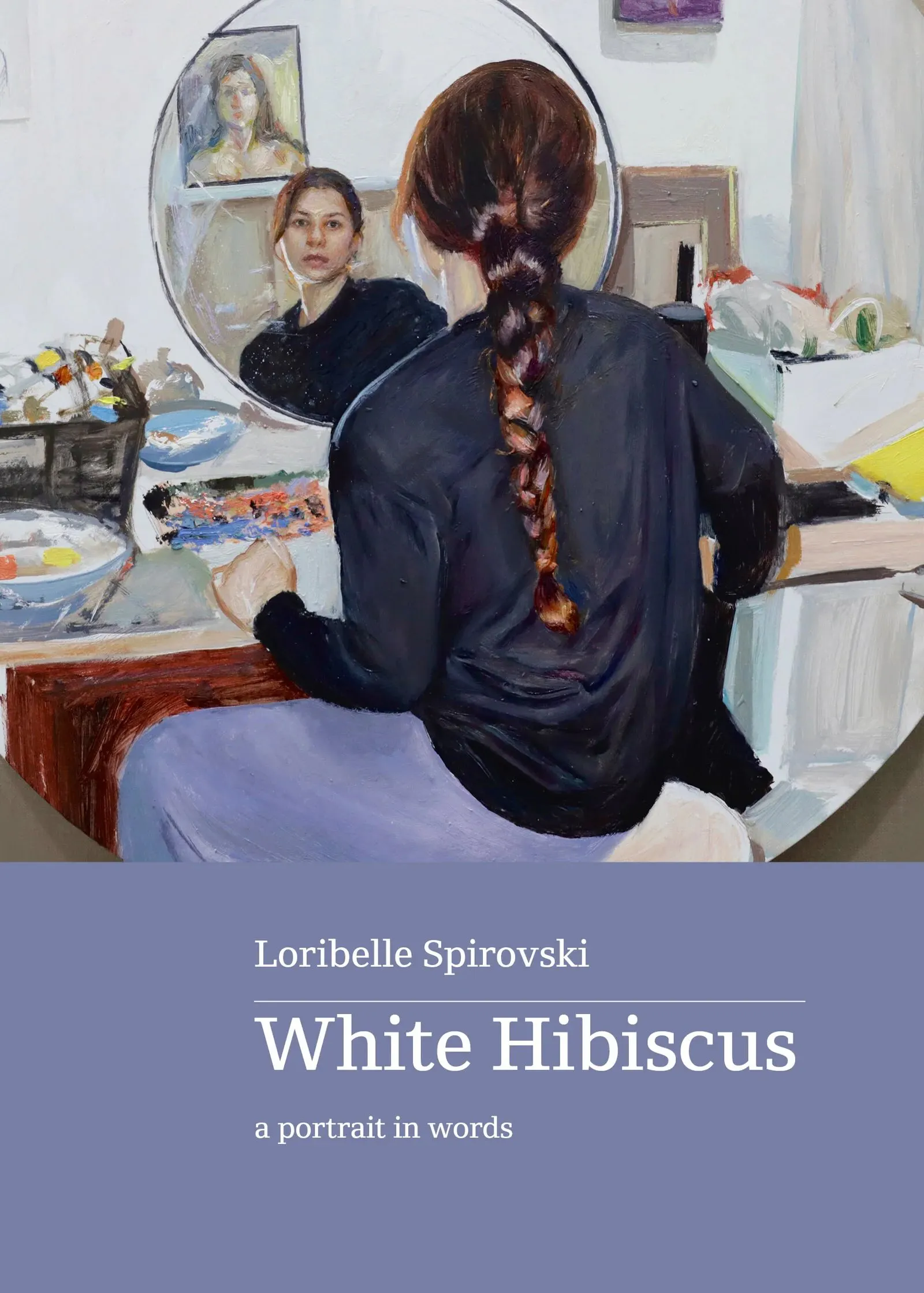

In real life, and on the page, Loribelle Spirovski is a celebrated Australian artist. Born to a Filipina mother and Serbian (formerly Yugoslavian) father, she grew up partly in the Philippines before relocating to Australia as a child. Like her diegetic counterpart, she is also married to an Australian concert pianist who is about nine years her senior.

These identity dynamics resist simplistic expression. And yet the tendency of the world at large, as explored in White Hibiscus, is to put people into neatly defined categories. Spirovski has her narrator, Loribelle, raise the topic of the containment enacted by stereotype through an intimate exchange with her husband: ‘– So strange that you had a Filipino nanny’, Loribelle says. ‘– And now I have a Filipino child bride /                   laughs    laughs’, her husband replies, suggesting that this is a joke based on an agreed understanding of how certain clichés don’t actually map onto their nuanced reality. Elsewhere, the project of fitting Loribelle’s identity into a one-word package relies, disturbingly, on the assumption that whole people, not just national origins, can be objectified. ‘What are you?’ an elderly passenger asks. Loribelle’s ultimate response – a brief but apparently too-long ‘two-sentence memoir’ – clearly fails to satiate the passenger’s hunger for a tidier identifying label. ‘[S]he “hmm’d” with bored delight,’ Spirovski writes of the woman, ‘tuberose wafting from / her linen dress as she stepped / out of the ship’s library’.

Throughout the book, Loribelle expresses her horror at this bundling of complex realities into neat packages that obscure the truth of their contents, including a scene where her husband, emerging naked from the shower, prepares for a concert. Wondering if ‘he only / really feels like himself / when there are no / clothes to hide behind’, she watches with distress as he dresses for his performance: ‘as the clothes envelope his body / one garment at a time,’ she says, ‘he disappears / and I want to scream out his name’.

As a five-year old contestant in the Little Miss Philippines beauty pageant, Loribelle was involved in another exercise heavily invested in the neat packaging up of young female bodies and approved national identities. The theme song of Little Miss Philippines – a gratingly repetitive anthem called ‘It’s a Small World’ – is lifted from a sixty-year-old Disney park boat ride. On this ride, per Disney’s website, guests can ‘[c]ruise along the Seven Seas Waterway on a gentle 10-minute journey through all 7 continents’ and ‘watch as the Audio-Animatronics figures achieve universal harmony as they sing one song’. The Small World ride and song are representative of the desire to conceive of the world as harmoniously, simplistically containable: a stable, amicably aligned set of nationalities that can be comprehensively expressed in doll-sized costumes and experienced in a ‘gentle 10-minute[s]’. But of course, the world is actually a complex matrix in constant flux: a place of shifting and hyphenated boundaries, within which countries are continuously made, unmade, and remade in different shapes with different names.

Loribelle speaks of her father growing up in ‘the place that would become / Yugoslavia until it was again / unmade / in the last decade of the 20th / century’ and notes a number of other place names and empires with which his side of the family have been, at different times and in different contexts, described and defined: Dalmatia, Macedonia, Serbia, Ottoman. Meanwhile, her mother’s country of origin – the Philippines – has been profoundly influenced, shaped, and re-shaped by wave upon wave of colonial incursion and internal redefinition. In Transpacific Femininities: The Making of the Modern Filipina, Denise Cruz describes how much change has occurred in the country over the last 150 years alone, citing the way in which nineteenth-century Spanish and U.S. regimes gave way to early twentieth-century independent movements and the granting of U.S. commonwealth status, only to be supplanted in the 1940s by the Japanese occupation and then Cold War-era governance negotiations with the U.S. and other Asian nations.  This turbulent history has made the Philippines, Cruz argues, into a ‘transpacific’ place, heavily influenced by its evolving forms of contact with other overseas places near and far.

The effort to reassert stable, self-contained categories of national identity throughout these fraught and complicated exchanges, Cruz adds, has played out on women’s bodies. Analysing the cover of a 2006 issue of Manila’s Wedding Essentials magazine, she observes how the four women on its cover represent the four supposedly essential ‘types of Filipina femininity: mestiza, morena, chinita, and dusky’. Cruz notes how the captions accompanying the cover photo and internal spread ‘divide and categorise their essential characteristics, with observations about each model’s presumed ancestral origin, class position, and defining personal qualities […] distilled into four containable and ostensibly replicable versions.’ The layout of the spread ‘reproduces a racial hierarchy’ that ‘privileges Spanish aristocracy’, embodied by mestizas. This, of course, is an artificial and heavily racialised ranking system that collapses complex identities into neat aesthetic expressions and then rates them for relative value. However manufactured and harmful, though, it’s clear that these constructs have thoroughly permeated concepts of feminine value in the country. In White Hibiscus, Loribelle notes that the Little Miss Philippines crown she vied for as a child was awarded to a girl who appears to align with Wedding Essentials’ caricature of the elite mestiza: she  ‘only speaks Spanish / her heavy flamenco dress / the red of rose petals / and blood’.

It is fair to say that, in reality, no person of any gender could fit wholly into Wedding Essentials reductionist categories. Loribelle, however, feels that she is exceptionally other and discomfiting in her difference. Her mixed European and Filipina heritage, in theory, aligns her with the elite mestiza class; but unlike mestiza/o families, Loribelle’s ancestors did not enjoy the privileges afforded to those legally categorised as mestiza casta during the Spanish colonial era, and she herself didn’t grow up with mestiza-type trappings of affluence. The identity types espoused in Wedding Essentials imply socioeconomic status as well as ethnic inheritance, and Loribelle lacks the three qualifying tenets that define the stereotypical, desirable mestiza: generational wealth, European heritage specifically from members of the colonial elite, and local social legitimacy. Rather than being the descendant of a historically privileged class of mixed-race elites, she is the product of a love story arising from the conditions associated with transnational labour migration.

She recalls how, during her childhood in Manila, community members were reluctant to accept that she is both Filipina and European at once. Instead, a divisive binary was applied to her: rather than being recognised as mestiza, she was classified as either / or: white or non-white. ‘While walking / down Manila streets,’ the narrator recalls,

I remember people

teasing my mother

about where she’d found

the white child whose

sweaty hand she held

as though I was only a flower

she’d plucked by the roadside.

I didn’t look particularly Filipino.


I’d search my reflection

for signs that gave me away.

Watch the features shift

from my mother’s to my

father’s and back again.

In the context of Filipina women being expected to embody specific forms of national identity, acknowledging that someone is both European and Filipina - but not in an accepted, generations-deep, aesthetically and socioeconomically recognised way - is problematic. It draws attention to the actual porousness of a country’s cultural dynamics and borders, and to the abject changeability and hybridity involved in national and individual identity.

More often than not, as in the encounter with the tuberose-scented woman on the ship, people are inclined to insist that Loribelle confine herself to a single, non-hyphenated descriptor. The consequence of this is that her real self – a person made up of multiple influences, places, and genetic strands – often disappears, or is hidden, inside the hyphen. As a child, Loribelle was subject to the investigative, invasive gaze of others trying to reconcile her appearance with that of her mother: ‘I’d feel their gaze / on her (on me) / as though we still / shared the same body / and cry’, Loribelle says. A certain protective concealment followed; her mother, in response, would ‘move us then / to a quiet room’, Loribelle says, ‘away from the rest / safe’. Another scene in White Hibiscus supplies a metaphor for the feeling of disappearing between two poles of identity that, supposedly, can never meet or be reconciled. On the ship, adult Loribelle explains that

Wherever wood or tile

gave way to carpet

footsteps became inaudible

as though you disappeared

every now and then and

rematerialised across the room.

Loribelle connects this intermediary feeling – the sense of only being fully material on either side of a yawning divide – to her constant motion sickness aboard the ship. She likens her nausea to the queasy sense that she’s made up of two separate identities that float alongside each other but can’t integrate. ‘[M]y insides’, she tells us, ‘felt like a toy / I once saw at a market in / Manila: / a thimble-sized bottle half-filled with red water / contained inside a larger one / filled with blue.’

In contrast, Filipino crew members are described as though they are comprised of uniform, fully integrated characteristics. Cruise passengers past and present describe them using reductive, essentialising descriptions that Spirovski appears to have drawn from real-life travel discussion threads and cruise reviews, citing sources such as Quora.com, cruisecritic.com, bworldonline.com, and other websites throughout. One such comment commodifies all crew members as labour units, claiming that Filipinos are consistently the most industrious and best value for money: ‘I’ve sailed for more than 30 years and Filipinos are the most hard-working people. Others need to be prodded into doing work or else demand more wages for less work’, it reads. Another testimonial comes from a group who say that their Filipina waitress was always ‘so joyful and full of energy’. Cumulatively, the effect of these and other similar comments is to suggest that Filipino people possess some naturally occurring, genetic predilection for overseas labour and permanent good cheer. But, like the ‘meticulously crafted fantasy’ of the cruise ship environment, this so-called ‘fact’ is actually the result of heavily manufactured identity curation.

Transnational labour-brokering in the Philippines is a ubiquitous and sophisticated process through which street-corner recruiters, overseas placement agencies, and state-sanctioned messaging encourage Filipinos to work abroad and send money home. Remittances from Overseas Filipino Workers (OFWs) form a significant portion of the country’s GDP (nearly $38.5 billion or 8.5 per cent of GDP in 2024, according to Cuervo Appraisals Inc.), and it’s vital to understand that this is no accident; it is a deliberate financial strategy that is quietly but firmly mandated by the Philippine state. In Marketing Dreams, Manufacturing Heroes: the Transnational Labor Brokering of Filipino Workers, scholar Anna Romina Guevarra notes that a series of state-enforced regulations, first introduced in 1974, require OFWs to remit fifty to eighty per cent of their earnings back to the Philippines through official banking channels and remittance centres. These remittance requirements remain in place today. OFWs are also behaviourally groomed in culturally loaded ways that require and reward ‘a particular type of racialized work ethic,’ Guevarra argues. To achieve this, she continues, ‘state and employment agencies exercise a kind of disciplinary power toward migrant Filipinos that aims to govern their social conduct’ through the ‘promotion of an ethic of responsibility to their nation, families, and the image of the Great Filipino Worker’.

As Guevarra rightly points out, none of this is to suggest that OFWs aren’t in fact exemplary workers, nor ‘that working overseas does not provide myriad opportunities for upward social and professional mobility.’ With this in mind, it is important to note that the design of the Philippines’ overseas work scheme does make light of its peoples’ dreams. Overseas employment is strategically marketed as an advantageous individual adventure: a way in which individual Filipinos can fulfil their own economic aspirations while enjoying the pleasures of travel. In White Hibiscus, for example, Spirovski describes the ‘ad in the paper’ that led Loribelle’s mother to work overseas: it asked ‘if she “dreamt of travel?” and “could sing?”’ Rather than truly representing an opportunity for outward exploration and dream-fulfilment, however, the scheme is a elaborate means whereby OFWs are kept tethered to the state as critical sources of national income. Permanent migration is never the state-sanctioned outcome; it is expected that OFWs should serve, earn, and return. Nor is personal pleasure or travel-related leisure accommodated. Apart from requiring that nominees submit evidence of ‘heroic acts’ accomplished overseas, the Bagong Bayani Awards prohibit applications from any Filipino who has ever left the country on a tourist visa.

The cost of transgressing these parameters – by travelling on one’s own terms, for example, or by doing what Loribelle’s mother did (marrying and having a child with a man from another country, and then permanently relocating to Australia) – is cultural exclusion. Adult Loribelle now occupies the marginal, outsider space of the excluded. She describes her longing to re-enter Filipino cultural spaces, which, in White Hibiscus, take the shape of cordoned-off crew quarters. Despite never crossing the ‘red velvet rope’ that separates ‘the lower floors / the crew’s floors,’ from the ship, she hovers with an ache at the boundary. ‘I went closer,’ she says in one scene,

peering past the bend

in the staircase which crept

into darkness listening

for any sounds the crew made


edging

until I felt

the heavy rope

against my thigh


the longer I looked

the more the void

yawned open to me


until it filled

my entire field of vision


I opened my mouth


and let it enter.

It’s at points like these that White Hibiscus makes something poetically, painfully clear: Loribelle’s trauma has both collective and personal dimensions. The two elements of what she carries – that which relates to certain socio-political legacies, and that which relates to her experience of sexual abuse – overlap and leak into each other.


The publisher’s description of the book notes that, as Loribelle’s journey progresses, an ‘archived memory’ is ‘unlocked’.  The memory turns out to be compound, concerning not only her individual experiences of sexual abuse and unbelonging, but also certain collective horrors sustained on a national scale. It is worth digressing here to more deeply explore how Spirovski’s work references elements of collective Filipino trauma while concurrently surfacing an experience of personal abuse.

The Marcos dictatorship of the 1970s and 80s was an undeniably pivotal time in the entrenchment of the Philippines’ identity as a labour brokerage state. This is not only, Guevarra writes, because President Ferdinand Marcos ‘formally institutionalized the country’s labor export policy’ by passing ‘by executive order the Labor Code of 1974’; but also because the Marcos regime significantly compounded the Philippine economic crisis that had been escalating since 1965. Under President Ferdinand Marcos’ rule, Guevarra writes, ‘the nation’s external debt climbed from approximately $2 billion to $24 billion’ – an escalation that was no doubt significantly fueled by the Marcoses’ corrupt siphoning of public funds for personal use.

In 1986, four years before Loribelle Spirovski was born in Manila, Marcos was deposed from power following years of escalating public outrage and suffering. The national crisis had become so pronounced by that time that most media outlets had taken to calling the country ‘the Sick Man of Asia’ in their coverage. The Marcos family fled the country, leaving for Hawaii from the rooftop helipad of Manila’s Malacañang Palace. The items they took with them, which included diamonds hidden in diapers, represented only a fraction of their plundered multi-billion-dollar fortune.

Hot on their heels, throngs of ordinary Filipinos stormed the palace, finding a vast mountain of assets inside. The Marcoses had purchased a prolific stockade of ornamental items and built up enormous wealth by helping themselves to public funds, including aid money sent by other nations. Malacañang was stuffed to the gills with priceless paintings,  jewellery, and at least three thousand pairs of designer shoes. There was also a huge archive of family videos, documenting hundreds of hours of opulent parties.

One infamous video shows a birthday party that took place just three months prior to the Marcoses’ deposition, held on the BRP Ang Pangulo presidential superyacht. Amongst the crowd we see First Lady Imelda; her husband, the president; their son, provincial Governor Ferdinand Jr. ‘Bongbong’ Marcos; his sister, Irene; and a large adult man dressed up as a baby. The crowd are singing a karaoke rendition of ‘We Are The World’ – a megahit charity effort released that same year and designed to raise funds to aid Ethiopian famine victims. At one point Governor Bongbong steps up to the mic: ‘There are people dy-ying,’ he sings, smiling broadly.

Sung in this context, ‘We Are The World’ comes to powerfully and ironically symbolise the Marcos’ blatant disregard for the suffering in full swing all around them. During this period, while they partied in floating luxury, an estimated 70,000 Filipinos were incarcerated, 35,000 tortured, and 3,200 killed by the Marcos regime. The birthday party video nauseates by virtue of omission and denial. It shows us how precarious the distinction between innocuousness and monstrousness can be, depending on what you know. There really were people dying locally, when this party took place, due to famine in the Philippines itself. And many other people – especially those who tried to resist or speak out – were tortured using corporeal punishment and sexual violence. These catastrophic economic conditions and devastating forms of abuse were directly caused and compounded by the actions of the very people seen partying in this video. Once you know this, you can begin to understand the shock with which the video, once aired, was received.

Both Malacañang Palace and the BRP Ang Pangulo presidential superyacht functioned as ornate containers for the Marcos family’s extravagance. Through containment and concealment, the Marcoses tried to hide anything that would destabilise people’s belief in their clean and blameless identity. The footage of Filipino people storming the palace therefore signified a massive national moment of abjection. Everything that had been strategically hidden from public view suddenly overflowed into visibility; the membrane between inside and outside was ruptured, and evidence of the Marcoses’ excesses and offences flowed violently and undeniably into public view.

You would think that these images would be indelible, and the horrible truths of the martial law period – exposed in the aftermath of the storming of Malacañang Palace, a time now known as the People Power revolution – would remain unforgettable. But that is not how things tend to play out in the wake of significant trauma. For victims, ‘the ordinary response to atrocities’, writes seminal trauma theorist Judith Lewis Herman, ‘is to banish them from consciousness. Certain violations […] are too terrible to utter aloud: this is the meaning of the word unspeakable.’ This mutism – due to victims of trauma being unable to describe what happened to them or only being able to speak about it in ‘a highly emotional, contradictory, or fragmented manner’ – is partly because traumatic memories remain lodged in the amygdala (the sensory section of our brains, where instincts like fight-or-flight are encoded) rather than being filed, as other memories are, in the pre-frontal cortex (where language and narrative functions are centred). But there is another aspect to the amnesia that so often follows in trauma’s wake. When collectively witnessed traumatic events ‘are of human design,’ Herman argues, ‘those who bear witness are caught in the conflict between victim and perpetrator,’ and

it is very tempting to take the side of the perpetrator. All the perpetrator asks

is that the bystander do nothing. He appeals to the universal desire to see, hear,

and speak no evil. The victim, on the contrary, asks the bystander to share the

burden of pain. The victim demands action, engagement, and remembering.

In a piece titled 'Never Forget What People Power Was About', written for Rappler, an independent Philippine news organisation founded by Nobel Peace Prize Laureate Maria Ressa, Inday Espina-Varona recalls the gradual process by which the lessons of People Power were forgotten, perverted, and/or deliberately buried. ‘We ousted a dictator to birth an equitable democracy,’ she writes. ‘We had a new Constitution. Yet oligarchs and political dynasties held sway.’ Over time, a kind of national amnesia set in, nurtured and cultivated by those who wished to return to power.  Revisionist versions of history gained traction in Philippine classrooms, for example, convincing a whole new generation that martial law was an era of shared wealth and happy stability.

The perpetrator of trauma, Herman writes, ‘does everything in his power to promote forgetting’. This is what happened in the Philippines. In Lauren Greenfield’s 2019 film The Kingmaker, former first lady Imelda Marcos speaks of the Marcos dictatorship as a time during which she ‘gave birth to what I dreamt of’. But this isn’t true; the Marcoses didn’t deliver a living, hopeful future for the Philippines. Instead, they implanted the country with a particular traumatic legacy that persists into the present day – not unlike the way in which trauma was installed, and continues to resurface, in White Hibiscus, in Loribelle’s body. In 2022, the unthinkable happened: Bongbong, of the flashing red bowtie on the boat, was elected to power. Or, in Espina-Verona’s words: ‘Ferdinand Marcos Jr. succeeded [previous president] Duterte after decades of carefully building a disinformation network that hammered at People Power and glossed over the brutalities and rapine of the first Marcos regime.’ This coordinated effort has thrust the Philippines into the throes of a recurring nightmare, its population unwittingly, perpetually subject to a time of trauma, a moment of terror that refuses to end.


It is no coincidence, I think, that Spirovski chose to tell the story of her personal sexual trauma in the context of a cruise ship, against the backdrop of her childhood in the Philippines and its complicated socio-political shadows. Her personal experience of sexual assault shares traumatic DNA with the collective assault and abuse to which the Filipino people have been subjected. And the unique temporal world of the cruise ship – which assumes the form of a kind of static, perpetual present – provides a way for Spirovski to explore the sense of failing to awake from a nightmare that recurs with nauseating rhythm.

Citing decades of clinical research, Herman describes the temporal topography of trauma as one which seems to demand its own perpetuation and repetition. ‘Traumatised people’, she writes, ‘relive the moment of trauma not only in their thoughts and dreams but also in their actions […] Adults as well as children often feel impelled to re-create the moment of terror, either in literal or disguised form.’ Time inside the world of the cruise ship aligns with this traumatic temporality. Returning to the sameness of the boat after a day-tour somewhere, it must seem sometimes for passengers that no time at all intervened – that no other place was visited. On the ship, things are now as they were before. It is as if neither the guests nor the hands of clocks have moved. On the cruise in White Hibiscus, this sense of static perpetuity is sometimes purposely exaggerated. Describing the ship’s ballroom, Spirovski writes that ‘[i]nstead of walls / wide windows wrapped / the room in a pink-tinted glow / that made the sky look always / on the verge of sunset’. It’s apt that this is the room in which – as I previously described – Loribelle encounters the spectre of her nausea made manifest, as something she feels inside her, even as she gazes on its externalised form. This space outside of time – this space of traumatic time – is an apt arena for the narrator’s ongoing, never completely fulfilled desire to express or expel the horror that happened to her.

If perpetuity and recurrence characterise traumatic memories, so too does the resistance to linguistic explication. This is because, Herman explains, traumatic memories ‘are not encoded like the ordinary memories of adults in a verbal, linear narrative that is assimilated into an ongoing life story’. In explaining why, she cites the psychiatrist Bessel van der Kolk, who speculated that ‘in states of high sympathetic nervous system arousal, the linguistic encoding of memory is inactivated’. This aligns with the hazy way in which Loribelle’s account of her sexual assault shows up in White Hibiscus – hinted at and circled around, but never explicitly described. This depictive mode correlates to the lived experiences of trauma survivors who struggle to apply language to fragmented, broken memories. It also keeps Loribelle’s experience moored in that same territory on which the book is so committedly fixated: the hyphen, the in-between, that space where I am and yet where I also am not. 

There are some words, enough words, provided to give us a vague idea of what was done by an unidentified perpetrator during a childhood game of hide and seek. (No wonder, again, that the narrator is regularly preoccupied with and disturbed by instances of concealment – twice in the course of the book, she points out that the ship’s decor includes ‘porcelain vases / large enough to hide a man’.) And there is a brief description of the aftermath, provided in a scene where Loribelle describes one exhausted evening on the ship: ‘I was tired enough not to need a pill,’ she says,

the wave of sleep coming

as instantly as being put under


an echo of the only time

I’d ever been anaesthetised


the pregnancy


stopped before it could become more


than a few instances of morning sickness.

This scene imbues Loribelle’s constant nausea with new meaning: a sign of the original trauma trying to repeat itself via gastroenteric recurrence. Morning sickness is a peculiar kind of emesis in that it doesn’t purge the body of what inhabits it; a growing baby usually remains in place despite the mother’s vomiting, as opposed to the kind of vomiting that follows mild food poisoning, in which the source of stomach irritation might be effectively removed.   

Like a form of nausea from which one can’t find relief, Spirovski’s book keeps us inside the uncomfortable, abject quality of traumatic truth. The memory of what happened to her draws attention to the point at which her most personal boundaries were violated. It is not hers, in that she didn’t perpetuate it; it came from outside. And yet it is hers, in that she has to carry it: it cannot be completely erased. This is a discomfort that we are not used to sitting with, perhaps, after a book’s last page.

The book ends not by suggesting that trauma can be healed through deletion, expulsion, or resolution. Instead, it proposes a way forward through the introduction of a counterpart –  an alternative, radically different kind of birth, which challenges and displaces the prime position occupied by the other, traumatic implantation, and allows a person to go on. In the context of the Philippines, this might look like the introduction of a genuinely new, non-corrupt political administration, rather than what has been delivered in real life (a traumatic circling back to the genetics of dictatorship, resurrected through the son of the abusive oligarch, as though no intervening time or healing had occurred).

For Loribelle, it looks like the arrival of her brother. This new child, born in Australia, arrives prematurely: ‘ahead of time’, Loribelle’s mother tells her, ‘because he couldn’t / wait to see us / any longer’. In her acknowledgements, Spirovski credits this new child, who enters his older sister’s life just before her tenth birthday, with saving her life ‘exactly when I needed’. The implication seems to be that, had he not arrived, the assault to which she had been subjected would have stayed at the helm of her childhood, commandeering her future. Instead, Spirovski suggests that although her brother’s arrival wasn’t enough to erase the horror of what she’d experienced, it was enough to challenge that horror’s complete authority over her life and future. When Loribelle puts her arm inside the hospital vessel protecting his premature body, ‘it was’, she says, ‘like / first touch / again / so warm it erased / what preceded it’.