




Is she: listening? To her father, or the many ghosts who mill about this place asking:
Ask!
All answers lie in the past.
Our work is made possible through the support of the following organisations:




Jacinta Mulders on Rose Michael’s hopeful climate-change novel
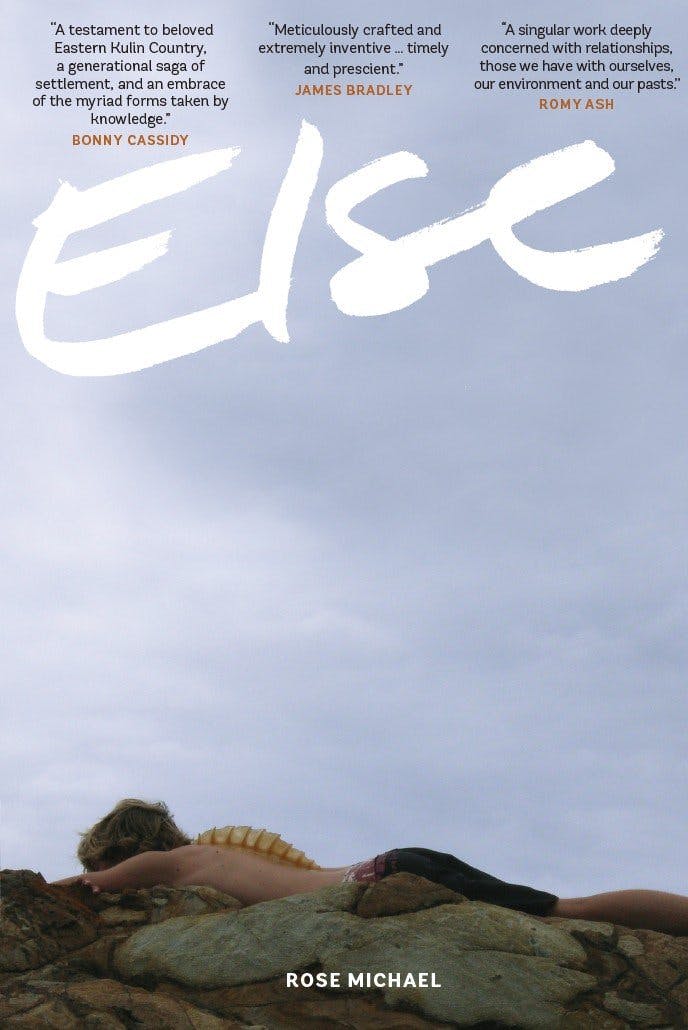
Rose Michael’s lyrical novel about a mother and daughter’s flight from the city dares to hazard optimism in the face of climate apocalypse. But the vision of human flourishing it puts forth is far from typical.
It feels fair to say that the presiding tenor of media coverage on the climate crisis is one of pessimism. There’s a sense that the world is headed for sure and certain doom. On the day of drafting this review, online articles report that the world’s oceans are losing their greenness, that its landscapes are losing their wild animals. On the regulatory side, the view is no less bleak: the shelving of a global shipping emissions levy due to pressure from US officials; the repealing of clean energy targets in the Australian state of Queensland. The effects of our warming planet are varied and multi-pronged, and the global community is not doing nearly enough to prevent their onset or remediate their effects. It takes a brave person – a brave author – to imagine a future for humankind among this upswell of desolation, and a braver one still to buck the prevailing tone of certain catastrophe to hazard imagining something else.
Melbourne-based writer and academic Rose Michael does just this in her newest novel. Else is ultimately hopeful, imagining a future for our country and our earth that redirects our attention, away from the threat of annihilation and towards the potential for transformation, radically reshaping how we conceive human life on earth. Her novel proposes rethinking our position of dominance, swapping it for one of submission to an order greater than ourselves. Furthermore, it suggests this relinquishment is necessary if humans are to survive.
Else tracks the flight of Leisl and Else, a middle-aged woman and her thirteen-year-old daughter, as they make their way out of the city into the narrowing landmass of the Mornington Peninsula (referred to in the novel only ever by its local nickname, ‘the Ninch’). Their departure is propelled by extreme floods that threaten to make their city uninhabitable. Their destination is an unoccupied family home belonging to Leisl’s ancestors, which is off-grid. It is named ‘the White House’ for its limestone walls; the stone was excavated on the peninsula by Leisl’s forebears, who had business in the trade of lime. Although the pair settle there for a time, as the novel progresses, they decide to leave the house and travel deeper into the interior of the diminishing peninsula, a choice that represents moving even further from the world of human shelter and human comforts and towards an existence more in sync with and responsive to the nature that surrounds them. Their movements follow and anticipate the weather – extreme conditions reflective of what we in Australia have grown accustomed to due to our changing climate. Fire comes after flood: the land is soaked then scorched. Juxtapositions between the two states abound throughout the novel. ‘Smoke – mushrooming up in atomic clouds – is exorcised by a sweet sea breeze. Revealing: blackened land, as far as one can see. […] The thought of water, the memory of water, the look of water… washing away the unreal haze of days.’ Mother and daughter are driven by instincts that neither are capable of pinpointing with clarity. The reader moves with them, in a kind of morass of weather and feeling, as they sense their way through circumstances both unprecedented and unexpected.
This journey, which is tethered to nature and the surrounding bushland, is accompanied by another, psychological, journey, occurring predominantly in Leisl’s interior life. As they travel further into the Ninch, Leisl and Else encounter their family’s history, largely in the form of memories and spectres.
Is she: listening? To her father, or the many ghosts who mill about this place asking:
Ask!
All answers lie in the past.
These sections, furnishing obliquely glimpsed moments from the lives of Leisl’s ancestors, involve many tropes of the Australian literary imagination: migration, convicts, land-derived business, madness and depression, and dissatisfaction with suburban life.
There is the sense that the freak weather is merely a pretext to act on instincts that have lain dormant in Leisl and Else their entire lives. Leisl surrenders with little resistance to the direction the weather appears to be pushing her, feeling ill-fitted for the urban world she occupies at the novel’s beginning: ‘Rip up the roads, she thinks. Tear it all down. School. Work. Medical appointments. Other mothers’ judgement. Let it burn, burn, burn.’ Her perspective is informed by exhaustion and a sense that the way she and we other humans live is untenable: the way society has turned pregnancy and childbirth into yet another production line; the impossibility of balancing work and family life. Else’s struggle with the ‘normal’ life she is expected to occupy is more straightforward: she is neurodivergent. As she and her mother travel deeper into the Ninch, the qualities that made her an outlier in the city cease to be disadvantages, and, at the same time, her particular sensitivities – most potently, an understanding of the natural landscape and an interest in its creatures – are permitted to come into their own. Both women seem soothed and enlivened by the possibilities of living in nature, off the grid. The nagging pressures of modern life fall away as they submit themselves to the uncertainty of the future and the primacy of the natural world.
In keeping with the rain, Else is a watery novel. The first half is deluged by floodwater and the second feels hemmed in by the risen ocean surrounding the protagonists as they travel down narrowing land. The ocean is always on their minds: it backdrops their activities, it is the source of their food, and it is the place that Else disappears to for increasingly long stretches of time. Aptly, in keeping with all this water, Michael’s prose is slippery and lyrical. It is as though she is striving to devise a language that reflects the scattered and harried consciousness of Leisl, and also how environmental change of gargantuan proportions is affecting human action and thought. In the midst of these new weather patterns, it is as if the ways we are accustomed to making sense of the world must fall away, and we need a new language to describe not only what is occurring to climate, weather, soil, rocks, mammals, birds, and insects, but also to us – how we will respond and continue to exist. Significantly, the experimental prose also makes space for the way that Else speaks, and the way that Leisl and Else speak to one another. It welcomes echolalia, stuttering, vocal stimming, and unfinished sentences, imbuing these non-typical modes of expression with beauty, and showing how they can construct meaning. At several points in the novel, the repetition inherent in echolalia is used to connect the present to the past, or one species to another. For example, when describing the presence of bees at the White House:
Maybe they’d come closer to gloat? To drive Leisl crazy with their constant
hmmmmmmming!
Like someone else she knew. She thinks of Else – ticking and tocking, singing and
rocking. How like a caged hmmmmmming bird her daughter is.
A little later, a distorted recording of Leisl’s father’s voice, found on a portable tape player at the White House – ‘Well, well, well. Whadayaknow?’ – is used, refrain like, to link father and daughter together. The phrase ‘Whadayaknow’, or variations on it, comes up often when Leisl is thinking of him. He ‘laughs as the tape sticks and clicks! Wha-??? – Wha-wha-da-ya – Time: ticks.’
A passage describing Leisl’s arrival at the White House shows several recurring stylistic features of the novel at work:
Leisl moves, mouse-like herself, through the house, opening windows and doors. Unlatching. Unlocking. Inviting in clean wind. She sneaks a breath. And then another: slow-er. Squeaks. Throwing up the last sash, takes stock. They are here. They are then. Can she …
sense a shift? Something, somewhere tipped. Tripped. Wild life is on the turn. A rising tide – of non-human animals.
A wet, woody smell
wafts in. Welcoming them. Green curtains growing over the windows give the room an underwater light. Everything, everywhere, drips.
Line breaks give the packed lyricism of the prose some breathing space and create room for other unconventional features: italics for emphasis, associative wordplay, consonance and assonance, sentence fragments. Michael stretches and condenses pacing, makes use of rhyme and onomatopoeia. This poeticism and playfulness forges links and creates a system of meaning. ‘Mouse-like’ connects with ‘squeaks’ and ‘wild life’. ‘Tipped’ goes with ‘tripped’, ‘rising tide’ and ‘underwater’. In developing this language, dense with connection, Michael seems intent on asking bigger questions about interdependence within our world. How are we connected to our forebears? How are we connected to our environment? How are all components of our environment contingent on each other? Notably, Leisl is always considering lineage – her own and that of the land and organisms around her. Her outlook is characterised by a sense of deep time and a preference towards connective and associative ways of thinking. ‘The whole world was a web.’
Still, Michael’s writing style can make meaning elliptical, at times frustrating efforts at comprehension – as if the author is so absorbed in drawing connections that she has forgotten whether her reader can keep up or make sense of what is happening beneath the associations and analogies. This problem is sometimes compounded by the slantways introduction of a new character, or new story elements. Consider the following passage:
‘Yu know—’ Her ‘s’ is so quiet it snakes away: Yu knows.
‘You? Who?’ Her mother hoots.
There were worse ways to go:
‘On?’ Her mother, who is in no state to travel, mutters: ‘go?’ Fist curled around a dictaphone that isn’t, any more. A claw! Does she think: she’s talking into a tape?
It took me several pages to understand that a new character, Yu, had entered the novel. Nor did I understand the connection between a magpie that keeps her characters company and Leisl’s migrant grandmother. But then again, perhaps the world that Michael is describing, and perhaps the point beyond climate apocalypse, is a place that requires a new kind of sense to comprehend. I wonder whether my slight annoyance at sometimes not being able to follow Michael’s prose says something about the coming future, and the fact that we all will have to get used to a state of unknowing. Else’s neurodivergence also asks us to reconsider what constitutes ‘sense’, for who can say which way of thinking or speaking is the right one? Who can say whether the hegemonic fiction conventions I’ve been trained in, about the necessity of leading the reader gently through an predictable and subtly foreshadowed world, are appropriate for every kind of narrative? The muddling reality of climate change is that everything is or will become curdled. The chattery and unstable narration of Else might be one mode of conveying it.
The possibility of a suggested post-climate-crises life seems one of the things that Michael is keenest to emphasise and iterate throughout Else. The idea that Leisl anticipates something beyond the climate apocalypse seems present in the novel’s earliest sentences:
The call comes when Leisl least expects it. But
ever on edge, she was born
ready.
One of Leisl’s qualities is that she always anticipates the worst. But the flip side of this tendency is that, once on the Ninch, she can sense, however indistinctly, future possibilities, too. Her versatility in the face of chaos and uncertainty may derive from her awareness of the many ways her ancestors – migrants, tradespeople, one of them a convict – eked out lives and incomes on a continent that was new to them. What is life at the frontier of climate change if not learning to live differently, under altered conditions? Michael asks us to consider other questions, too: Could there be something life-giving about the changing weather? Might genetic mutations give rise to new ways of living? Could the annihilation of our current mode of existence be a good thing? The concepts of adaptation and mutation appear throughout the book, like a constant and hopeful refrain.
These themes tie in well with Leisl’s enthralment with the animal world. Her relentless cataloguing of facts about different species is a habit she has picked up from her father and grandfather, and this mode of speaking makes up a large part of her communication with Else. The dispensation of knowledge about animal characteristics and behaviours back and forth between mother and daughter serves as a kind of cipher, standing in for what the two are unable to say to one another. These exchanges often indirectly describe or illuminate other things, usually to do with Leisl or Else, or some aspect of their family’s past. For example, a statement by Leisl about the flight of an eastern curlew is used to suggest the coming migration of mother and daughter. Leisl says: ‘She doubles her bodyweight before flying north to breed. Internal organs shrivelling to almost nothing, saving even those precious grams of weight. She digests her own muscles en route. Saves nothing for the way back.’ In other places, such facts serve to illustrate the possibilities of life in the face of climate change. Beetles, notes Leisl,
can tolerate extreme environments. Some enter diapause, lowering their metabolism
to outlast unfavourable conditions.’ They’d been found in vast numbers – whole cities slumbering like a Kool-Aid cult. Not to experience the rapture, but outlast this apocalypse.
And, presumably, wake after.
‘They mutate. They migrate.’
Inside the loopy lyricism of the text, these factual insertions come off relatively straight: almost as if Michael has copied pages from a textbook or general knowledge repository about various organisms into the prose. Combined with the text’s other experimentalisms, this sometimes makes the story feel less like linear narrative and more like scrapbook or song. The choice feels intentional: Michael is concerned with both relics of the past and visceral parts of the present. Dog fur, her daughter’s clawing in the sand, the sounds of the trees and the sea – details are layered to form a composite narratorial present tense.
Leisl believes she and her daughter are ill-suited to life in the city, and routinely casts themselves as outcasts. Throughout, she distinguishes herself and her daughter from others who have fled the city or abandoned large houses on the Ninch. Although it is easy to see why Else’s neurodivergence makes city life a poor fit, the reasons Leisl feels like a pariah are less clear. Perhaps the idea of outcast heroes surviving in opposition to the rest of the population despite all odds owes itself partly to the tropes of speculative fiction, which Michael would be familiar with in her capacity as a scholar of the genre. But she is also trying to indicate, I think, that the qualities and skills needed in response to climate change are different to the middle-class ones lauded in our for-profit world. The traits that make Leisl and Else atypical in normal company – their ‘mutations’ – are what enable them to survive. An analogy to the animal world proves fitting again: ‘Oddities ostracised by their own species may prove adept when old models aren’t. There are other examples – birds we feared would die out with the warming weather follow changing temperatures.’
Leisl and Else are adaptable, often finding themselves at home in a world of flipping and flipped logic. Their detailed observations on the intelligent and hidden behaviours of plant and animal species show us that ‘normal’ is just a matter of perspective: ‘“Plants,” Else points to the greenery growing out of the sea-mist that separates shed from house, “are farming us. Feeding us oxygen, to keep us alive till we die. And become their food.” Happy meat, free to roam.’ Leisl and Else’s willingness to think differently about themselves and their world allows them to thrive in a landscape devoid of other human life. This capitulation to a new reality is cast as a healthy deference to what cannot be known or controlled.
It is, of course, debatable whether sensitivity to the natural world is what will help people better weather climate change – as opposed to, say, privilege, or the ability of each person to buffer themselves, via money, from the worst of its onslaughts. But it seems unfair to read Else as a novel that offers realistic prospects for how to survive when the novel is so clearly anagogical, concerned more with the poetic and a larger vision of a reconfigured relationship with the natural world than any real-life response to a future that may or may not be coming for us. What is different about this novel is its advocation for dynamism in the face of what many consider to be a foregone conclusion. ‘Look,’ it seems to be saying. ‘There is more than one way of responding to this.’ The behaviours that Leisl and Else exhibit as they travel further into the Ninch – behaviours reciprocal and synchronous with the nature around them – seem to serve as a guide to how to live now, before things become even worse. Perhaps if humans had been more mindful of the natural environment in the first place, we would not have got ourselves into this situation. The realisation that we might not necessarily be a determinative part of the world’s future is a radical proposition to accept, and one that requires a certain humility. It's the knowledge that a reversal in our relationship with the earth – from dominance and control to grace and surrender – might not be the worst outcome. We can’t know our fate; the only surety is that change is coming. ‘What has flushed new life up, now seems set to wash the old world out.’
Michael’s novel is perhaps most entrancing when her prose captures the interconnectedness of all life on earth, and it is within these moments that the novel comes close to realising the possibility of a narration not centred around, or reliant on, human life. This occurs most strongly during the middle of the novel, when Leisl is almost killed when she is tossed into the ocean by a monster wave that approaches the coast. It’s possible to feel all the minerality and chaos of the bubbling, deep blue water in the following passage:
Alive! Leisl, letting go – some, sense, of – self, feels: LIFE. Bubbling up from beneath a never-was or ever-will-be their country. Amoebae siblings, offspring, parents. Single cells that don’t belong to any single group but are in every major lineage. Line. Age! Ah!! She is her self and … atoms? DNA. Carbon dust. Rising off a page left behind on a distant, drenched bench. Residue of wood borers hatching in a living tree. Dots of…
nothing.
Particles of…
something. Every thing! There is so much matter in this black water that is NOT quiet. Not still. Not empty. No one thing but, instead, she senses: an indivisible collective river. Life and light and Leisl. Animal and environment. Past.
Present.
Then, again, at the novel’s end, Michael describes the Australian landmass from the perspective of non-human species, articulating it as a place that humans have vacated: ‘Wombats emerge from underground burrows […] Lyrebirds […] embark on elaborate courtship performances. Which no human sees. Which no human hears. […] Found in fossil records dating back fifteen million years, the birds will be around after humans have become… something else.’ It’s possible to feel, in these sentences, a world vacated of our presence. And even though the arrival of a world without humans can never, nor will ever, be described in human prose, Michael’s novel reminds us that it is still possible to behave in a way that pays deference to this vision – by treading more lightly, by leaving less of a trace of ourselves on a country we mistakenly thought was ours.
For a novel set in Australia and so concerned with the human relationship with the natural world, the omission of First Nations perspectives on the environment is somewhat conspicuous, though the novel does make reference to First Nations’ ownership and the fact of stolen land. But these feel like passing gestures or composite parts of Michael’s wordplay rather than a real consideration of how these perspectives might alter how the country is articulated and described. These references do not seem to have any structural effect on the fiction, and this does feel like an oversight, particularly given the intense connection Leisl and Else feel with the Australian landscape, as well as the availability of literature on First Nations’ perspectives in relation to climate change mitigation. When, for example, the group comes upon a deserted site, it is described as ‘[a]n abandoned camp, like this country’s custodians might have made. Her own ancestors: raided.’ And then the prose careens forward, racing into an involved description of Else accessing a tunnel behind the camp. Flagging this history without more detail — Who specifically raided camps? What did the raiding mean? Why is this important to note? How does it affect Else? How should acknowledging it affect the prose? — makes the mention feel cursory, superficial: a matter of language or gesture only.
However, what Michael’s prose does acknowledge in a deeper way, when speaking of Leisl’s ancestry and lineage, is the reality of dispossession. Her writing is live to the difficulties of articulating an uncomfortable settler legacy, and this is best encapsulated in the way Leisl’s ancestors are described. Lacking body, they do not belong in any particular place, but drift over the landscape and through the text. Part of the difficulty of living in Australia as a non-Indigenous person is figuring out if and how we can feel belonging or how to be, given a violent legacy unresolved. The way Michael’s characters understand their own history is sensitive, and laden with the discomfort that such sensitivity entails.
Nonetheless, Else is propelled by breathless conviction and giddying hope. In the end, it doesn’t matter what we hope for; more important is the act of hoping, and what it sustains in the present moment. Leisl and Else continue because they give themselves over to this ever-morphing present, determined, yet not attached to the idea of their own continuation in any particular form.
Leisl dares to imagine: a new life for the pair of them. Not just not-that-life, but a bright sharp shiny thing. Fresh-shucked. Greedily she slurps up Else’s shellfish, which are meaty and don’t slide down easily. The mollusc juice runs over Leisl’s chin as she fingers the empty mother-of-pearl plate cupped before her face. […]
She feels, without fear, the future, near: a midden avalanche, moving their way.
The spectacular power of nature forces them into a kind of humility. Through prose by turns shuffled, phonic, and musical, Else dares to imagine that such humility is not necessarily a bad thing.